Effects of Invisalign (G5) with virtual bite ramps for skeletal deep overbite malocclusion correction in adults
- PMID: 33434276
- PMCID: PMC8028480
- DOI: 10.2319/072220-646.1
Effects of Invisalign (G5) with virtual bite ramps for skeletal deep overbite malocclusion correction in adults
Abstract
Objectives: To investigate the skeletal and dentoalveolar effects of Invisalign's G5 protocol with virtual bite ramps in the treatment of adults with skeletal deep bites.
Materials and methods: This retrospective study was conducted on consecutively treated adults presenting with skeletal deep bites as defined by the Overbite Depth Indicator (ODI). Subjects were divided into 2 groups: Invisalign group (n = 24) treated with the Invisalign G5 protocol and a full fixed appliance (FFA) group (n = 24) treated with edgewise FFAs and matched to the Invisalign group by ODI, sex, type of malocclusion, and non-extraction treatment. Pretreatment (T1) and post-comprehensive treatment (T2) lateral cephalograms were obtained and analyzed.
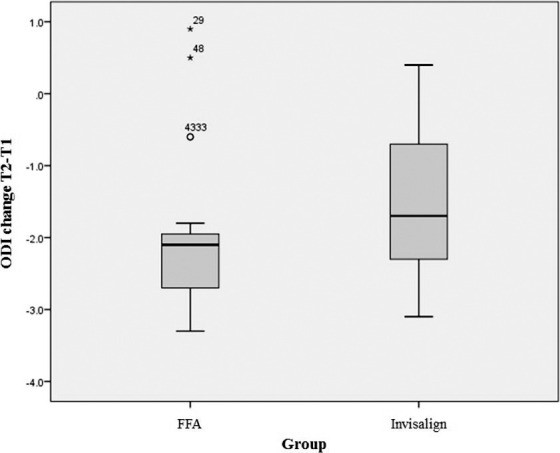
Results: Both the Invisalign and FFA groups showed significant changes from T1 to T2 in ODI and other skeletal and dentoalveolar measurements. The mean change in ODI was -1.5° (P < .001) for the Invisalign group and -2.0° (P < .001) for the FFA group. The mean decrease in overbite was 1.3 mm (P < .001) and 2.0 mm (P < .001) for the Invisalign and FFA groups, respectively. The mean increase in mandibular plane angle (Sn-GoGn) was 0.65° (P = .003) for the Invisalign group and 1.15° (P < .001) for the FFA group. When the groups were compared with each other, both ODI (P = .03) and overbite (P = .003) were significantly different in addition to other measurements.
Conclusions: Although FFA treatment had more apparent skeletal changes for deep bite adult patients when compared with Invisalign, both systems were effective in opening deep bites at dentoalveolar and skeletal levels.
Keywords: Adult; Clear aligners; Deep bite; Fixed appliances.
© 2021 by The EH Angle Education and Research Foundation, Inc.
Figures
References
-
- Parker CD, Nanda RS, Currier GF. Skeletal and dental changes associated with the treatment of deep bite malocclusion. Am J Orthod Dentofacial Orthop. 1995;107(4):382–393. - PubMed
-
- Nanda R. Correction of deep overbite in adults. Dent Clin North Am. 1997;41(1):67–87. - PubMed
-
- Djeu G, Shelton C, Maganzini A. Outcome assessment of Invisalign and traditional orthodontic treatment compared with the American Board of Orthodontics objective grading system. Am J Orthod Dentofacial Orthop. 2005;128(3):292–298. discussion 98. - PubMed
-
- Gracco A, Mazzoli A, Favoni O, et al. Short-term chemical and physical changes in invisalign appliances. Aust Orthod J. 2009;25(1):34–40. - PubMed
-
- Boyd RL. Surgical-orthodontic treatment of two skeletal Class III patients with Invisalign and fixed appliances. J Clin Orthod. 2005;39(4):245–258. - PubMed
MeSH terms
LinkOut - more resources
Full Text Sources
Other Literature Sources