


The Association Between Constipation and Lower Urinary Tract Symptoms in Parous Middle-Aged Women: A Prospective Cohort Study
- PMID: 33434452
- PMCID: PMC8403183
- DOI: 10.1089/jwh.2020.8624
The Association Between Constipation and Lower Urinary Tract Symptoms in Parous Middle-Aged Women: A Prospective Cohort Study
Abstract
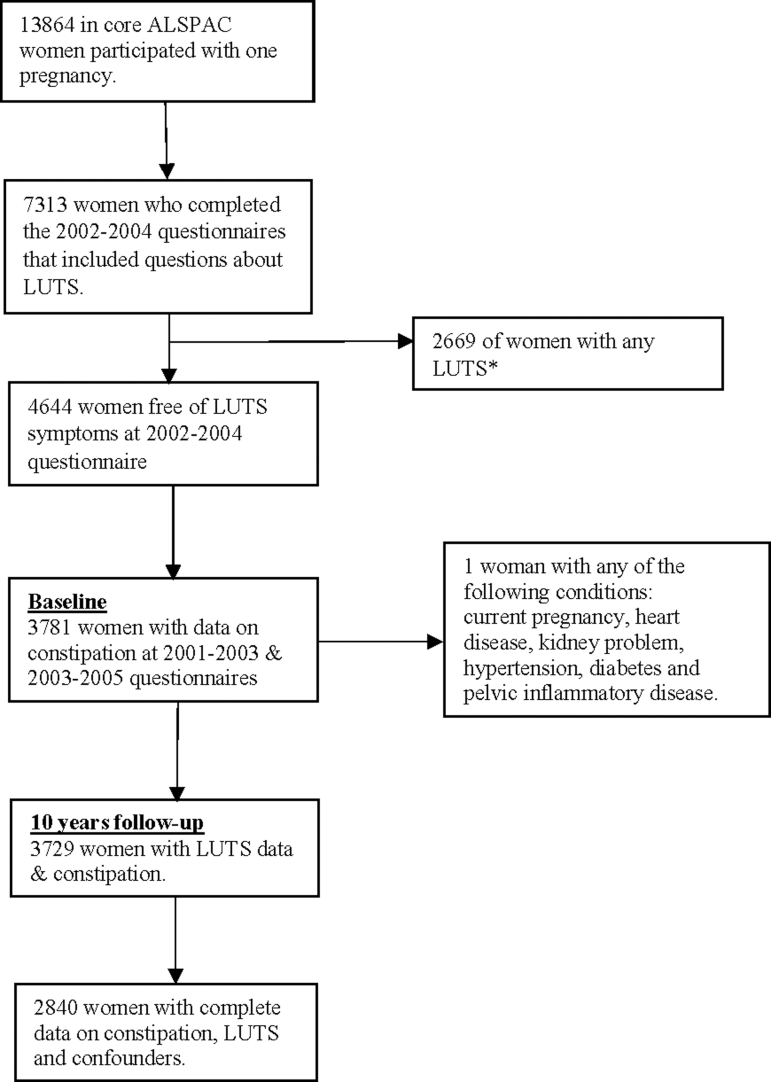
Objective: To examine the prospective association between constipation and risk of developing lower urinary tract symptoms (LUTS) in parous middle-aged women. Materials and Methods: The study uses data from 3,729 women from the Avon Longitudinal Study of Parents and Children who provided self-reports of medication intake for constipation at two time points (Baseline): 2001-2003 and 2003-2005. Women with LUTS at baseline were excluded. After 10 years of follow-up, women provided self-reports of LUTS using an adapted version of the International Consultation on Incontinence Questionnaire on Female LUTS. LUTS were categorized according to International Continence Society definitions as stress urinary incontinence (UI), urgency UI, mixed UI, nocturia, increased daytime frequency, urgency, hesitancy, and intermittency. LUTS were considered present if symptoms were reported to occur at least "sometimes" for all subtypes, except for increased daytime frequency (≥9 times) and nocturia (≥2 times nightly). Results: At follow-up, the prevalence of any LUTS was 40%. Women (mean age 43.3 years, standard deviation 0.5), who took medication for constipation at either time point had increased risks of urgency (adjusted relative risks [RRs] = 1.35; 95% confidence interval [CI] 1.04-1.95) and hesitancy (adjusted RR = 1.72; 95% CI 1.04-3.01) compared with women who reported not using medication for constipation at either time point. The risk of urgency (adjusted RR = 1.94; 95% CI 1.15-3.29) and hesitancy (adjusted RR = 1.78; 95% CI 1.03-4.19) was greater for women who reported taking medication for constipation at both time points. There was no evidence that constipation was associated with stress UI, urgency UI, mixed UI, nocturia, increased daytime frequency, and intermittency. Conclusion: Constipation is prospectively associated with an increased risk of urgency and hesitancy among parous middle-aged women. If further research finds evidence that this association is causal, this implies that women should seek treatment to alleviate constipation to reduce their consequent risk of developing these LUTS.
Keywords: ALSPAC; LUTS; constipation; urinary incontinence; women's health.
Conflict of interest statement
No competing financial interests exist.
Figures
References
-
- Haylen BT, De Ridder D, Freeman RM, et al. . An International Urogynecological Association (IUGA)/International Continence Society (ICS) joint report on the terminology for female pelvic floor dysfunction. Neurourol Urodyn 2010;29:4–20 - PubMed
-
- Riss P, Kargl J. Quality of life and urinary incontinence in women. Maturitas 2011;68:137–142 - PubMed
-
- Pereira MG, Lynch B, Hall-Faul M, Pedras S. Quality of life of women with urinary incontinence in rehabilitation treatment. J Health Psychol 2019;24:254–263 - PubMed
-
- Bartoli S, Aguzzi G, Tarricone R. Impact on quality of life of urinary incontinence and overactive bladder: A systematic literature review. Urology 2010;75:491–500 - PubMed
Publication types
MeSH terms
Grants and funding
LinkOut - more resources
Full Text Sources
Other Literature Sources
Medical
