Review
. 2021 Jan 10;18(2):511.
doi: 10.3390/ijerph18020511.

Role of NLRP3 Inflammasome Activation in Obesity-Mediated Metabolic Disorders

Affiliations
Review

Role of NLRP3 Inflammasome Activation in Obesity-Mediated Metabolic Disorders

Kaiser Wani et al. Int J Environ Res Public Health. .

Abstract

NLRP3 inflammasome is one of the multimeric protein complexes of the nucleotide-binding domain, leucine-rich repeat (NLR)-containing pyrin and HIN domain family (PYHIN). When activated, NLRP3 inflammasome triggers the release of pro-inflammatory interleukins (IL)-1β and IL-18, an essential step in innate immune response; however, defective checkpoints in inflammasome activation may lead to autoimmune, autoinflammatory, and metabolic disorders. Among the consequences of NLRP3 inflammasome activation is systemic chronic low-grade inflammation, a cardinal feature of obesity and insulin resistance. Understanding the mechanisms involved in the regulation of NLRP3 inflammasome in adipose tissue may help in the development of specific inhibitors for the treatment and prevention of obesity-mediated metabolic diseases. In this narrative review, the current understanding of NLRP3 inflammasome activation and regulation is highlighted, including its putative roles in adipose tissue dysfunction and insulin resistance. Specific inhibitors of NLRP3 inflammasome activation which can potentially be used to treat metabolic disorders are also discussed.

Keywords: NLRP3 inflammasome; diabetes; insulin resistance; metabolic stress; obesity.


Conflict of interest statement

The authors declare no conflict of interest.

Figures
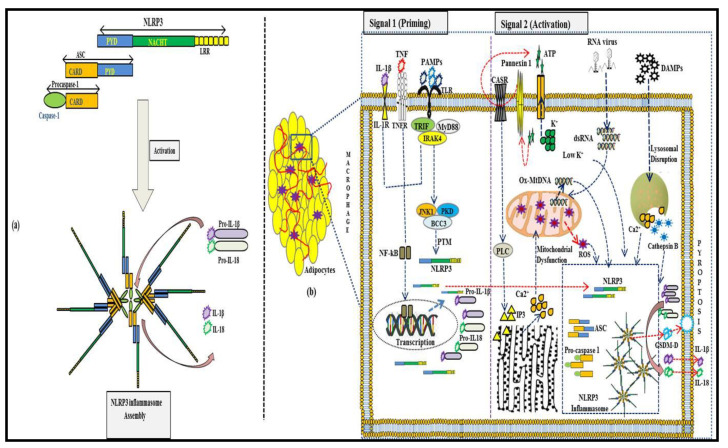
Figure 1
Figure 1
Classical NLRP3-inflammasome activation mediated maturation of pro-inflammatory signals in adipose tissue. (a): Individual components of NLRP3 inflammasome. It consists of NLRP3 protein with leucine-rich repeats (LRR), globular NACHT domain, and homologous PYD domain, which interact with PYD of adapter ASC. The CARD domain of ASC allows interaction with pro-caspase-1, which matures into caspase-1 upon NLRP3 inflammasome activation and oligomerization. (b): NLRP3 inflammasome activation in adipocyte invading ATM’s requires two signals. The first signal involves the priming signal, which is induced by endogenous cytokines or microbial components, such as lipopolysaccharide (LPS), leading to NF-κB-mediated upregulation of NLRP3 and pro-IL-1β. The second signal triggered by specific stimuli, PAMPs, and DAMPs, results in stresses, such as K+ efflux, mitochondrial dysfunction, and lysosomal disruption, which stimulates NLRP3 inflammasome formation. The activation of the NLRP3 inflammasome leads to procaspase-1 self-cleavage, generating active caspase-1, which in turn mediates IL-1β and IL-18 secretion and pyroptosis.
Figure 2
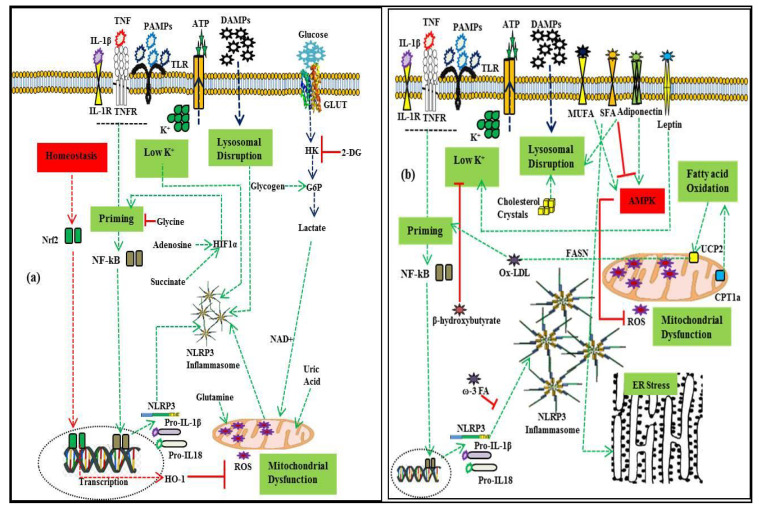
Figure 2
Metabolic regulation of NLRP3 inflammasome activation. (a): Regulation by glycolytic flux and amino acid metabolism. As a part of homeostatic regulation, the priming signal activates nuclear factor erythroid 2-related factor 2 (Nrf2), which promotes heme-oxygenase-1 (HO-1), mitigating the effect of mtROS. Increased production of succinate enhances the transcription of pro-IL1β through hypoxia-inducible factor (HIF-1α). Glycolytic flux promotes inflammasome activation which is inhibited by 2-deoxy-D-glucose (2-DG). Glycine enhances Nrf2-mediated mitigation of inflammasome activity. Glutamine and uric acid enhance it through mtROS. (b): Regulation by adipokines and lipid metabolism. The activity of fatty acid synthase (FASN) promotes priming, while omega-3 fatty acid inhibits inflammasome assembly. Saturated fatty acids promote lysosomal disruption and ER stress, while monounsaturated fatty acids promote AMP-activated protein kinase, which in turn inhibits mtROS production. Cholesterol crystals promote inflammasome activation through lysosomal disruption. Similarly, carnitine palmitoyl-transferase 1A (CPT1A) promotes inflammasome activation, and β-hydroxybutyrate inhibits it by suppressing K+ efflux. Adiponectin acts as an initiator of AMPK-autophagy inhibition of mtROS and K+ efflux, while leptin enhances NLRP3 inflammasome activation. Green lines depict the promotion of inflammasome activation, while red lines depict inhibition.
Figure 3
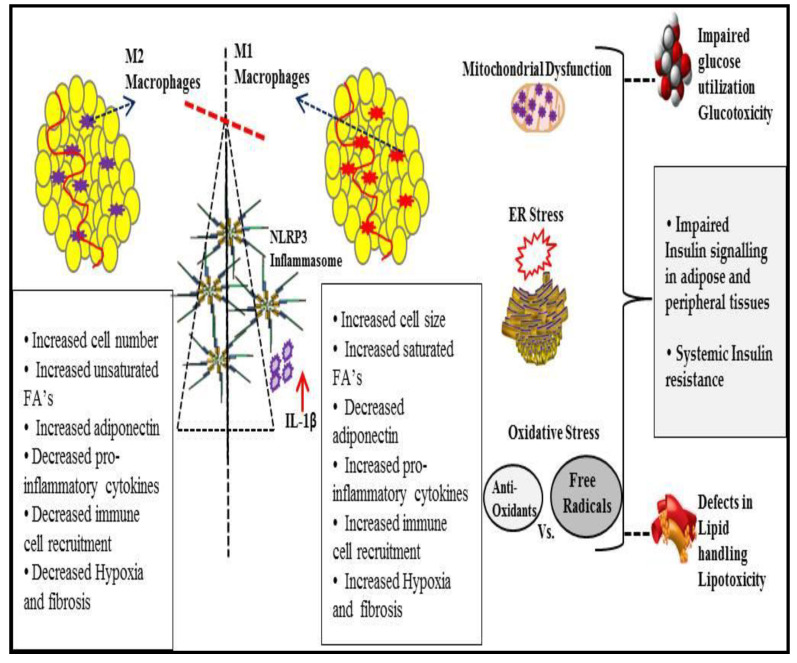
Figure 3
Overview of obesity-associated metabolic inflammation and insulin resistance. NLRP3 inflammasome activation as a consequence of obesity-mediated immunological and metabolic dysregulation, including changes in adipose tissue-resident immune cells, impaired adipogenesis, decreased anti-inflammatory adipokines, hypoxia, fibrosis, etc., and helped by oxidative and ER stress, leads to a glucotoxicity, lipotoxicity, and systemic insulin resistance.

References

    1. Takeuchi O., Akira S. Pattern recognition receptors and inflammation. Cell. 2010;140:805–820. doi: 10.1016/j.cell.2010.01.022. - DOI - PubMed
    1. Tang D., Kang R., Coyne C.B., Zeh H.J., Lotze M.T. Pamp s and damp s: Signal 0s that spur autophagy and immunity. Immunol. Rev. 2012;249:158–175. doi: 10.1111/j.1600-065X.2012.01146.x. - DOI - PMC - PubMed
    1. Vandanmagsar B., Youm Y.-H., Ravussin A., Galgani J.E., Stadler K., Mynatt R.L., Ravussin E., Stephens J.M., Dixit V.D. The nlrp3 inflammasome instigates obesity-induced inflammation and insulin resistance. Nat. Med. 2011;17:179. doi: 10.1038/nm.2279. - DOI - PMC - PubMed
    1. Martinon F., Burns K., Tschopp J. The inflammasome: A molecular platform triggering activation of inflammatory caspases and processing of proil-β. Mol. Cell. 2002;10:417–426. doi: 10.1016/S1097-2765(02)00599-3. - DOI - PubMed
    1. Davis B.K., Wen H., Ting J.P.-Y. The inflammasome nlrs in immunity, inflammation, and associated diseases. Annu. Rev. Immunol. 2011;29:707–735. doi: 10.1146/annurev-immunol-031210-101405. - DOI - PMC - PubMed

Publication types

Substances

LinkOut - more resources