


Association between Influenza Vaccine Administration and Primary Care Consultations for Respiratory Infections: Sentinel Network Study of Five Seasons (2014/2015-2018/2019) in the UK
- PMID: 33435229
- PMCID: PMC7827078
- DOI: 10.3390/ijerph18020523
Association between Influenza Vaccine Administration and Primary Care Consultations for Respiratory Infections: Sentinel Network Study of Five Seasons (2014/2015-2018/2019) in the UK
Abstract
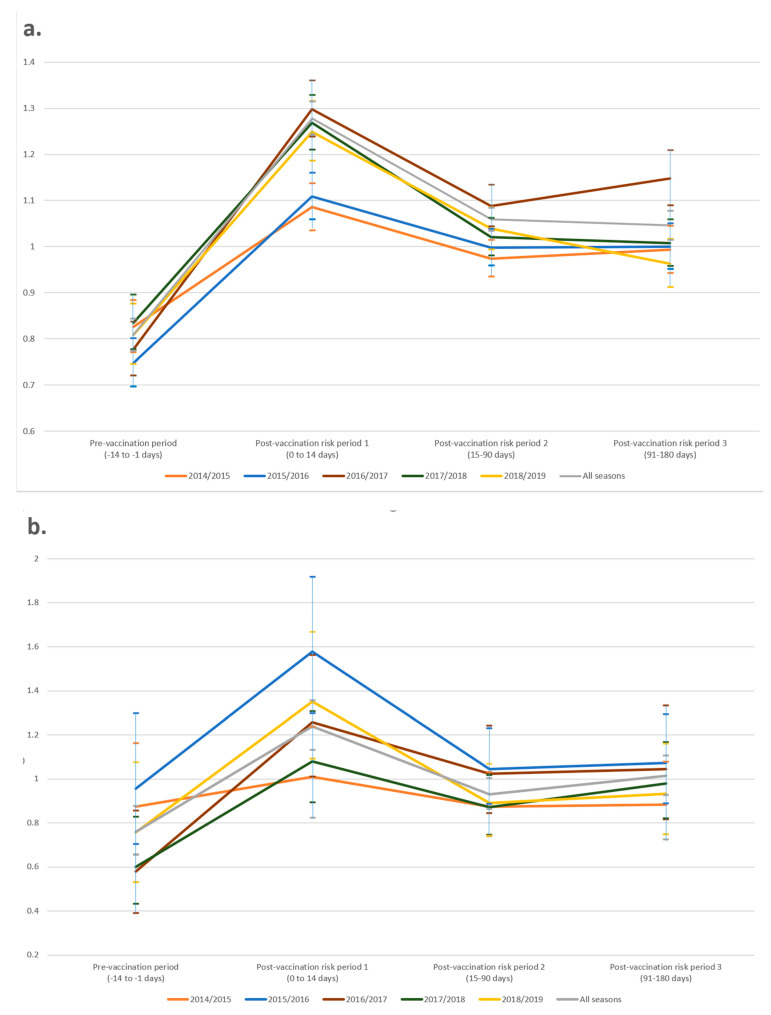
Influenza, a vaccine preventable disease, is a serious global public health concern which results in a considerable burden on the healthcare system. However, vaccine hesitancy is increasingly becoming a global problem. One prevalent misconception is that influenza vaccinations can cause the flu. We carried out this study to determine whether people undertaking influenza vaccination presented less with acute respiratory tract infection (ARTI) and influenza-like-illness (ILI) following vaccination. We utilised the Oxford Royal College of General Practitioners Research and Surveillance Centre sentinel database to examine English patients who received vaccination between 2014/2015 and 2018/2019. Of the 3,841,700 influenza vaccinations identified, vaccination details and primary care respiratory consultation counts were extracted to calculate the relative incidence (RI) per exposure risk period using the self-controlled case series methodology. Results showed a significant increase in the RI of respiratory consultation rates within fourteen days of vaccination across all five years. Less than 6.2% of vaccinations led to consultations for ARTI or ILI in primary care (crude consultation rate 6196 per 100,000). These findings, particularly if confirmed in further research, may reduce the risk of cross-infection between waiting patients and increase uptake of influenza vaccine.
Keywords: general practice; influenza vaccine; primary care; vaccine hesitancy.
Conflict of interest statement
Simon de Lusignan is the Director of the RCGP RSC and has received funding through his University for studies from Eli Lilly, AstraZeneca, Sanofi, GSK, Seqirus, and Takeda; he has also been a member of advisory boards for influenza for Seqirus and Sanofi. These funders had no role in the design of the study; in the collection, analyses, or interpretation of data; in the writing of the manuscript, or in the decision to publish the results.
Figures
References
-
- World Health Organization Influenza (Seasonal) [(accessed on 1 July 2020)]; Available online: https://www.who.int/en/news-room/fact-sheets/detail/influenza-(seasonal)
-
- Iuliano A.D., Roguski K.M., Chang H.H., Muscatello D.J., Palekar R., Tempia S., Cohen C., Gran J.M., Schanzer D., Cowling B.J., et al. Estimates of global seasonal influenza-associated respiratory mortality: A modelling study. Lancet. 2018;391:1285–1300. doi: 10.1016/S0140-6736(17)33293-2. - DOI - PMC - PubMed
-
- Wang X., Li Y., O’Brien K.L., Madhi S.A., Widdowson M.A., Byass P., Omer S.B., Abbas Q., Ali A., Amu A., et al. Global burden of respiratory infections associated with seasonal influenza in children under 5 years in 2018: A systematic review and modelling study. Lancet Glob. Health. 2020;8:e497–e510. doi: 10.1016/S2214-109X(19)30545-5. - DOI - PMC - PubMed
MeSH terms
Substances
LinkOut - more resources
Full Text Sources
Other Literature Sources
Medical
