


Mangiferin as New Potential Anti-Cancer Agent and Mangiferin-Integrated Polymer Systems-A Novel Research Direction
- PMID: 33435313
- PMCID: PMC7827323
- DOI: 10.3390/biom11010079
Mangiferin as New Potential Anti-Cancer Agent and Mangiferin-Integrated Polymer Systems-A Novel Research Direction
Abstract
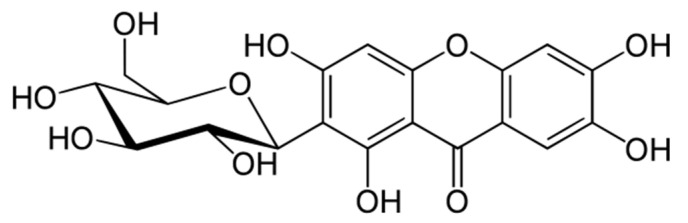
For a long time, the pharmaceutical industry focused on natural biologically active molecules due to their unique properties, availability and significantly less side-effects. Mangiferin is a naturally occurring C-glucosylxantone that has substantial potential for the treatment of various diseases thanks to its numerous biological activities. Many research studies have proven that mangiferin possesses antioxidant, anti-infection, anti-cancer, anti-diabetic, cardiovascular, neuroprotective properties and it also increases immunity. It is especially important that it has no toxicity. However, mangiferin is not being currently applied to clinical use because its oral bioavailability as well as its absorption in the body are too low. To improve the solubility, enhance the biological action and bioavailability, mangiferin integrated polymer systems have been developed. In this paper, we review molecular mechanisms of anti-cancer action as well as a number of designed polymer-mangiferin systems. Taking together, mangiferin is a very promising anti-cancer molecule with excellent properties and the absence of toxicity.
Keywords: cancer; drug delivery; mangiferin; molecular mechanisms; polymer systems.
Conflict of interest statement
The authors declare no conflict of interest.
Figures
References
-
- Nott P.E., Roberts J.C. The structure of mangiferin. Phytochemistry. 1967;6:741–747. doi: 10.1016/S0031-9422(00)86015-X. - DOI
-
- Bhatia V.K., Ramanathan J.D., Seshadri T.R. Constitution of mangiferin. Tetrahedron. 1967;23:1363–1368. doi: 10.1016/0040-4020(67)85090-7. - DOI
-
- Nott P.E., Roberts J.C. A synthesis of mangiferin. Phytochemistry. 1967;6:1597–1599. doi: 10.1016/S0031-9422(00)82959-3. - DOI
-
- da Cruz J.W., Jr, de Moraes L.R., dos Santos M.H., da Silva G.A., Brigagão M.R.P.L., Ellena J., Doriguetto A.C. Crystalline structure of mangiferin, a C-Glycosyl-Substituted 9H-Xanthen-9-one isolated from the stem bark of mangifera indica. Helv. Chim. Acta. 2008;91:144–154. doi: 10.1002/hlca.200890005. - DOI
Publication types
MeSH terms
Substances
LinkOut - more resources
Full Text Sources
Other Literature Sources
