


The Multifaced Role of STAT3 in Cancer and Its Implication for Anticancer Therapy
- PMID: 33435349
- PMCID: PMC7826746
- DOI: 10.3390/ijms22020603
The Multifaced Role of STAT3 in Cancer and Its Implication for Anticancer Therapy
Abstract
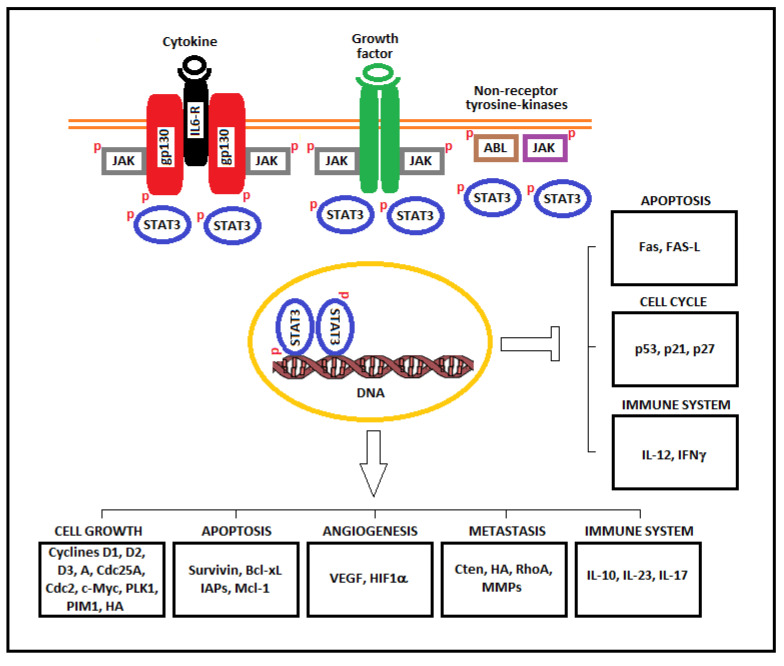
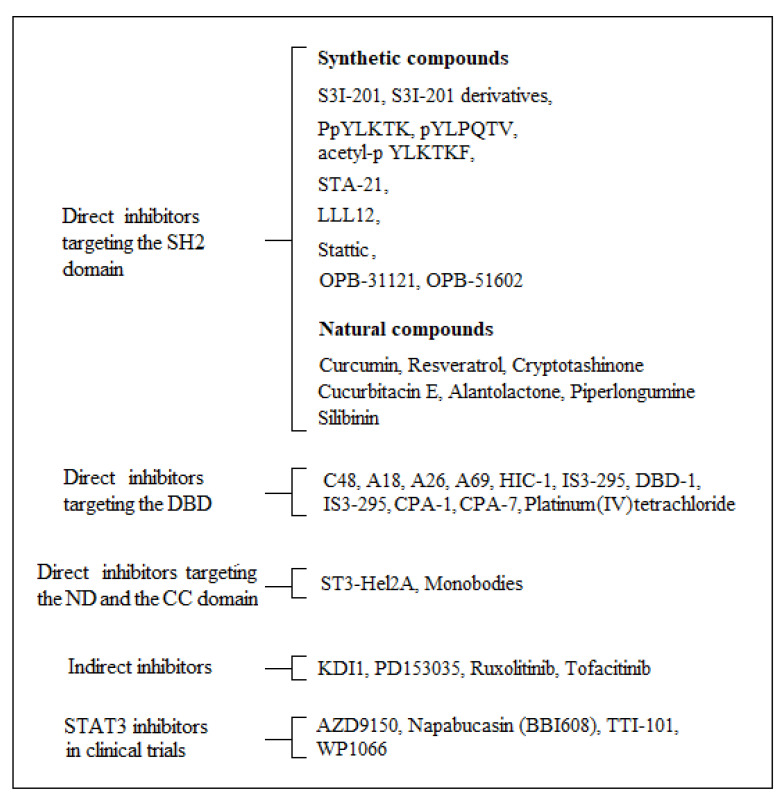
Signal transducer and activator of transcription (STAT) 3 is one of the most complex regulators of transcription. Constitutive activation of STAT3 has been reported in many types of tumors and depends on mechanisms such as hyperactivation of receptors for pro-oncogenic cytokines and growth factors, loss of negative regulation, and excessive cytokine stimulation. In contrast, somatic STAT3 mutations are less frequent in cancer. Several oncogenic targets of STAT3 have been recently identified such as c-myc, c-Jun, PLK-1, Pim1/2, Bcl-2, VEGF, bFGF, and Cten, and inhibitors of STAT3 have been developed for cancer prevention and treatment. However, despite the oncogenic role of STAT3 having been widely demonstrated, an increasing amount of data indicate that STAT3 functions are multifaced and not easy to classify. In fact, the specific cellular role of STAT3 seems to be determined by the integration of multiple signals, by the oncogenic environment, and by the alternative splicing into two distinct isoforms, STAT3α and STAT3β. On the basis of these different conditions, STAT3 can act both as a potent tumor promoter or tumor suppressor factor. This implies that the therapies based on STAT3 modulators should be performed considering the pleiotropic functions of this transcription factor and tailored to the specific tumor type.
Keywords: STAT3; cancer; tumor promoter; tumor suppressor.
Conflict of interest statement
The authors declare no conflict of interest.
Figures

References
-
- Wegenka U.M., Buschmann J., Lütticken C., Heinrich P.C., Horn F. Acute-phase response factor, a nuclear factor binding to acute-phase response elements, is rapidly activated by interleukin-6 at the posttranslational level. Mol. Cell. Biol. 1993;13:276–288. doi: 10.1128/MCB.13.1.276. - DOI - PMC - PubMed
-
- Hemmann U., Gerhartz C., Heesel B., Sasse J., Kurapkat G., Grötzingerl J., Wollmert A., Zhong Z., Darnell J.E., Graeve L., et al. Differential activation of acute phase response factor Stat3 and Stat1 via the cytoplasmic domain of the interleukin 6 signal transducer gp130. II. Src homology SH2 domains define the specificity of stat factor activation. J. Biol. Chem. 1996;271:2999–3007. doi: 10.1074/jbc.271.22.12999. - DOI - PubMed
Publication types
MeSH terms
Substances
LinkOut - more resources
Full Text Sources
Other Literature Sources
Medical
Miscellaneous
