Review
. 2021 Jan 8;11(1):77.
doi: 10.3390/biom11010077.

Jasmonates, Ethylene and Brassinosteroids Control Adventitious and Lateral Rooting as Stress Avoidance Responses to Heavy Metals and Metalloids

Affiliations
Review

Jasmonates, Ethylene and Brassinosteroids Control Adventitious and Lateral Rooting as Stress Avoidance Responses to Heavy Metals and Metalloids

Camilla Betti et al. Biomolecules. .

Abstract

Developmental and environmental signaling networks often converge during plant growth in response to changing conditions. Stress-induced hormones, such as jasmonates (JAs), can influence growth by crosstalk with other signals like brassinosteroids (BRs) and ethylene (ET). Nevertheless, it is unclear how avoidance of an abiotic stress triggers local changes in development as a response. It is known that stress hormones like JAs/ET and BRs can regulate the division rate of cells from the first asymmetric cell divisions (ACDs) in meristems, suggesting that stem cell activation may take part in developmental changes as a stress-avoidance-induced response. The root system is a prime responder to stress conditions in soil. Together with the primary root and lateral roots (LRs), adventitious roots (ARs) are necessary for survival in numerous plant species. AR and LR formation is affected by soil pollution, causing substantial root architecture changes by either depressing or enhancing rooting as a stress avoidance/survival response. Here, a detailed overview of the crosstalk between JAs, ET, BRs, and the stress mediator nitric oxide (NO) in auxin-induced AR and LR formation, with/without cadmium and arsenic, is presented. Interactions essential in achieving a balance between growth and adaptation to Cd and As soil pollution to ensure survival are reviewed here in the model species Arabidopsis and rice.

Keywords: adventitious rooting; auxin; brassinosteroids; cadmium and arsenic soil pollution; ethylene; jasmonates; lateral rooting; nitric oxide.


Conflict of interest statement

The authors declare no conflict of interest.

Figures
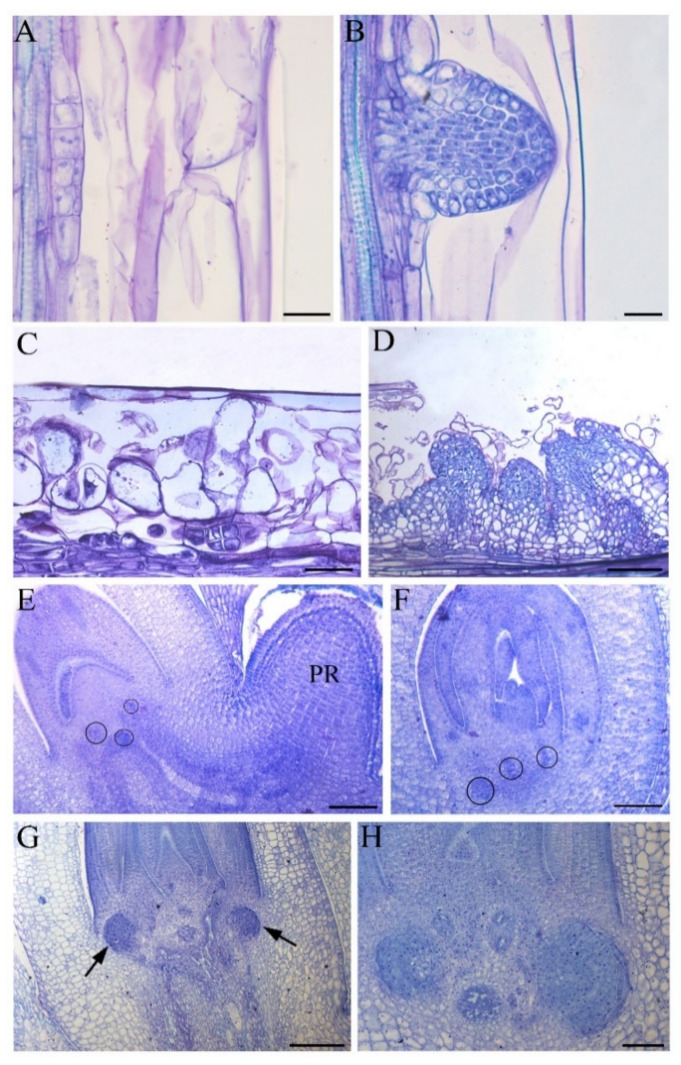
Figure 1
Figure 1
Adventitious root (AR) formation in hypocotyls (A,B) and thin cell layer explants (C,D) of Arabidopsis, and in the mature embryo of rice (EH). First anticlinal cell divisions in the hypocotyl pericycle (A), and AR-primordium formation (B) in Arabidopsis seedlings. Radial longitudinal sections of Arabidopsis thin cell layers (TCLs) excised from the inflorescence stem and cultured under darkness in the presence of 10 μM of indole-3-butyric acid (IBA). Periclinal cell divisions in the stem endodermis and meristemoid formation from the most superficial derivatives at day 5 (C), and further development of these meristemoids into AR primordia ((D), day 10). Mature embryos of rice showing meristematic clumps (circles) initiating AR primordia at the scutellar node (E,F). Adventitious root primordia at the scutellar node at day 3 of germination ((G), arrows). Dome-shaped adventitious root primordium with cap differentiation ((H), day 4 of germination). PR, primary root. Longitudinal sections stained with toluidine blue. Bars = 20 µm (A,B), 50 µM (C), 100 µM (H) and 200 µm (DG).
Figure 2
Figure 2
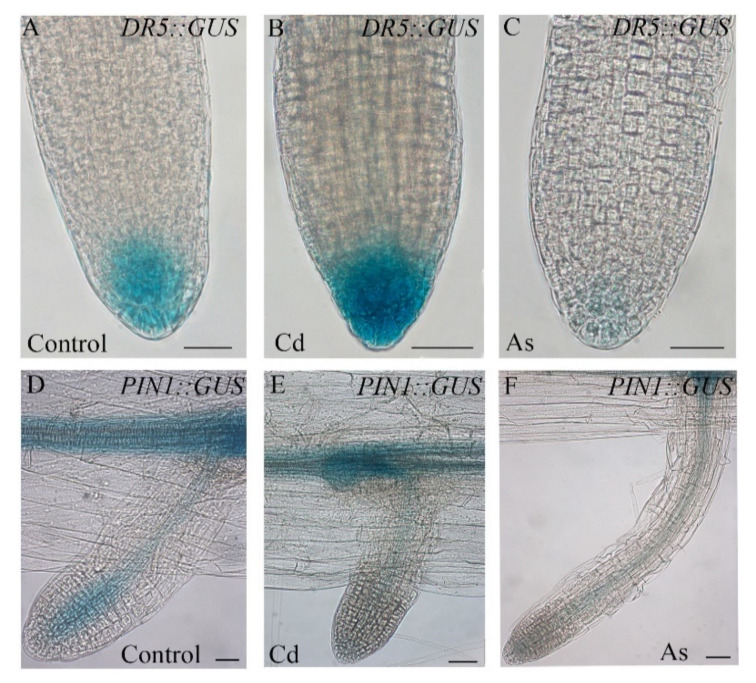
Expression patterns of DR5::GUS and PIN1::GUS in lateral roots (LRs) of Arabidopsis DR5::GUS and PIN1::GUS seedlings non-exposed (Control, (A,D)) or exposed to 60 µM CdSO4 (Cd, (B,E)) or 400 µM Na2HAsO4·7H2O (As, (C,F)). Bars = 20 µm (AC), 30 µm (D) and 50 µm (EF).
Figure 3
Figure 3
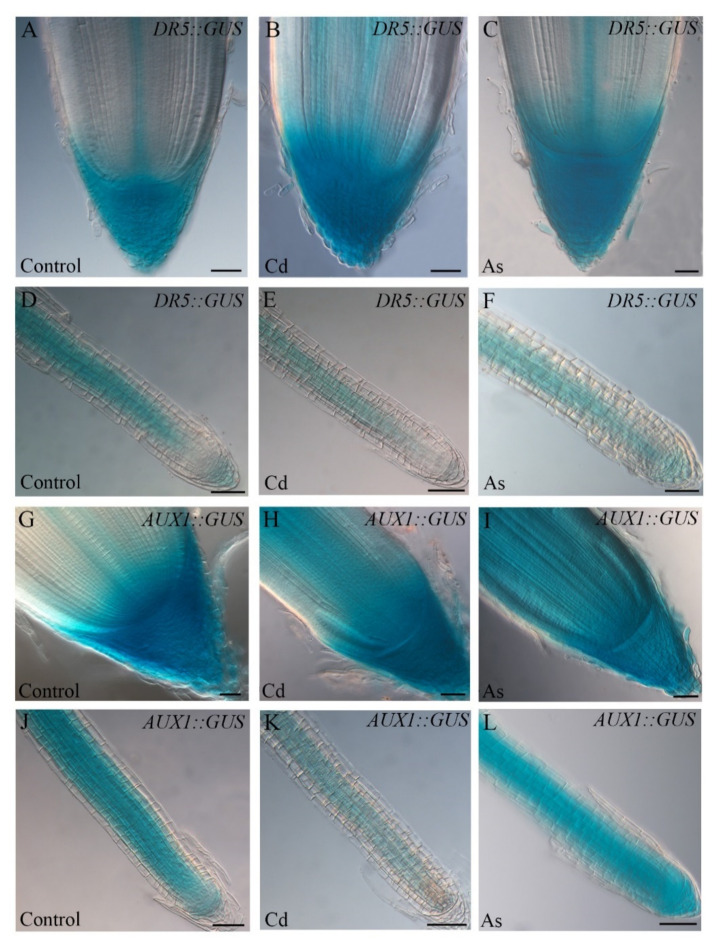
Expression patterns of DR5::GUS and AUX1::GUS in adventitious roots (ARs, (AC,GI)) and lateral roots (LRs, (DF, JL)) of Oryza sativa DR5::GUS and AUX1::GUS seedlings non-exposed (Control, (A,D,G,J)) or exposed to 100 µM CdSO4 (Cd, (B,E,H,K)) or 100 µM Na2HAsO4·7H2O (As, (C,F,I,L)). Bars = 40 µm.
Figure 4
Figure 4
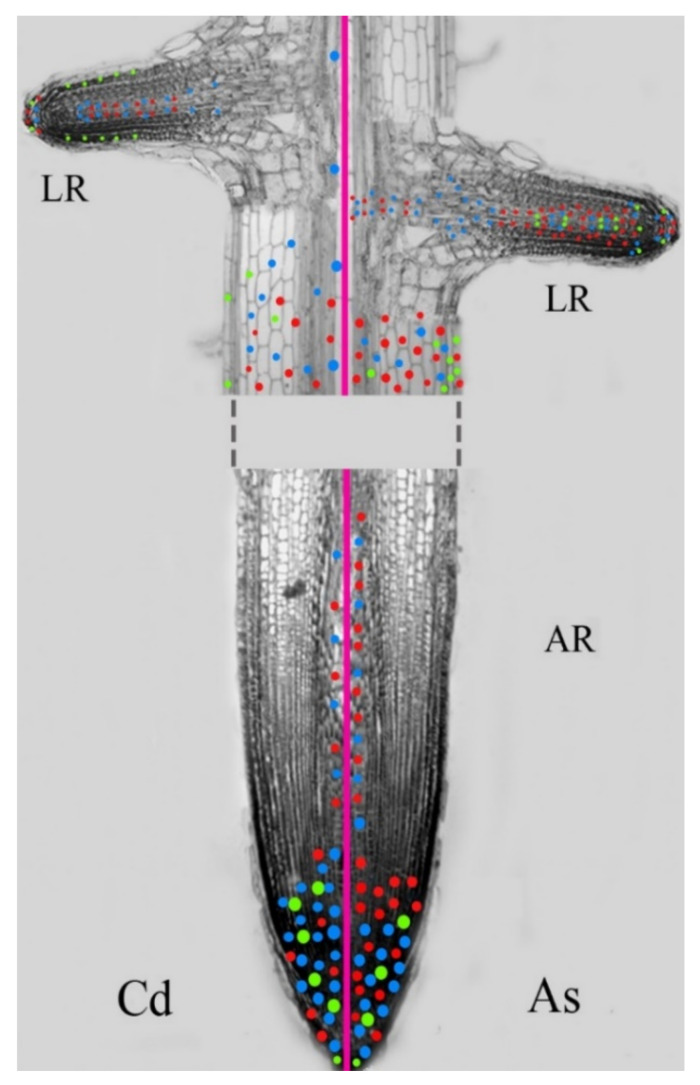
Model of indole-3-acetic acid (IAA) localization (blue dots), AUX1 expression (red dots) and nitric oxide (NO) signal (bright green dots) in an adventitious root (AR) and in lateral roots (LRs) of rice seedlings grown for 10 days in the presence of Cd or As.

References

    1. Gaillochet C., Stiehl T., Wenzl C., Ripoll J.J., Bailey-Steinitz L.J., Li L., Pfeiffer A., Miotk A., Hakenjos J.P., Forner J., et al. Control of plant cell fate transitions by transcriptional and hormonal signals. ELife. 2017;6:e30135. doi: 10.7554/eLife.30135. - DOI - PMC - PubMed
    1. Pfeiffer A., Wenzl C., Lohmann J.U. Beyond flexibility: Controlling stem cells in an ever changing environment. Curr. Opin. Plant Biol. 2017;35:117–123. doi: 10.1016/j.pbi.2016.11.014. - DOI - PubMed
    1. Fahn A. Plant Anatomy. 4th ed. Pergamon Press; Oxford, UK: 1990.
    1. Steffens B., Rasmussen A. The Physiology of Adventitious Roots. Plant Physiol. 2016;170:603–617. doi: 10.1104/pp.15.01360. - DOI - PMC - PubMed
    1. Rebouillat J., Dievart A., Verdeil J.L., Escoute J., Giese G., Breitler J.C., Gantet P., Espeout S., Guiderdoni E., Périn C. Molecular genetics of rice root development. Rice. 2009;2:15–34. doi: 10.1007/s12284-008-9016-5. - DOI

Publication types

MeSH terms