


Effect of professional certification on employees' return-to-work rate after occupational injuries in Korea: focusing on vulnerable groups
- PMID: 33435870
- PMCID: PMC7802128
- DOI: 10.1186/s12199-020-00930-0
Effect of professional certification on employees' return-to-work rate after occupational injuries in Korea: focusing on vulnerable groups
Abstract
Background: One effective way to improve return-to-work (RTW) performance may be to convince the employer that the worker has the necessary skills. The aim of this paper is to investigate the effect of having a professional certification among workers injured in occupational injuries on their return to work.
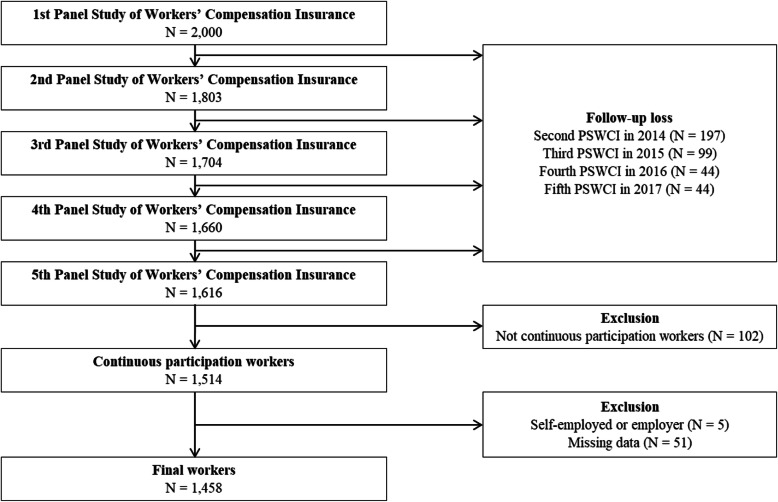
Methods: The Panel Study of Workers' Compensation Insurance (PSWCI) targets workers who completed medical care in 2012 after an occupational injury. The study population (n = 2000) was stratified by gender, age, region, disability grade, and rehabilitation service use. A total of 1458 workers were finally selected for this study. The effect of having a certification on RTW status was calculated with an odds ratio and 95% confidence intervals using binomial and multinomial logistic regression analyses. In the binomial logistic regression analysis, the RTW group was made up as a combination of the return to original work and the reemployment groups.
Results: The ORs of RTW among those with a certification compared to those without certification were 1.38 (1.16-1.65) in Model 1, 1.25 (1.05-1.50) in Model 2, and 1.22 (1.01-1.47) in Model 3. Among female workers with a certification, the OR of RTW was 4.60 (2.68-7.91), that of return to original work was 3.21 (1.74-5.91), and that of reemployment was 5.85 (3.34-10.27). Among daily workers with a certification, the OR of RTW was 1.32 (1.03-1.69) and that of reemployment was 1.37 (1.07-1.76).
Conclusion: In conclusion, injured workers with a certification generally had a higher RTW rate. In particular, the RTW rate was higher among female workers and daily workers with a certification than among those without.
Keywords: Certification; Occupational injury; Return to work; Workers’ compensation insurance.
Conflict of interest statement
The authors declare that they have no competing interests.
Figures
References
-
- Ministry of Employment and Labor (KR): Analysis of occupational accidents 2018. http://www.moel.go.kr/policy/policydata/view.do?bbs_seq=20191200830 (2020).
-
- Ministry of Employment and Labor (KR): Analysis of occupational accidents 2017. http://www.moel.go.kr/policy/policydata/view.do?bbs_seq=20190300037 (2019). Accessed January 20.
-
- Korea Workers’ Compensation & Welfare Service: 2018 Statistics of Korea Workers’ Compensation and Welfare Service. https://www.kcomwel.or.kr/kcomwel/info/data/stat/stat.jsp (2019). Accessed January 20.
-
- Haupt Theo C, Pillay K. Investigating the true costs of construction accidents. Journal of Engineering, Design and Technology. 2016;14:373–419. doi: 10.1108/JEDT-07-2014-0041. - DOI
MeSH terms
LinkOut - more resources
Full Text Sources
Other Literature Sources
Medical