


Reduced intensity of early intensification does not increase the risk of relapse in children with standard risk acute lymphoblastic leukemia - a multi-centric clinical study of GD-2008-ALL protocol
- PMID: 33435902
- PMCID: PMC7805214
- DOI: 10.1186/s12885-020-07752-x
Reduced intensity of early intensification does not increase the risk of relapse in children with standard risk acute lymphoblastic leukemia - a multi-centric clinical study of GD-2008-ALL protocol
Abstract
Background: The prognosis of childhood acute lymphoblastic leukemia (ALL) is optimistic with a 5-year event-free survival (EFS) rate of 70-85%. However, the major causes of mortality are chemotherapy toxicity, infection and relapse. The Guangdong (GD)-2008-ALL collaborative protocol was carried out to study the effect of reduced intensity on treatment related mortality (TRM) based on Berlin-Frankfurt-Münster (BFM) 2002 backbone treatment. The study was designed to elucidate whether the reduced intensity is effective and safe for children with ALL.
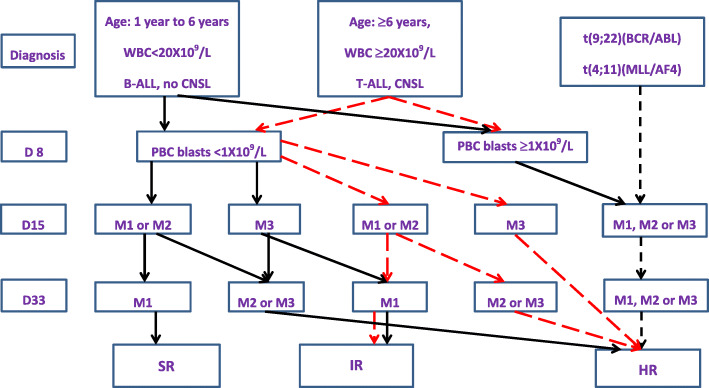
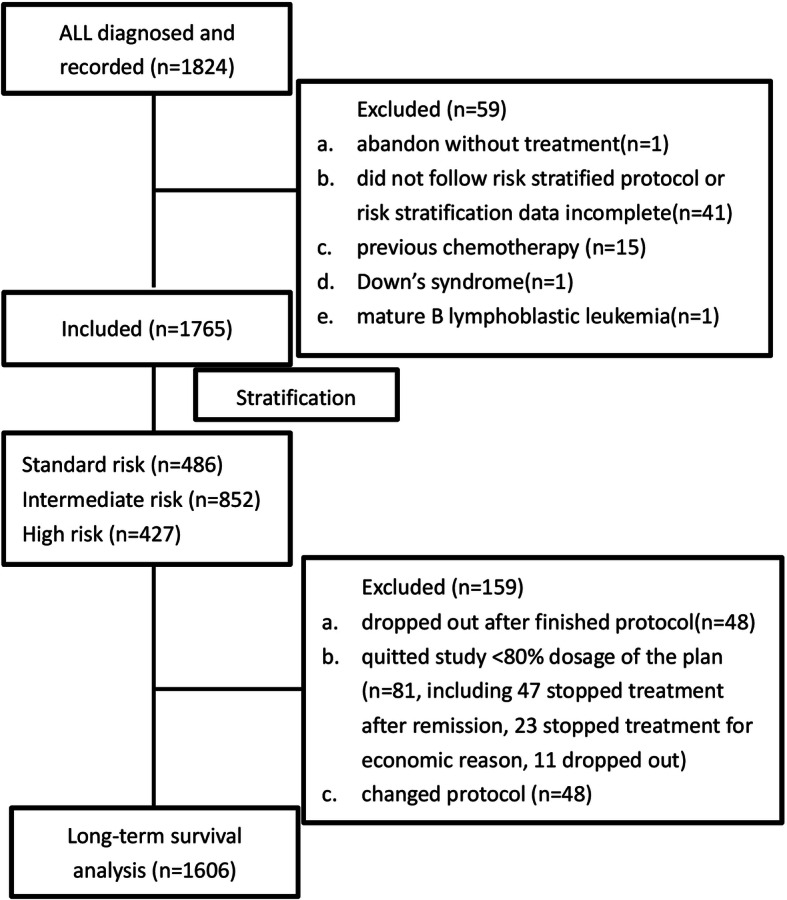
Methods: The clinical data were obtained from February 28, 2008 to June 30, 2016. A total of 1765 childhood ALL cases from 9 medical centers were collected and data were retrospectively analyzed. Patients were stratified into 3 groups according to bone marrow morphology, prednisone response, age, genotype, and karyotype information: standard risk (SR), intermediate risk (IR) and high risk (HR). For SR group, daunorubicin was decreased in induction IA while duration was reduced in Induction Ib (2 weeks in place of 4 weeks). Doses for CAM were same in all risk groups - SR patients received one CAM, others got two CAMs.
Results: The 5-year and 8-year overall survival (OS), event-free survival (EFS) and cumulative incidence of relapse (CIR) were 83.5±0.9% and 83.1±1.0%, 71.9±1.1% and 70.9±1.2%, and 19.5±1.0% and 20.5±1.1%, respectively. The 2-year treatment-related mortality (TRM) was 5.2±0.5%. The 5-year and 8-year OS were 90.7±1.4% and 89.6±1.6% in the SR group, while the 5-year and 8-year EFS were 81.5±1.8% and 80.0±2.0%. In the SR group, 74 (15.2%) patients measured minimal residual disease (MRD) on Day 15 and Day 33 of induction therapy. Among them, 7 patients (9.46%) were MRD positive (≥ 0.01%) on Day 33. The incidence of relapse in the MRD Day 33 positive group (n=7) was 28.6%, while in the MRD Day 33 negative group (n=67) was 7.5% (p=0.129).
Conclusions: The results of GD-2008-ALL protocol are outstanding for reducing TRM in childhood ALL in China with excellent long term EFS. This protocol provided the evidence for further reducing intensity of induction therapy in the SR group according to the risk stratification. MRD levels on Day 15 and Day 33 are appropriate indexes for stratification.
Keywords: Acute lymphoblastic leukemia; Chemotherapy; Children; Reduced intensity multi-centric clinical study.
Conflict of interest statement
The authors declare that they have no competing interests.
Figures

References
-
- Gao C, Zhao XX, Li WJ, et al. Clinical features, early treatment responses, and outcomes of pediatric acute lymphoblastic leukemia in China with or without specific fusion transcripts: a single institutional study of 1,004 patients. Am J Hematol. 2012;87(11):1022–1027. doi: 10.1002/ajh.23307. - DOI - PubMed
-
- Research SMSGoCsALL Multi-center trial based on SCMC-ALL-2005 for children's acute lymphoblastic leukemia. Zhonghua Er Ke Za Zhi. 2013;51(7):495–501. - PubMed
Publication types
MeSH terms
Substances
LinkOut - more resources
Full Text Sources
Other Literature Sources
Research Materials
