


Prevalence, predictors and outcome of carotid stenosis: a sub study in the Preventive Antibiotics in Stroke Study (PASS)
- PMID: 33435918
- PMCID: PMC7802330
- DOI: 10.1186/s12883-020-02032-4
Prevalence, predictors and outcome of carotid stenosis: a sub study in the Preventive Antibiotics in Stroke Study (PASS)
Abstract
Background: The prevalence of carotid artery stenosis (CAS) in acute ischaemic stroke (AIS) patients is historically reported at 15-20%, but an up-to-date estimate is lacking. We hypothesise it is lower than historically reported, due to better risk management to date. The study aims to study prevalence, predictors and survival of CAS in AIS patients.
Methods: We included patients with AIS from the Preventive Antibiotics in Stroke Study (PASS), a large Dutch randomized, multicentre, open-label phase III trial that included 2538 patients with acute stroke and randomised between standard care or preventive ceftriaxone. Patients with stroke in the anterior circulation that underwent diagnostic testing of the internal carotid artery (ICA) were eligible for this sub study and used in these secondary analyses. Logistic regression analyses were performed to identify predictors for CAS ≥ 50%. Additionally, an ordinal regression was performed to assess the association between presence of CAS at baseline and functional outcome at three months on the modified Rankin scale (mRS).
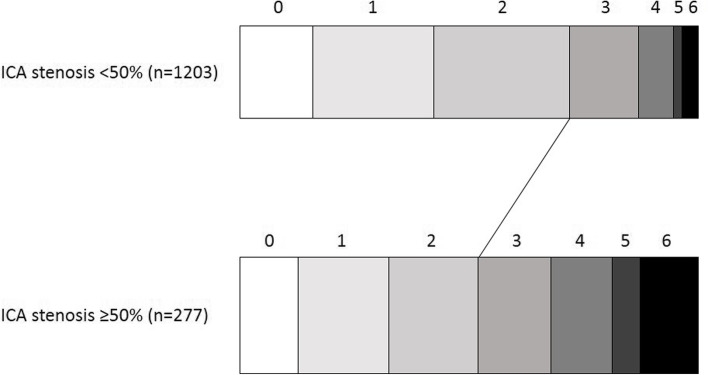
Results: 1480 patients with AIS were included; 277 had CAS (18.7%; 95%CI:17.7-19.7). Age, hypertension, smoking and male gender were found as best-fit predictors for presence of CAS. Significant shift in mRS score after 90 days for CAS ≥50% towards a higher mRS score with an OR of 1.66 (95% CI 1.30-2.10) was found.
Conclusions: Current prevalence of CAS is 18.7%, which is higher than we expected. Gender, smoking and hypertension are important factors associated with CAS. Patients with CAS had a significantly higher mRs score after 90 days.
Trial registration: Unique identifier: ISRCTN66140176.
Keywords: Carotid stenosis; Ischaemic stroke; Predictors; Prevalence; Survival.
Conflict of interest statement
The authors declare that they have no competing interests.
Figures

References
-
- Petty GW, Brown RD, Jr, Whisnant JP, Sicks JD, O’Fallon WM, Wiebers DO. Ischemic stroke subtypes: a population-based study of incidence and risk factors. Stroke. 1999;30(12):2513–6. - PubMed
-
- Uchino K, Risser JMH, Smith MA, Moyé LA, Morgenstern LB. Ischemic stroke subtypes among Mexican Americans and non-Hispanic whites: the BASIC Project. Neurology. 2004;63(3):574–6. - PubMed
-
- Mast H, Thompson JL, Lin IF, Hofmeister C, Hartmann A, Marx P, et al. Cigarette smoking as a determinant of high-grade carotid artery stenosis in Hispanic, black, and white patients with stroke or transient ischemic attack. Stroke. 1998;29(5):908–12. - PubMed
MeSH terms
Grants and funding
LinkOut - more resources
Full Text Sources
Other Literature Sources
Medical
Miscellaneous
