


Skin autofluorescence predicts new cardiovascular disease and mortality in people with type 2 diabetes
- PMID: 33435948
- PMCID: PMC7802158
- DOI: 10.1186/s12902-020-00676-4
Skin autofluorescence predicts new cardiovascular disease and mortality in people with type 2 diabetes
Abstract
Background: Skin autofluorescence (SAF) is a non-invasive marker of tissue accumulation of advanced glycation endproducts (AGE). Recently, we demonstrated in the general population that elevated SAF levels predict the development of type 2 diabetes (T2D), cardiovascular disease (CVD) and mortality. We evaluated whether elevated SAF may predict the development of CVD and mortality in individuals with T2D.
Methods: We included 2349 people with T2D, available baseline SAF measurements (measured with the AGE reader) and follow-up data from the Lifelines Cohort Study. Of them, 2071 had no clinical CVD at baseline. 60% were already diagnosed with diabetes (median duration 5, IQR 2-9 years), while 40% were detected during the baseline examination by elevated fasting blood glucose ≥7.0 mmol/l) and/or HbA1c ≥6.5% (48 mmol/mol).
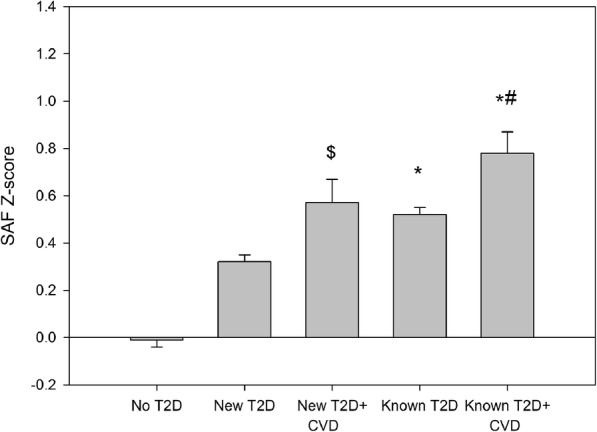
Results: Mean (±SD) age was 57 ± 12 yrs., BMI 30.2 ± 5.4 kg/m2. 11% of participants with known T2D were treated with diet, the others used oral glucose-lowering medication, with or without insulin; 6% was using insulin alone. Participants with known T2D had higher SAF than those with newly-detected T2D (SAF Z-score 0.56 ± 0.99 vs 0.34 ± 0.89 AU, p < 0.001), which reflects a longer duration of hyperglycaemia in the former group. Participants with existing CVD and T2D had the highest SAF Z-score: 0.78 ± 1.25 AU. During a median follow-up of 3.7 yrs., 195 (7.6%) developed an atherosclerotic CVD event, while 137 (5.4%) died. SAF was strongly associated with the combined outcome of a new CVD event or mortality (OR 2.59, 95% CI 2.10-3.20, p < 0.001), as well as incidence of CVD (OR 2.05, 95% CI 1.61-2.61, p < 0.001) and death (OR 2.98, 2.25-3.94, p < 0.001) as a single outcome. In multivariable analysis for the combined endpoint, SAF retained its significance when sex, systolic blood pressure, HbA1c, total cholesterol, eGFR, as well as antihypertensive and statin medication were included. In a similar multivariable model, SAF was independently associated with mortality as a single outcome, but not with incident CVD.
Conclusions: Measuring SAF can assist in prediction of incident cardiovascular disease and mortality in individuals with T2D. SAF showed a stronger association with future CVD events and mortality than cholesterol or blood pressure levels.
Keywords: Ageing; Cardiovascular disease; Diabetes; Mortality; Prediction; Skin autofluorescence.
Conflict of interest statement
RG and AJS are founders and shareholders in Diagnoptics Technologies (Groningen, the Netherlands), manufacturer of the AGE Reader. The other authors declare that they have no competing interests.
Figures
References
-
- Wolffenbuttel BHR, Van Haeften TW. Prevention of complications in non-insulin-dependent diabetes mellitus (NIDDM) Drugs. 1995;50(2):263–288. - PubMed
-
- Brownlee M. The pathobiology of diabetic complications: a unifying mechanism. Diabetes. 2005;54(6):1615–1625. - PubMed
-
- Lindstrom J, Tuomilehto J. The diabetes risk score: a practical tool to predict type 2 diabetes risk. Diabetes Care. 2003;26(3):725–731. - PubMed
-
- Conroy RM, Pyorala K, Fitzgerald AP, Sans S, Menotti A, De Backer G, et al. Estimation of ten-year risk of fatal cardiovascular disease in Europe: the SCORE project. Eur Heart J. 2003;24(11):987–1003. - PubMed
MeSH terms
Substances
LinkOut - more resources
Full Text Sources
Other Literature Sources
Medical
Research Materials
Miscellaneous
