


Psychometric properties of burnout measures: a systematic review
- PMID: 33436137
- PMCID: PMC8057391
- DOI: 10.1017/S2045796020001134
Psychometric properties of burnout measures: a systematic review
Abstract
Aims: Occupational Burnout (OB) is currently measured through several Patient-Reported Outcome Measures (PROMs) and some of them have become widely used in occupational health research and practice. We, therefore, aimed to review and grade the psychometric validity of the five OB PROMs considered as valid for OB measure in mental health professionals (the Maslach Burnout Inventory (MBI), the Pines' Burnout Measure (BM), the Psychologist Burnout Inventory (PBI), the OLdenburg Burnout Inventory (OLBI) and the Copenhagen Burnout Inventory (CBI)).
Methods: We conducted systematic literature searches in MEDLINE, PsycINFO and EMBASE databases. We reviewed studies published between January 1980 and September 2018 following a methodological framework, in which each step of PROM validation, the reference method, analytical technics and result interpretation criteria were assessed. Using the COnsensus-based Standards for the selection of health Measurement Instruments we evaluated the risk of bias in studies assessing content and criterion validity, structural validity, internal consistency, reliability, measurement error, hypotheses testing and responsiveness of each PROM. Finally, we assessed the level of evidence for the validity of each PROM using the GRADE approach.
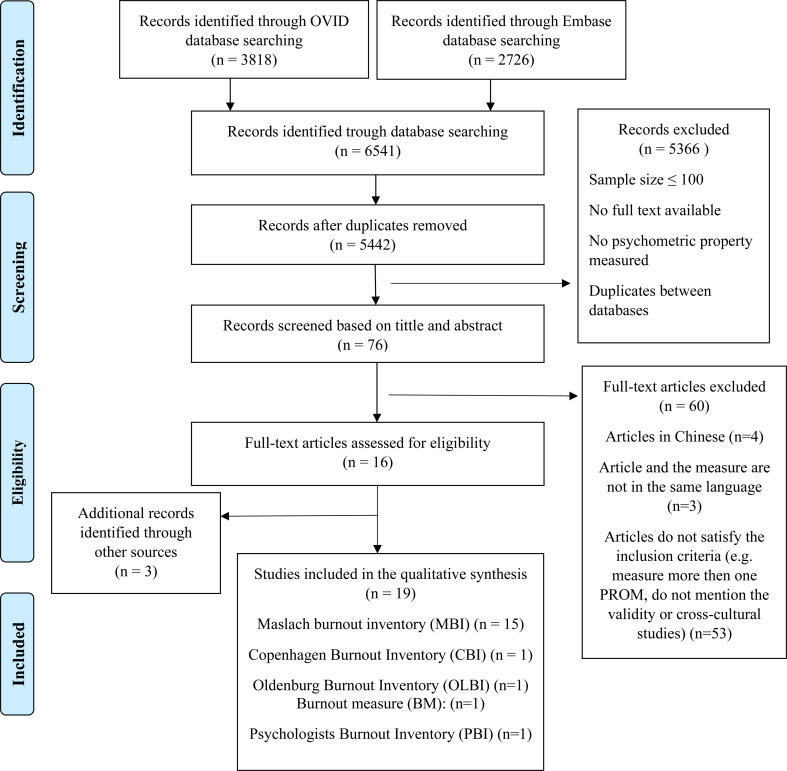
Results: We identified 6541 studies, 19 of which were included for review. Fifteen studies dealt with MBI whereas BM, PBI, OLBI and CBI were each examined in only one study. OLBI had the most complete validation, followed by CBI, MBI, BM and PBI, respectively. When examining the result interpretation correctness, the strongest disagreement was observed for MBI (27% of results), BM (25%) and CBI (17%). There was no disagreement regarding PBI and OLBI. For OLBI and CBI, the quality of evidence for sufficient content validity, the crucial psychometric property, was moderate; for MBI, BM and PBI, it was very low.
Conclusion: To be validly and reliably used in medical research and practice, PROM should exhibit robust psychometric properties. Among the five PROMs reviewed, CBI and, to a lesser extent, OLBI meet this prerequisite. The cross-cultural validity of these PROMs was beyond the scope of our work and should be addressed in the future. Moreover, the development of a diagnostic standard for OB would be helpful to assess the sensitivity and specificity of the PROMs and further reexamine their validity.The study protocol was registered in PROSPERO (CRD 42019124621).
Keywords: Occupational Burnout; Patient-Reported Outcome Measures (PROM); psychometric properties; validity.
Conflict of interest statement
None.
References
-
- Ackerley GD, Burnell J, Holder DC and Kurdek LA (1988) Burnout among licensed psychologists. Professional Psychology-Research and Practice 19, 624–631.
-
- Beaton DE, Bombardier C, Guillemin F and Ferraz MB (2000) Guidelines for the process of cross-cultural adaptation of self-report measures. Spine (Phila Pa 1976) 25, 3186–3191. - PubMed
-
- Beckstead JW (2002) Confirmatory factor analysis of the Maslach Burnout Inventory among Florida nurses. International Journal of Nursing Studies 39, 785–792. - PubMed
-
- Bianchi R (2017) Is the “burnout epidemic” an academic fiction? BMJ (Clinical research ed.) 358, j4389. - PubMed
Publication types
MeSH terms
LinkOut - more resources
Full Text Sources
Other Literature Sources
Miscellaneous
