. 2021 Jan 12;12(1):e03022-20.
doi: 10.1128/mBio.03022-20.

Do an Altered Gut Microbiota and an Associated Leaky Gut Affect COVID-19 Severity?

Affiliations

Do an Altered Gut Microbiota and an Associated Leaky Gut Affect COVID-19 Severity?

Heenam Stanley Kim. mBio. .

Abstract

Coronavirus disease 2019 (COVID-19), which has been declared a pandemic, has exhibited a wide range of severity worldwide. Although this global variation is largely affected by socio-medical situations in each country, there is also high individual-level variation attributable to elderliness and certain underlying medical conditions, including high blood pressure, diabetes, and obesity. As both elderliness and the aforementioned chronic conditions are often associated with an altered gut microbiota, resulting in disrupted gut barrier integrity, and gut symptoms have consistently been associated with more severe illness in COVID-19 patients, it is possible that dysfunction of the gut as a whole influences COVID-19 severity. This article summarizes the accumulating evidence that supports the hypothesis that an altered gut microbiota and its associated leaky gut may contribute to the onset of gastrointestinal symptoms and occasionally to additional multiorgan complications that may lead to severe illness by allowing leakage of the causative coronavirus into the circulatory system.

Keywords: COVID-19; SARS-CoV-2; coronavirus; gut barrier integrity; gut microbiota; leaky gut.


Figures

FIG 1
FIG 1
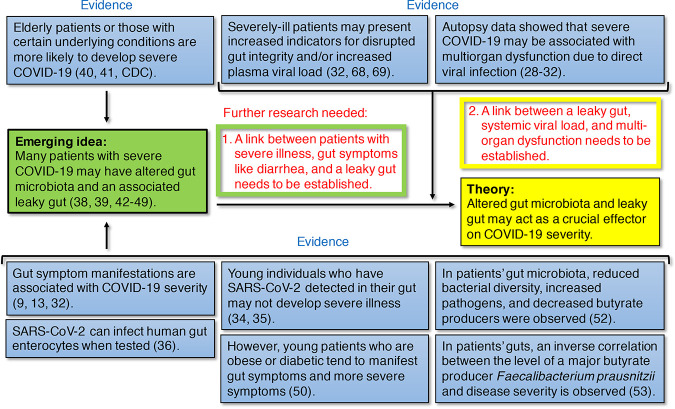
Lines of evidence supporting the hypothesis that a leaky gut affects COVID-19 severity and further studies that are needed. Current evidence supporting the emerging idea (in the green box) and evidence directly supporting the hypothesis (in the yellow box) are shown in the blue boxes with reference numbers. The ideas that are needed to be established through further research to support the emerging idea and the hypothesis are highlighted in matching green and yellow boxes, respectively.
FIG 2
FIG 2
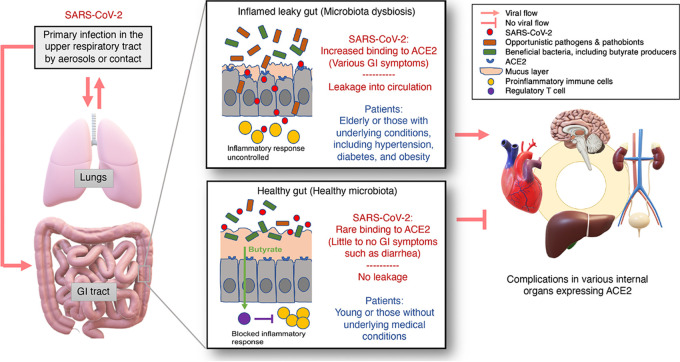
Model for COVID-19 pathogenesis leading to extrapulmonary complications. Localized infections by SARS-CoV-2 mostly begin in the respiratory system and then progress to the GI tract; they may later develop into a systemic disease, resulting in multiorgan complications. Disrupted gut barrier integrity associated with elderliness or underlying chronic conditions, such as hypertension, diabetes, and obesity, may be a crucial effector that allows the virus to gain access to ACE2 on the enterocytes and leak out of the GI tract to spread throughout the body. If SARS-CoV-2 penetrates the gut barrier, it may cause inflammation due to overly reactive immune responses that thereby further increase its leakage from the gut. Contrastingly, in a healthy GI tract with a higher number of Treg cells due to their activation by butyrate, such as in young healthy children, the virus may be contained in the GI tract and excreted in feces without posing a considerable threat to the other organs of the body.
FIG 3
FIG 3
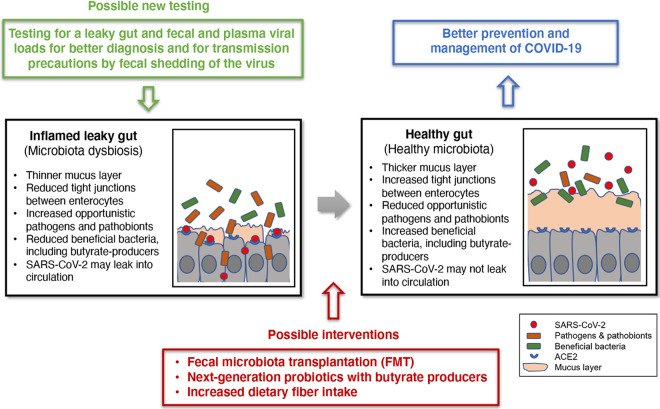
Exploiting the gut microbiota for better COVID-19 disease prevention and management. Testing for leaky gut and fecal and plasma viral loads may be used to improve diagnoses for seriously ill patients and for establishing a basis for transmission precautions from some patients who may have prolonged fecal shedding of the virus even after viral clearance in the respiratory tract. This presents the intriguing, but presently unsubstantiated, possibility that an inflamed leaky gut, which may be associated with a higher risk of severe illness, may be improved or treated via a few interventions. FMT, production of next-generation probiotics focusing on butyrate-producing gut microbes, or simply increasing the daily intake of dietary fiber may be considered in improving the gut health of COVID-19 patients.

References

    1. Fehr AR, Perlman S. 2015. Coronaviruses: an overview of their replication and pathogenesis, p 1–23. In Maier HJ, Bickerton E, Britton P (ed), Coronaviruses: methods and protocols. Springer New York, New York, NY. doi: 10.1007/978-1-4939-2438-7_1. - DOI - PMC - PubMed
    1. Zhu N, Zhang D, Wang W, Li X, Yang B, Song J, Zhao X, Huang B, Shi W, Lu R, Niu P, Zhan F, Ma X, Wang D, Xu W, Wu G, Gao GF, Tan W, China Novel Coronavirus Investigating and Research Team. 2020. A novel coronavirus from patients with pneumonia in China, 2019. N Engl J Med 382:727–733. doi: 10.1056/NEJMoa2001017. - DOI - PMC - PubMed
    1. Rabi FA, Al Zoubi MS, Kasasbeh GA, Salameh DM, Al-Nasser AD. 2020. SARS-CoV-2 and coronavirus disease 2019: what we know so far. Pathogens 9:231. doi: 10.3390/pathogens9030231. - DOI - PMC - PubMed
    1. de Wit E, van Doremalen N, Falzarano D, Munster VJ. 2016. SARS and MERS: recent insights into emerging coronaviruses. Nat Rev Microbiol 14:523–534. doi: 10.1038/nrmicro.2016.81. - DOI - PMC - PubMed
    1. Lu R, Zhao X, Li J, Niu P, Yang B, Wu H, Wang W, Song H, Huang B, Zhu N, Bi Y, Ma X, Zhan F, Wang L, Hu T, Zhou H, Hu Z, Zhou W, Zhao L, Chen J, Meng Y, Wang J, Lin Y, Yuan J, Xie Z, Ma J, Liu WJ, Wang D, Xu W, Holmes EC, Gao GF, Wu G, Chen W, Shi W, Tan W. 2020. Genomic characterisation and epidemiology of 2019 novel coronavirus: implications for virus origins and receptor binding. Lancet 395:565–574. doi: 10.1016/S0140-6736(20)30251-8. - DOI - PMC - PubMed

Publication types