Review
. 2021 Jan;6(1):e003221.
doi: 10.1136/bmjgh-2020-003221.

A systematic approach to context-mapping to prepare for health interventions: development and validation of the SETTING-tool in four countries

Collaborators, Affiliations
Review

A systematic approach to context-mapping to prepare for health interventions: development and validation of the SETTING-tool in four countries

Evelyn A Brakema et al. BMJ Glob Health. 2021 Jan.

Abstract

Effectiveness of health interventions can be substantially impaired by implementation failure. Context-driven implementation strategies are critical for successful implementation. However, there is no practical, evidence-based guidance on how to map the context in order to design context-driven strategies. Therefore, this practice paper describes the development and validation of a systematic context-mapping tool. The tool was cocreated with local end-users through a multistage approach. As proof of concept, the tool was used to map beliefs and behaviour related to chronic respiratory disease within the FRESH AIR project in Uganda, Kyrgyzstan, Vietnam and Greece. Feasibility and acceptability were evaluated using the modified Conceptual Framework for Implementation Fidelity. Effectiveness was assessed by the degree to which context-driven adjustments were made to implementation strategies of FRESH AIR health interventions. The resulting Setting-Exploration-Treasure-Trail-to-Inform-implementatioN-strateGies (SETTING-tool) consisted of six steps: (1) Coset study priorities with local stakeholders, (2) Combine a qualitative rapid assessment with a quantitative survey (a mixed-method design), (3) Use context-sensitive materials, (4) Collect data involving community researchers, (5) Analyse pragmatically and/or in-depth to ensure timely communication of findings and (6) Continuously disseminate findings to relevant stakeholders. Use of the tool proved highly feasible, acceptable and effective in each setting. To conclude, the SETTING-tool is validated to systematically map local contexts for (lung) health interventions in diverse low-resource settings. It can support policy-makers, non-governmental organisations and health workers in the design of context-driven implementation strategies. This can reduce the risk of implementation failure and the waste of resource potential. Ultimately, this could improve health outcomes.

Keywords: asthma; chronic obstructive pulmonary disease; diagnostics and tools; health policies and all other topics; public health.


Conflict of interest statement

Competing interests: None declared.

Figures
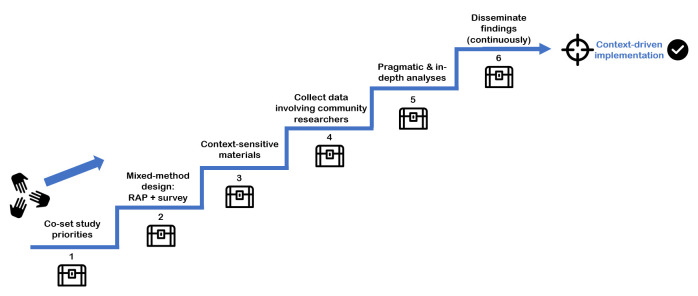
Figure 1
Figure 1
The Setting Exploration Treasure Trail to Inform implementatioN strateGies-tool; a step-by-step guide. This trail is a continuous, joint walk for researchers (those studying the context), foreseen end-users of the resulting information and other stakeholders. Certain factors, the treasures along the way, are considered to be key in successful completion of the step. RAP, rapid assessment process.
Figure 2
Figure 2
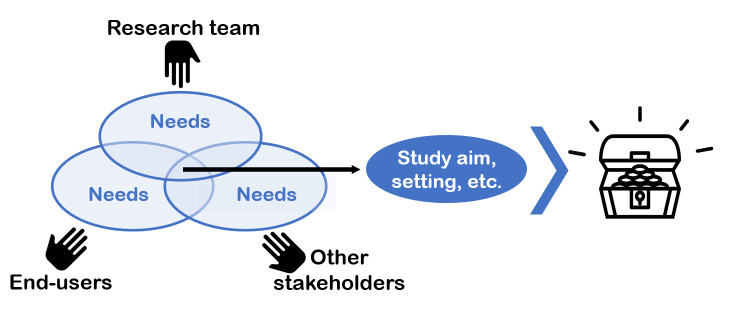
Step 1: collaboratively set the study priorities. Key to the treasure case (to successful completion of the step) is to define end-users of the study data, identify other stakeholders and actively engage all. Then explore the needs and coformulate the exact aim and scope of the context assessment, the setting and other priorities.
Figure 3
Figure 3
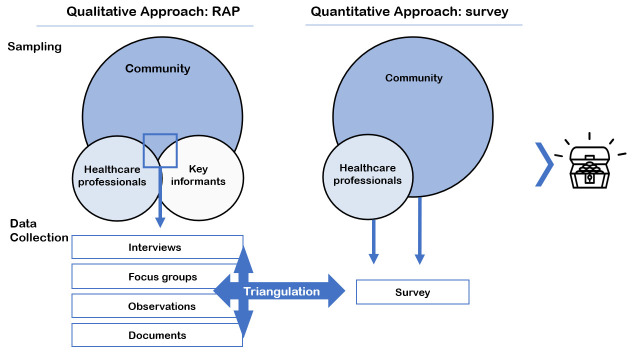
Step 2: a mixed-method study design. Key is to include (1) a qualitative rapid assessment process (RAP) in which data are collected by multiple methods, sources and researchers, and (2) a quantitative survey.
Figure 4
Figure 4
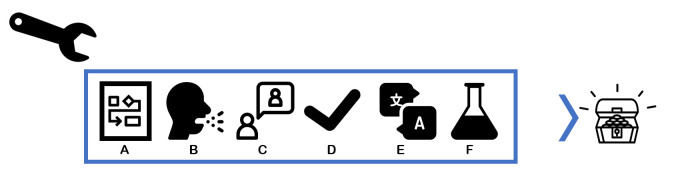
Step 3: a toolbox for creating context-sensitive materials with high validity. Key to success is to use evidence-based components where available throughout every sub-step, in our case: use (A) a theoretical framework to guide development of the materials, (B) a syndromic approach for expected low awareness of the phenomenon studied, (C) a vignette to avoid stigmatisation or address sensitive topics, (D) validated questionnaires, (E) a careful translation process and (F) pilot-testing of the materials.
Figure 5
Figure 5
Step 4: collect data involving community researchers, who are trusted by their community and have a thorough understanding of local networks and local health beliefs and behaviours. Key to the treasure case is the combination of local researchers with an insiders’ perspective, with researchers with an external perspective.
Figure 6
Figure 6
Step 5: decide to analyse the data pragmatically and/or in-depth, depending on the objective; key to success is timely informing the implementation design for related health interventions, which may have to be supplemented by more in-depth analyses for scientific purposes.
Figure 7
Figure 7
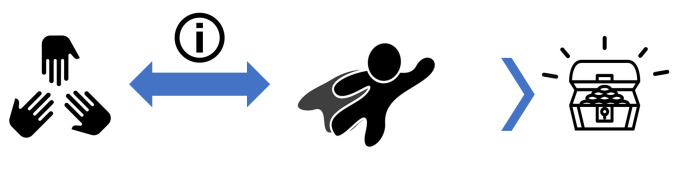
Step 6: continuous communication between the research team, end-users, and other stakeholders by a tailored message and delivery method ensures that findings will be received and used.

References

    1. Grimshaw JM, Eccles MP, Lavis JN, et al. . Knowledge translation of research findings. Implement Sci 2012;7:50. 10.1186/1748-5908-7-50 - DOI - PMC - PubMed
    1. Durlak JA, DuPre EP. Implementation matters: a review of research on the influence of implementation on program outcomes and the factors affecting implementation. Am J Community Psychol 2008;41:327–50. 10.1007/s10464-008-9165-0 - DOI - PubMed
    1. Peters DH, Adam T, Alonge O, et al. . Implementation research: what it is and how to do it. BMJ 2013;347:f6753. 10.1136/bmj.f6753 - DOI - PubMed
    1. Morris ZS, Wooding S, Grant J. The answer is 17 years, what is the question: understanding time lags in translational research. J R Soc Med 2011;104:510–20. 10.1258/jrsm.2011.110180 - DOI - PMC - PubMed
    1. Brakema EA, Vermond D, Pinnock H, et al. . Implementing lung health interventions in low- and middle-income countries: a fresh air systematic review and meta-synthesis. Eur Respir J 2020;56. 10.1183/13993003.00127-2020. [Epub ahead of print: 23 07 2020]. - DOI - PMC - PubMed

Publication types

LinkOut - more resources