Review
. 2021 Jan 13;6(1):16.
doi: 10.1038/s41392-020-00421-2.

Targeting ubiquitin signaling for cancer immunotherapy

Affiliations
Review

Targeting ubiquitin signaling for cancer immunotherapy

Xiaofei Zhou et al. Signal Transduct Target Ther. .

Abstract

Cancer immunotherapy has become an attractive approach of cancer treatment with tremendous success in treating various advanced malignancies. The development and clinical application of immune checkpoint inhibitors represent one of the most extraordinary accomplishments in cancer immunotherapy. In addition, considerable progress is being made in understanding the mechanism of antitumor immunity and characterizing novel targets for developing additional therapeutic approaches. One active area of investigation is protein ubiquitination, a post-translational mechanism of protein modification that regulates the function of diverse immune cells in antitumor immunity. Accumulating studies suggest that E3 ubiquitin ligases and deubiquitinases form a family of potential targets to be exploited for enhancing antitumor immunity in cancer immunotherapy.


Conflict of interest statement

The authors declare that they have no competing interests.

Figures
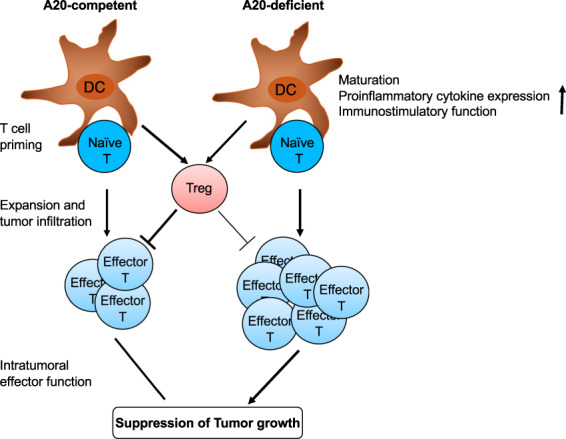
Fig. 1
Fig. 1
A20 knockdown or knockout in DCs promotes T cell activation and antitumor immunity. DCs with A20 knockdown or knockout display enhanced maturation, proinflammatory cytokine expression and T cell-stimulatory function. A20-silenced DCs are much more potent than wildtype DCs in promoting antitumor T cell responses and suppressing tumor growth
Fig. 2
Fig. 2
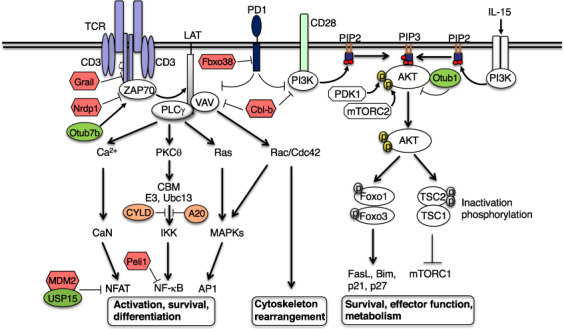
Regulation of T cell signaling by E3 ligases and DUBs. Grail and Cbl-b mediate ubiquitin-dependent degradation of TCR ζ chain and upstream signaling factors, VAV and PI3K, to negatively regulate TCR and CD28 signaling. Non-degradative ubiquitination of ZAP70, a negative mechanism of its regulation, is catalyzed by the E3 Nrdp1 and counteracted by the DUB Otud7b. MDM2 and Peli1 mediates ubiquitin-dependent degradation of NFAT1 and NF-kB c-Rel, respectively, to control these downstream pathways. The DUB USP15 stabilizes MDM2 in activated T cells and functions together with MDM2 in NFAT1 regulation. The CBM complex, composed of CARMA1, BCL10, and MALT1, associates with the K63-specific E2 Ubc13 and an E3 and catalyze K63 ubiquitination required for activation of IKK. This signaling step is negatively regulated by the DUBs CYLD and A20. The DUB Otub1 inhibits K63 ubiquitination and activation of AKT and controls a major metabolic signaling pathway of T cells. E3 ligase Fbxo38 mediates ubiquitin-dependent degradation of the coinhibitory receptor PD1, thereby promoting T cell responses in cancer immunity
Fig. 3
Fig. 3
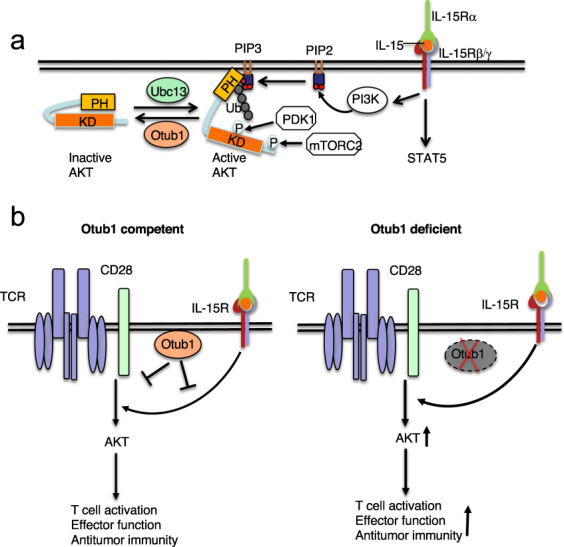
Otub1 serves as a checkpoint of IL-15-mediated CD8 T cell priming by deubiquitination of AKT. a, IL-15 stimulates PI3K activation and AKT K63 ubiquitination, both being required for AKT activation. AKT ubiquitination facilitates its binding to PIP3, probably through a conformational change leading to exposure of the PH domain of AKT, which recruits AKT to the membrane compartment, where AKT is phosphorylated and activated by the kinases PDK1 and mTORC2. Otub1 negatively regulates AKT activation through inhibiting its ubiquitination. b, IL-15 signal primes CD8 T cells for antigen stimulation, which is controlled by Otub1. In response to IL-15 stimulation, Otub1 is recruited to the membrane compartment, where it inhibits AKT activation induced by both IL-15 and TCR/CD28 signals. Otub1 thus functions as a checkpoint molecule regulating IL-15-mediated CD8 T cell priming. Deficiency in Otub1 causes increased AKT signaling and enhanced CD8 T cell responses in cancer immunity
Fig. 4
Fig. 4
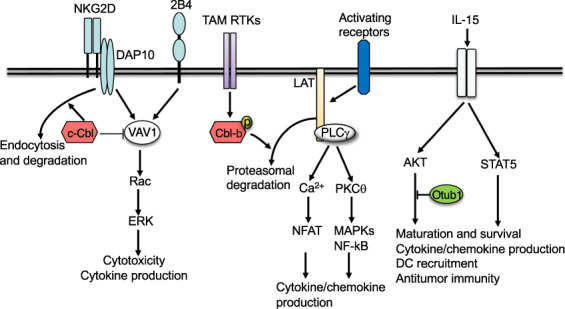
Regulation of NK cell activation by ubiquitination. Cbl-b is an E3 that mediates the inhibitory function of TAM family of receptor tyrosine kinases (RTKs). Upon activation by their ligands, TAM RTKs phosphorylate and activate Cbl-b, which mediates ubiquitin-dependent degradation of a key signaling adapter, LAT, thereby inhibiting activation of several signaling pathways involved in the induction of cytokines and chemokines. Another E3, c-Cbl, negatively regulates NK cell activation by two stimulatory receptors, NKG2D and 2B4, which involves inhibition of VAV1 via non-degradative ubiquitination and ubiquitin-dependent NKG2D endocytosis and degradation. The DUB Otub1 negatively regulates NK cell maturation, chemokine production, and antitumor functions by negatively regulating IL-15-stimulated AKT signaling
Fig. 5
Fig. 5
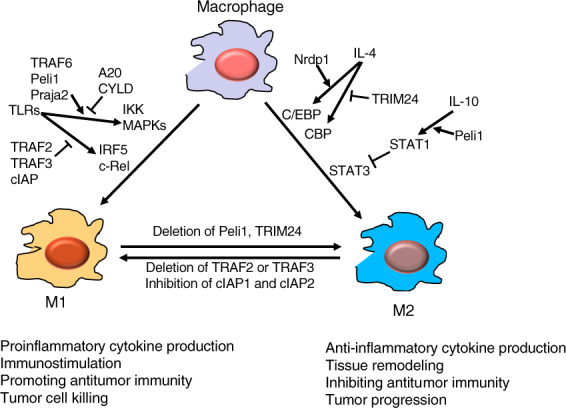
Regulation of macrophage activation and polarization by ubiquitination. E3 ligases TRAF, Peli1, and Praja2 promote TLR-stimulated proinflammatory cytokine expression and M1 polarization of macrophages, which is opposed by the DUBs A20 and CYLD. TRAF2, TRAF3, and cIAP form an E3 complex mediating ubiquitin-dependent degradation of IRF5 and c-Rel, transcription factors mediating induction of proinflammatory cytokine genes and M1 differentiation. E3 ligase Nrdp1 promotes IL-4-induced M2 gene expression by mediating K63 ubiquitination and activation of the transcription factor C/EBPβ. TRIM24 inhibits M2 differentiation through ubiquitinating the acetyltransferase CBP, a mechanism that facilitating CBP-mediated acetylation and attenuation of the M2-promoting transcription factor STAT6. In addition to its M1-promoting function, Peli1 negatively regulates IL-10-induced M2 differentiation. In this function, Peli1 ubiquitinates IRAK1 to trigger its function in activating STAT1, which in turn counteracts the M2-stimulated function of STAT3

References

    1. Gotwals P, et al. Prospects for combining targeted and conventional cancer therapy with immunotherapy. Nat. Rev. Cancer. 2017;17:286–301. doi: 10.1038/nrc.2017.17. - DOI - PubMed
    1. Sharma P, Allison JP. Immune checkpoint targeting in cancer therapy: toward combination strategies with curative potential. Cell. 2015;161:205–214. doi: 10.1016/j.cell.2015.03.030. - DOI - PMC - PubMed
    1. Sun SC. Deubiquitylation and regulation of the immune response. Nat. Rev. Immunol. 2008;8:501–511. doi: 10.1038/nri2337. - DOI - PMC - PubMed
    1. Hershko A, Ciechanover A. The ubiquitin system. Annu. Rev. Biochem. 1998;67:425–479. doi: 10.1146/annurev.biochem.67.1.425. - DOI - PubMed
    1. Hu H, Sun SC. Ubiquitin signaling in immune responses. Cell Res. 2016;26:457–483. doi: 10.1038/cr.2016.40. - DOI - PMC - PubMed

Publication types

MeSH terms