


Tumor microenvironment: an evil nexus promoting aggressive head and neck squamous cell carcinoma and avenue for targeted therapy
- PMID: 33436555
- PMCID: PMC7804459
- DOI: 10.1038/s41392-020-00419-w
Tumor microenvironment: an evil nexus promoting aggressive head and neck squamous cell carcinoma and avenue for targeted therapy
Erratum in
-
Correction: Tumor microenvironment: an evil nexus promoting aggressive head and neck squamous cell carcinoma and avenue for targeted therapy.Signal Transduct Target Ther. 2021 Feb 26;6(1):93. doi: 10.1038/s41392-021-00503-9. Signal Transduct Target Ther. 2021. PMID: 33637674 Free PMC article. No abstract available.
Abstract
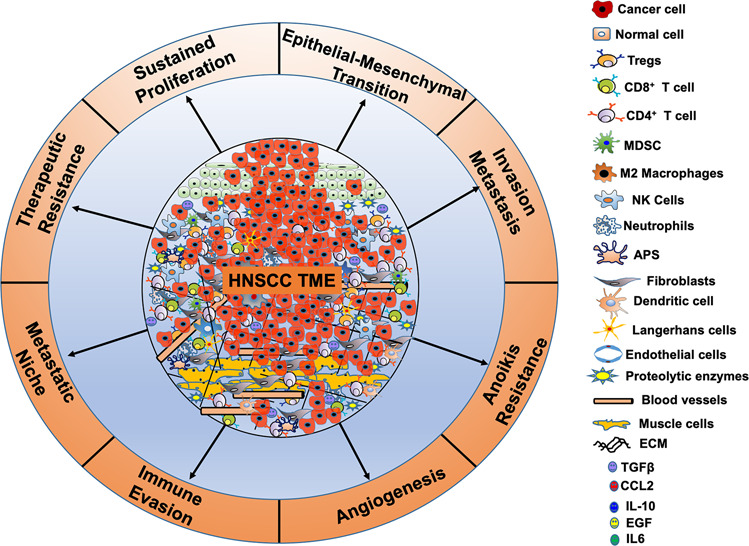
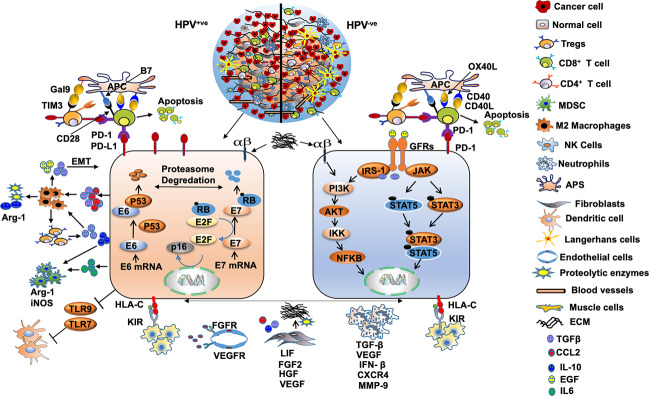
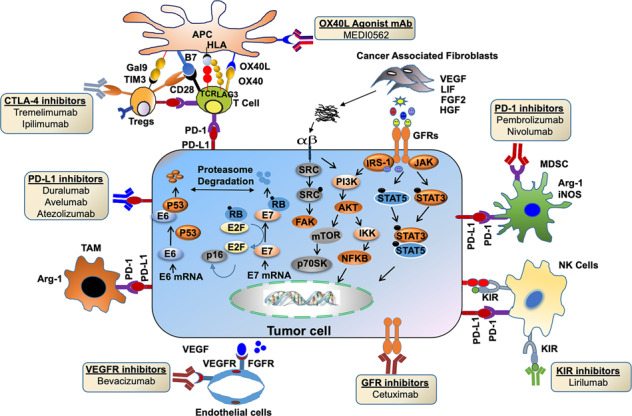
Head and neck squamous cell carcinoma (HNSCC) is a very aggressive disease with a poor prognosis for advanced-stage tumors. Recent clinical, genomic, and cellular studies have revealed the highly heterogeneous and immunosuppressive nature of HNSCC. Despite significant advances in multimodal therapeutic interventions, failure to cure and recurrence are common and account for most deaths. It is becoming increasingly apparent that tumor microenvironment (TME) plays a critical role in HNSCC tumorigenesis, promotes the evolution of aggressive tumors and resistance to therapy, and thereby adversely affects the prognosis. A complete understanding of the TME factors, together with the highly complex tumor-stromal interactions, can lead to new therapeutic interventions in HNSCC. Interestingly, different molecular and immune landscapes between HPV+ve and HPV-ve (human papillomavirus) HNSCC tumors offer new opportunities for developing individualized, targeted chemoimmunotherapy (CIT) regimen. This review highlights the current understanding of the complexity between HPV+ve and HPV-ve HNSCC TME and various tumor-stromal cross-talk modulating processes, including epithelial-mesenchymal transition (EMT), anoikis resistance, angiogenesis, immune surveillance, metastatic niche, therapeutic resistance, and development of an aggressive tumor phenotype. Furthermore, we summarize the recent developments and the rationale behind CIT strategies and their clinical applications in HPV+ve and HPV-ve HNSCC.
Conflict of interest statement
The authors declare no competing interests.
Figures
References
-
- Fitzmaurice C, et al. Global, regional, and national cancer incidence, mortality, years of life lost, years lived with disability, and disability-adjusted life-years for 32 cancer groups, 1990 to 2015: a systematic analysis for the global burden of disease study. JAMA Oncol. 2017;3:524–548. doi: 10.1001/jamaoncol.2017.1747. - DOI - PMC - PubMed
-
- Ghantous Y, Abu Elnaaj I. Global incidence and risk factors of oral cancer. Harefuah. 2017;156:645–649. - PubMed
-
- Bray F, et al. Global cancer statistics 2018: GLOBOCAN estimates of incidence and mortality worldwide for 36 cancers in 185 countries. CA: Cancer J. Clin. 2018;68:394–424. - PubMed
Publication types
MeSH terms
LinkOut - more resources
Full Text Sources
Other Literature Sources
Medical
