


Succumbing to the COVID-19 Pandemic-Healthcare Workers Not Satisfied and Intend to Leave Their Jobs
- PMID: 33437225
- PMCID: PMC7790354
- DOI: 10.1007/s11469-020-00418-6
Succumbing to the COVID-19 Pandemic-Healthcare Workers Not Satisfied and Intend to Leave Their Jobs
Erratum in
-
Correction to: Succumbing to the COVID-19 Pandemic-Healthcare Workers Not Satisfied and Intend to Leave Their Jobs.Int J Ment Health Addict. 2022;20(4):2115. doi: 10.1007/s11469-021-00502-5. Epub 2021 Mar 1. Int J Ment Health Addict. 2022. PMID: 33679270 Free PMC article.
Abstract
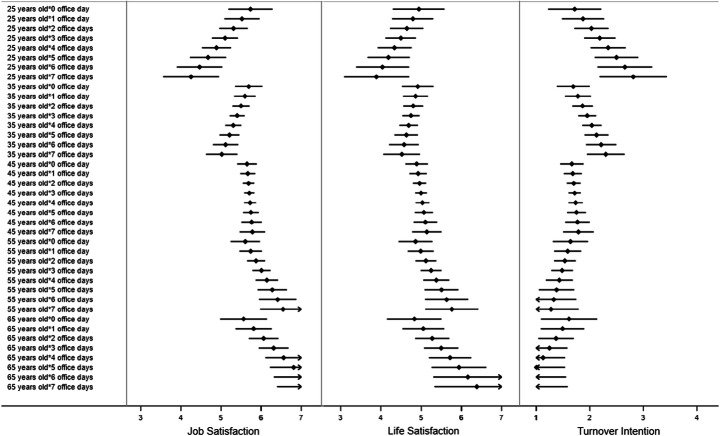
Healthcare workers are under such a tremendous amount of pressure during the COVID-19 pandemic that many have become concerned about their jobs and even intend to leave them. It is paramount for healthcare workers to feel satisfied with their jobs and lives during a pandemic. This study aims to examine the predictors of job satisfaction, life satisfaction, and turnover intention of healthcare workers during the COVID-19 pandemic. Between 10 and 30 April 2020, 240 healthcare workers in Bolivia completed a cross-sectional online survey, which assessed their job satisfaction, life satisfaction, and turnover intention in the ongoing COVID-19 pandemic. The results revealed that their number of office days predicted job satisfaction, life satisfaction, and turnover intention, but the relationships varied by their age. For example, healthcare workers' office days negatively predicted job satisfaction for the young (e.g., at 25 years old: b = - 0.21; 95% CI: - 0.36 to - 0.60) but positively predicted job satisfaction for the old (e.g., at 65 years old: b = 0.25; 95% CI: 0.06 to 0.44). These findings provide evidence to enable healthcare organizations to identify staff concerned about job satisfaction, life satisfaction, and turnover intention to enable early actions so that these staffs can remain motivated to fight the prolonged COVID-19 pandemic.
Keywords: 2019-nCoV; Coronavirus; Latin America; Occupational well-being; Risk factors.
© Springer Science+Business Media, LLC, part of Springer Nature 2021.
Conflict of interest statement
Conflict of InterestThe authors declare that there are no potential conflicts of interest with respect to the research, authorship, and/or publication of this article.
Figures
References
-
- Alvarez-Risco A, Mejia CR, Delgado-Zegarra J, Del-Aguila-Arcentales S, Arce-Esquivel AA, Valladares-Garrido MJ, et al. The Peru approach against the COVID-19 infodemic: Insights and strategies. The American Journal of Tropical Medicine and Hygiene. 2020;103(2):583–586. doi: 10.4269/ajtmh.20-0536. - DOI - PMC - PubMed
-
- Arigho-Stiles O. (2020). Covid-19 in Bolivia fuels political crisis. Discover Society. https://discoversociety.org/2020/04/03/covid-19-in-bolivia-fuels-politic.... Accessed 3 Jul 2020.
-
- Brayfield AH, Rothe HF. An index of job satisfaction. Journal of Applied Psychology. 1951;35:307–311. doi: 10.1037/h0055617. - DOI
-
- Cammann, C., Fichman, M., Jenkins, D., & Klesh, J. (1979). The Michigan Organizational Assessment Questionnaire. Unpublished manuscript. University of Michigan, Ann Arbor.
-
- Chen X, Zhang SX, Jahanshahi AA, Alvarez-Risco A, Dai H, Li J, Ibarra VG. Belief in a COVID-19 conspiracy theory as a predictor of mental health and well-being of health care workers in Ecuador: Cross-sectional survey study. JMIR Public Health and Surveillance. 2020;6(3):e20737. doi: 10.2196/20737. - DOI - PMC - PubMed
LinkOut - more resources
Full Text Sources
Other Literature Sources
Miscellaneous