


Neutrophil-to-Lymphocyte Ratio as an Alternative Marker of Neonatal Sepsis in Developing Countries
- PMID: 33437537
- PMCID: PMC7786268
- DOI: 10.5001/omj.2021.05
Neutrophil-to-Lymphocyte Ratio as an Alternative Marker of Neonatal Sepsis in Developing Countries
Abstract
Objectives: We sought to analyze the neutrophil-to-lymphocyte ratio (NLR) as an alternative marker of neonatal sepsis.
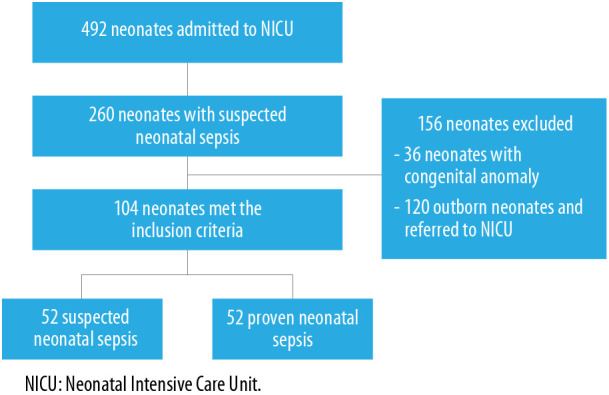
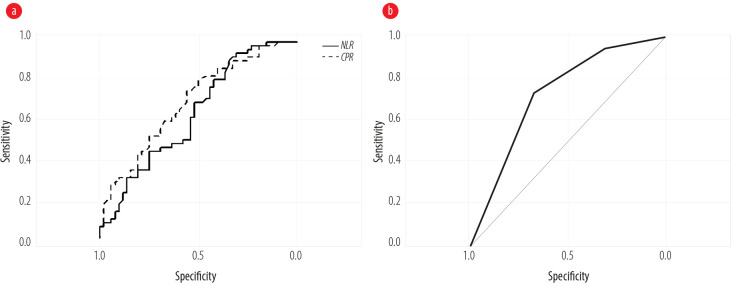
Methods: In this cross-sectional study, we undertook consecutive sampling in all inborn neonates admitted to the Neonatal Intensive Care Unit with clinical manifestations of neonatal sepsis. Neonates with congenital anomalies and referred neonates were excluded. Complete blood count, C-reactive protein (CRP), and blood culture were carried out as the septic workup examinations based on the local Clinical Practical Guidelines. NLR is obtained by dividing the absolute count of neutrophils from lymphocytes manually. A cut-off value of NLR is obtained using a receiver operating characteristic curve.
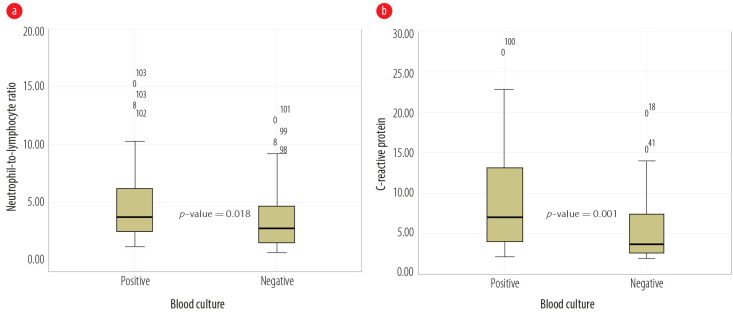
Results: The median NLR value of the 104 neonates who met the inclusion and exclusion criteria was 3.63 (2.39-6.12). Neonates with NLR of 2.12 have the area under the curve of 0.630 (95% confidence interval (CI): 0.528-0.741) and 0.725 (95% CI: 0.636-0.814) when combined with CRP = 2.70 mg/dL. Neonates with NLR ≥ 2.12 in clinical neotnatal sepsis had almost double the risk of providing positive blood culture results (relative risk = 1.867, 95% CI: 1.077-3.235; p = 0.011).
Conclusions: NLR, calculated from complete blood count, can be used as an alternative marker of easy and relatively inexpensive neonatal sepsis, especially in developing countries, and detection of proven neonatal sepsis to be better when combined with CRP.
Keywords: C-Reactive Protein; Infant, Newborn; Intensive Care Units, Neonatal; Lymphocytes; Neonatal Sepsis; Neutrophils.
The OMJ is Published Bimonthly and Copyrighted 2021 by the OMSB.
Figures
References
-
- Hasibuan BS. Comparison of microbial pattern in early and late onset neonatal sepsis in referral center Haji Adam Malik hospital Medan Indonesia. IOP Conf Ser Earth Enviromental Sci 2018;125(1):012053.
-
- Edwards MS, Baker CJ. Sepsis in the newborn. In: Gershon A, Hotez P, Katz S, editors. Krugman’s Infectious Disease of Children. 11th ed. Philadelphia, 2003. p. 545–563.
-
- Bany-Mohammed F. Sepsis. In: Gomella TL, Cunningham MD, Eyal FG, editors. Neonatology : management, procedures, on-call problems, disesase and drugs. 7th ed. New York, 2013. p. 865-874.
LinkOut - more resources
Full Text Sources
Research Materials
Miscellaneous