


Defining disease progression in Chinese mainland people: Association between bone mineral density and knee osteoarthritis
- PMID: 33437621
- PMCID: PMC7773972
- DOI: 10.1016/j.jot.2020.07.006
Defining disease progression in Chinese mainland people: Association between bone mineral density and knee osteoarthritis
Abstract
Objective: To evaluate change in bone mineral density (BMD) during development of knee osteoarthritis (OA) in elderly Chinese community residents. Further, to monitor disease progression by recording speed of sound (SOS), one parameter of BMD provided by quantitative ultrasound measurement.
Methods: A total of 4173 community residents of the Chinese mainland were organized to complete questionnaires and relevant measurements, including anthropometry, radiology and quantitative ultrasound (QUS). SOS measurements of the distal radius were acquired using QUS measurements. The Kellgren-Lawrence (KL) grade of knee OA was evaluated by two experienced radiographers using X-rays. Finally, a general linear models analysis was performed to determine potential relationships. Further, the area under the receiver operating characteristic curve (ROC AUC) was applied to assess the distinction model.
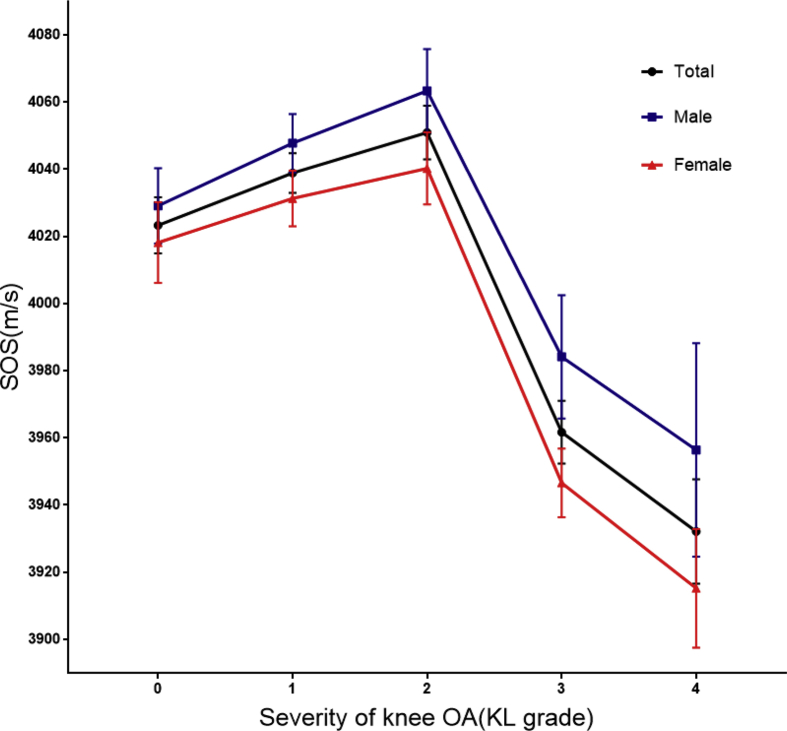
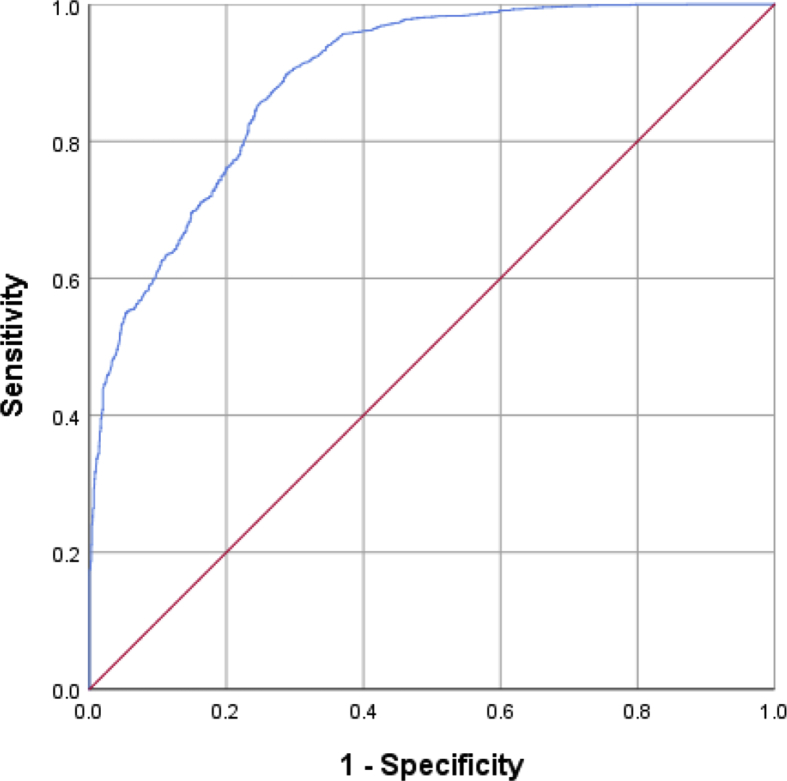
Results: The SOS score in the OA group was significantly lower than that in the control group (p < 0.001). However, after adjustment for age and body mass index (BMI), no significant difference was observed in the male population (p = 0.841), while a significantly lower SOS score presented in knee OA participants in the female population (p = 0.033). A turning point in SOS scores, from increasing to decreasing trends, occurred around KL grade 2; the SOS score gradually increased with progression in participants from KL grades 0 to 2, whereas the SOS score presented a significant decrease in participants with KL grades 3 and 4. The AUC for the model to distinguish OA progression was 0.891.
Conclusion: There was a non-linear and stage-specific association between SOS score and knee OA, which presented a positive relationship in early stages, but a negative relationship in advanced stages. A decline of SOS score in knee OA patients in early stages should alert clinicians to the possibility of disease progression.
The translational potential of this article: In the present study, the relationship between OA and BMD had established by SOS. The results suggested that close monitoring of SOS in elderly Chinese communities residents with knee OA could alert disease progression involvement by an easily accessible method, and help early referral to orthopedist consultation for further examination and treatment.
Keywords: Age; Body mass index; Bone mineral density; Osteoarthritis; Speed of sound.
© 2020 The Author(s).
Conflict of interest statement
The authors have no conflicts of interest to disclose in relation to this article.
Figures
References
-
- Glyn-Jones S., Palmer A.J., Agricola R., Price A.J., Vincent T.L., Weinans H. Osteoarthritis Lancet. 2015;386(9991):376–387. - PubMed
-
- Ondrésik M., Azevedo Maia F.R., da Silva Morais A., Gertrudes A.C., Dias Bacelar A.H., Correia C. Management of knee osteoarthritis. Current status and future trends. Biotechnol Bioeng. 2017;114(4):717–739. - PubMed
-
- Herrero-Beaumont G., Roman-Blas J.A., Largo R., Berenbaum F., Castañeda S. Bone mineral density and joint cartilage: four clinical settings of a complex relationship in osteoarthritis. Ann Rheum Dis. 2011;70(9):1523–1525. - PubMed
LinkOut - more resources
Full Text Sources
Other Literature Sources
Research Materials
