Review
. 2021 Feb 26;49(1):281-295.
doi: 10.1042/BST20200568.

Antivirals that target the host IMPα/β1-virus interface

Affiliations
Review

Antivirals that target the host IMPα/β1-virus interface

Alexander J Martin et al. Biochem Soc Trans. .

Abstract

Although transport into the nucleus mediated by the importin (IMP) α/β1-heterodimer is central to viral infection, small molecule inhibitors of IMPα/β1-dependent nuclear import have only been described and shown to have antiviral activity in the last decade. Their robust antiviral activity is due to the strong reliance of many different viruses, including RNA viruses such as human immunodeficiency virus-1 (HIV-1), dengue (DENV), and Zika (ZIKV), on the IMPα/β1-virus interface. High-throughput compound screens have identified many agents that specifically target this interface. Of these, agents targeting IMPα/β1 directly include the FDA-approved macrocyclic lactone ivermectin, which has documented broad-spectrum activity against a whole range of viruses, including HIV-1, DENV1-4, ZIKV, West Nile virus (WNV), Venezuelan equine encephalitis virus, chikungunya, and most recently, SARS-CoV-2 (COVID-19). Ivermectin has thus far been tested in Phase III human clinical trials for DENV, while there are currently close to 80 trials in progress worldwide for SARS-CoV-2; preliminary results for randomised clinical trials (RCTs) as well as observational/retrospective studies are consistent with ivermectin affording clinical benefit. Agents that target the viral component of the IMPα/β1-virus interface include N-(4-hydroxyphenyl) retinamide (4-HPR), which specifically targets DENV/ZIKV/WNV non-structural protein 5 (NS5). 4-HPR has been shown to be a potent inhibitor of infection by DENV1-4, including in an antibody-dependent enhanced animal challenge model, as well as ZIKV, with Phase II clinical challenge trials planned. The results from rigorous RCTs will help determine the therapeutic potential of the IMPα/β1-virus interface as a target for antiviral development.

Keywords: SARS-CoV-2; Zika virus; antiviral agents; dengue virus; importin; ivermectin.


Conflict of interest statement

D.A.J. is an inventor on a patent application for the use of ivermectin for coronavirus infection, and a patent on the use of 4-HPR in flavivirus infection. A.J.M. declares no competing interests.

Figures
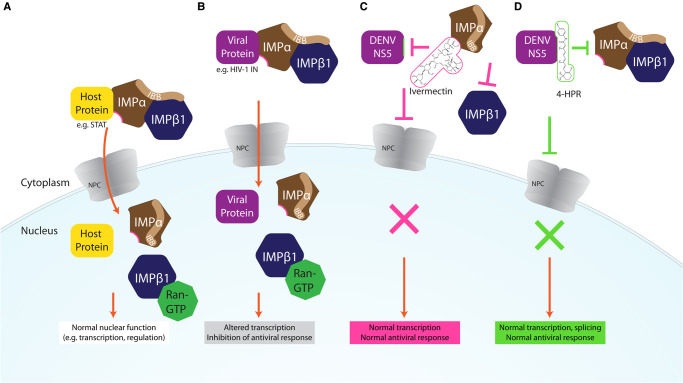
Figure 1.
Figure 1.. Schematic representation of the host IMPα/β1-dependent nuclear import pathway (A), showing how it is co-opted by viral proteins in viral infection (B), and how small molecule antivirals can impact the pathway (C,D).
(A) Host proteins (e.g. transcription factor STAT-2) contain nuclear localisation signals which are recognised by IMPα (brown), after the autoinhibitory IMPβ-binding (IBB) domain of IMPα binds IMPβ1, forming the IMPα/β heterodimer. This complex is then translocated across the nuclear pore complex (NPC), and the cargo is released after the binding of Ran-GTP to IMPβ1 dissociates the complex. The cargo can then carry out its normal nuclear function, such as transcriptional regulation of the antiviral response. (B) During viral infection, specific NLS-containing viral proteins (e.g. HIV-1 IN, purple) are imported into the nucleus by the same IMPα/β1 dependent mechanism, where they can interfere with normal cellular functions, such as altering transcription to antagonise the antiviral response in order to maximise the rate of virus production. (C) Ivermectin (pink) binds IMPα, dissociating the IMPα/β1 heterodimer and preventing binding to its viral (as well as host) protein target(s), thereby preventing its nuclear import and downstream transcriptional effects. (D) 4-HPR (green) specifically binds viral protein DENV2 NS5, preventing binding of the IMPα/β1 and nuclear import, and associated downstream effects on transcription and splicing.
Figure 2.
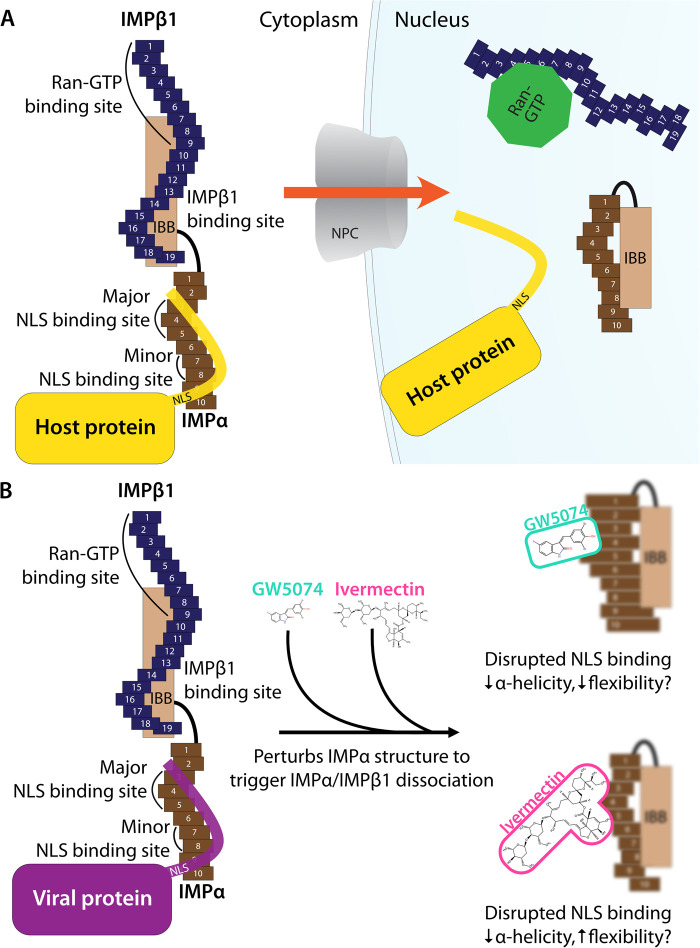
Figure 2.. Schematic representation of IMPα and IMPβ1 structural/functional domains; impact of inhibitors.
(A) Schematic representation of the IMPα/β1 complex based on the crystal structures of human IMPα and IMPβ1. IMPα comprises 10 armadillo (ARM) repeats and an IMPβ-binding (IBB) domain. IMPα ARM repeats 2–4 form the major cargo NLS binding site, while ARM 7–8 form the minor NLS binding site. IMPβ1 comprises 19 HEAT repeats, where repeats 7–19 bind the IMPα IBB domain, and Ran-GTP binds to the N-terminus/repeat 8. In the cytoplasm, IMPβ1 (blue) binds IMPα (brown) via the IBB domain, exposing the major NLS binding site for cargo protein (yellow) binding. After transport into the nucleus across the NPC, Ran-GTP binds to IMPβ1, altering its conformation and displacing and releasing the IBB domain, which then binds the NLS binding sites in an autoinhibitory manner, preventing NLS binding. (B) Ivermectin and GW5074 bind directly to IMPα to perturb its structural integrity as confirmed by biophysical measurements including circular dichroism, thermostability analysis, and analytical ultracentrifugation [44,47], to reduce IMPα-helicity/impact flexibility, and thereby prevent IMPα binding to NLS-containing proteins or IMPβ1.

References

    1. Aguzzi, A. and Altmeyer, M. (2016) Phase separation: linking cellular compartmentalization to disease. Trends Cell Biol. 26, 547–558 10.1016/j.tcb.2016.03.004 - DOI - PubMed
    1. Poon, I.K.H. and Jans, D.A. (2005) Regulation of nuclear transport: central role in development and transformation? Traffic (Copenhagen, Denmark) 6, 173–186 10.1111/j.1600-0854.2005.00268.x - DOI - PubMed
    1. Fulcher, A.J. and Jans, D.A. (2011) Regulation of nucleocytoplasmic trafficking of viral proteins: an integral role in pathogenesis? Biochim. Biophys. Acta 1813. 2176–2190 10.1016/j.bbamcr.2011.03.019 - DOI - PMC - PubMed
    1. Caly, L., Wagstaff, K.M. and Jans, D.A. (2012) Nuclear trafficking of proteins from RNA viruses: potential target for antivirals? Antivir. Res. 95, 202–206 10.1016/j.antiviral.2012.06.008 - DOI - PubMed
    1. Fried, H. and Kutay, U. (2003) Nucleocytoplasmic transport: taking an inventory. Cell Mol. Life Sci. 60, 1659–1688 10.1007/s00018-003-3070-3 - DOI - PMC - PubMed

Publication types

MeSH terms