


Baseline Characteristics from the Women Veterans Cohort Study: Gender Differences and Similarities in Health and Healthcare Utilization
- PMID: 33439756
- PMCID: PMC8290312
- DOI: 10.1089/jwh.2020.8732
Baseline Characteristics from the Women Veterans Cohort Study: Gender Differences and Similarities in Health and Healthcare Utilization
Erratum in
-
Correction to: Baseline Characteristics from the Women Veterans Cohort Study: Gender Differences and Similarities in Health and Healthcare Utilization by Gaffey, et al. J Women's Health 2020;30(7):944-955; doi: 10.1089/jwh.2020.8732.J Womens Health (Larchmt). 2023 Sep;32(9):1021. doi: 10.1089/jwh.2020.8732.correx. J Womens Health (Larchmt). 2023. PMID: 37672555 Free PMC article. No abstract available.
Abstract
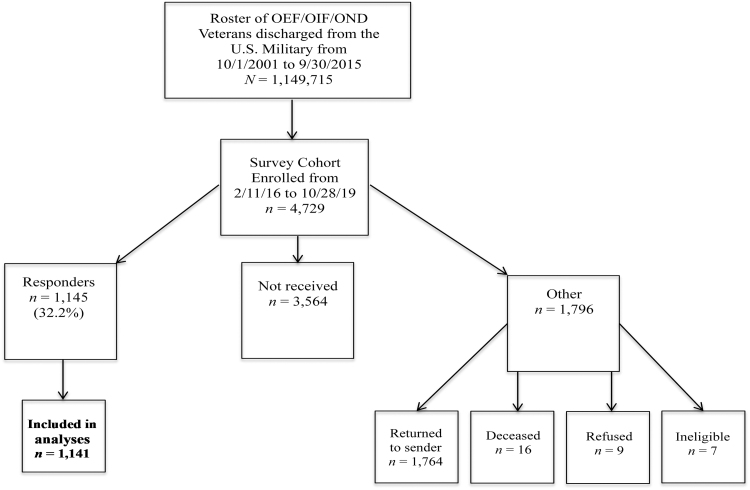
Introduction: With the unprecedented expansion of women's roles in the U.S. military during recent (post-9/11) conflicts in Iraq and Afghanistan, the number of women seeking healthcare through the Veterans Health Administration (VHA) has increased substantially. Women Veterans often present as medically complex due to multiple medical, mental health, and psychosocial comorbidities, and consequently may be underserved. Thus, we conducted the nationwide Women Veterans Cohort Study (WVCS) to examine post-9/11 Veterans' unique healthcare needs and to identify potential disparities in health outcomes and care. Methods: We present baseline data from a comprehensive questionnaire battery that was administered from 2016 to 2019 to a national sample of post-9/11 men and women Veterans who enrolled in Veterans Affairs care (WVCS2). Data were analyzed for descriptives and to compare characteristics by gender, including demographics; health risk factors and symptoms of cardiovascular disease, chronic pain, and mental health; healthcare utilization, access, and insurance. Results: WVCS2 included 1,141 Veterans (51% women). Women were younger, more diverse, and with higher educational attainment than men. Women also endorsed lower traditional cardiovascular risk factors and comorbidities (e.g., weight, hypertension) and greater nontraditional cardiovascular risk factors (e.g., trauma, psychological symptoms). More women reported single-site pain (e.g., neck, stomach, pelvic) and multisite pain, but did not differ from men in posttraumatic stress disorder (PTSD) symptoms or treatment for PTSD. Women seek care at VHA medical centers more frequently, often combined with outside health services, but do not significantly differ from men in their insurance coverage. Conclusion: Overall, this investigation indicates substantial variation in risk factors, health outcomes, and healthcare utilization among post-9/11 men and women Veterans. Further research is needed to determine best practices for managing women Veterans in the VHA healthcare system.
Keywords: Veterans; cardiovascular health; gender differences; mental health; pain; risk factors.
Conflict of interest statement
No competing financial interests exist.
Figures
Comment in
-
Understanding Sex Differences in Health and Health Care Utilization Among Veterans Can Help Guide Future Veterans Administration Health Care Planning and Policy.J Womens Health (Larchmt). 2021 Jul;30(7):916-917. doi: 10.1089/jwh.2020.9009. Epub 2021 Feb 23. J Womens Health (Larchmt). 2021. PMID: 33625276 No abstract available.
References
-
- Veteran Population Projections Model (VetPop). 2016 Tables 5L and 8D, 2016. Available at: www.va.gov/vetdata/Veteran_Population.asp Accessed April2, 2019
-
- Burkman K, Maguen S. Gender differences in sleep and war zone-related post-traumatic stress disorder. In Vermetten E, Germain A, Neylan T. (eds): Sleep and combat-related posttraumatic stress disorder. New York, NY: Springer, 2018:33–43
-
- Portnoy GA, Relyea MR, Decker S, et al. Understanding gender differences in resilience among veterans: Trauma history and social ecology. J Trauma Stress 2018;31:845–855 - PubMed
-
- Mattocks KM, Haskell SG, Krebs EE, Justice AC, Yano EM, Brandt C. Women at war: Understanding how women veterans cope with combat and military sexual trauma. Soc Sci Med 2012;74:537–545 - PubMed
-
- Klingensmith K, Tsai J, Mota N, Southwick SM, Pietrzak RH. Military sexual trauma in US veterans: Results from the National Health and Resilience in Veterans Study. J Clin Psychiatry 2014;75:e1133–e1139 - PubMed
Publication types
MeSH terms
Grants and funding
LinkOut - more resources
Full Text Sources
Other Literature Sources
Medical
