


Treatment outcomes, antibiotic use and its resistance pattern among neonatal sepsis patients attending Bahawal Victoria Hospital, Pakistan
- PMID: 33439876
- PMCID: PMC7806133
- DOI: 10.1371/journal.pone.0244866
Treatment outcomes, antibiotic use and its resistance pattern among neonatal sepsis patients attending Bahawal Victoria Hospital, Pakistan
Abstract
Background: Sepsis is one of the major causes of neonatal mortality in Pakistan. This study aimed to investigate the treatment outcomes, antibiotic use and its resistance pattern among neonatal sepsis patients attending a tertiary care hospital in Pakistan. We also aimed to identify the factors affecting mortality in neonatal sepsis patients.
Methods: A descriptive, cross-sectional study was conducted in the pediatric wards of the Bahawal Victoria Hospital, Bahawalpur, Pakistan. All eligible neonatal sepsis patients who were registered at the study site from January 1, 2019 to June 30, 2019 were included in the study. The data collection form included information on patient's characteristics, antibiotic use and its sensitivity pattern, laboratory and microbiological data, and final treatment outcomes. Treatment outcomes included, discharged (with treatment success), leave against medical advice (LAMA), discharged on request (DOR) and death. Multivariable binary logistic regression analysis was used to find the independent factors associated with death. A p-value of less than 0.05 was considered statistically significant.
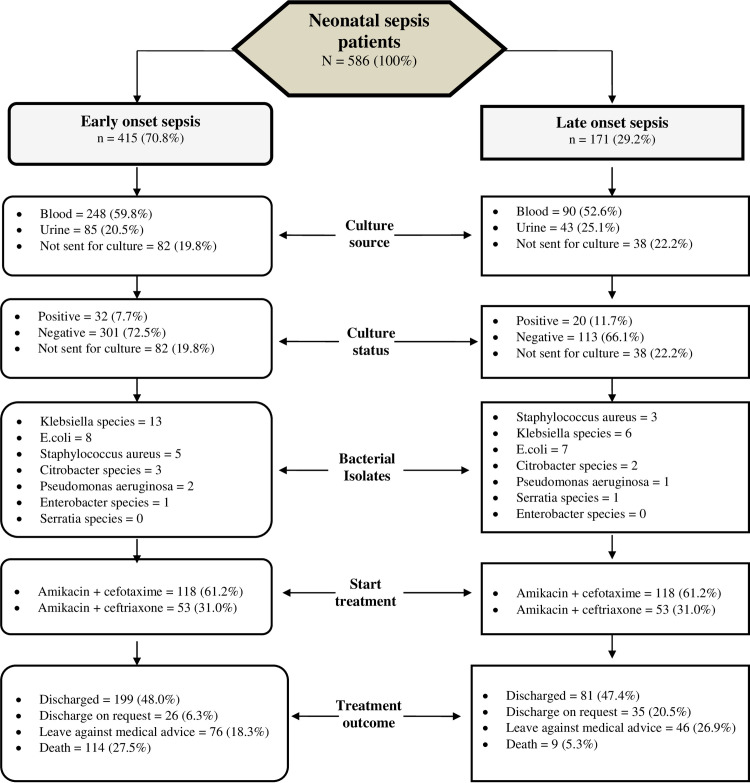
Results: Among the total 586 patients, 398 (67.9%) were male, 328 (56%) were preterm, 415 (70.8%) were diagnosed with early onset sepsis, 299 (51%) were born with low birth weight. Most of the patients (n = 484, 82.6%) were treated with amikacin+cefotaxime at the start of treatment. Culture was positive in 52 (8.9%) patients and the most commonly identified bacteria included, Klebsiella species (n = 19, 36.5%) followed by E. coli (n = 15, 28.5%) and Staphylococcus aureus (n = 8, 15.4%). The identified bacterial isolates showed high level of resistance against the antibiotics initiated at the start of the treatment, while resistance against piperacillin+tazobactam, imipenem, vancomycin and linezolid was very low. Just under half of the patients (n = 280, 47.8%) successfully completed the treatment (i.e., discharged with treatment success), while 123 (21%) patients died during treatment. In multivariable binary logistic regression, the factors which still remained significantly associated with neonatal death included, preterm delivery (AOR 9.59; 95% CI 4.41, 20.84), sub-optimal birth weight (AOR 5.13; 95% CI 2.19, 12.04), early onset sepsis (AOR 2.99; 95% CI 1.39, 6.41) and length of hospital stay (AOR 0.76; 95% CI 0.67, 0.88).
Conclusion: The mortality rate associated with sepsis was high in our study cohort. The bacterial isolates showed high level of resistance against the antibiotics started as the empiric therapy. Rational use of antibiotics can decrease the adverse outcomes in neonatal sepsis patients.
Conflict of interest statement
The authors have declared that no competing interests exist.
Figures
References
-
- Singh M, Gray CP. Neonatal sepsis. StatPearls: [Internet]: StatPearls Publishing; 2019. - PubMed
MeSH terms
Substances
LinkOut - more resources
Full Text Sources
Other Literature Sources
Medical
