


The Occurrence of Antimicrobial-Resistant Salmonella enterica in Hatcheries and Dissemination in an Integrated Broiler Chicken Operation in Korea
- PMID: 33440890
- PMCID: PMC7827806
- DOI: 10.3390/ani11010154
The Occurrence of Antimicrobial-Resistant Salmonella enterica in Hatcheries and Dissemination in an Integrated Broiler Chicken Operation in Korea
Abstract
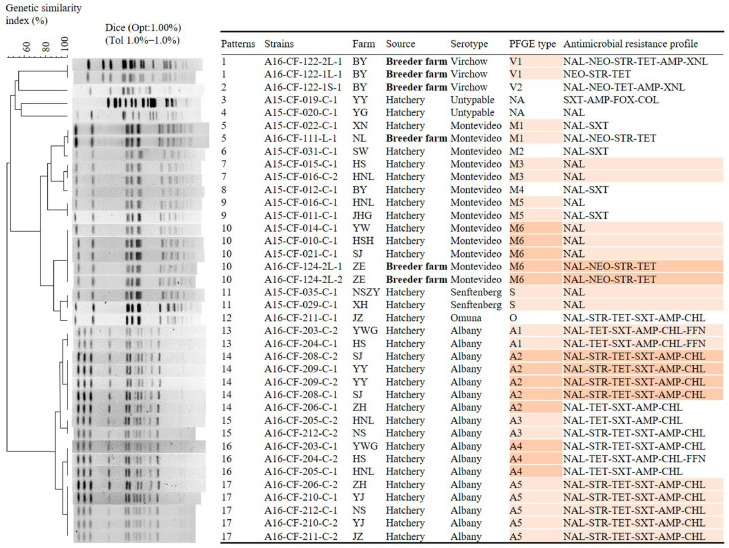
Positive identification rates of Salmonella enterica in hatcheries and upstream breeder farms were 16.4% (36/220) and 3.0% (6/200), respectively. Among the Salmonella serovars identified in the hatcheries, S. enterica ser. Albany (17/36, 47.2%) was the most prevalent, followed by the serovars S. enterica ser. Montevideo (11/36, 30.6%) and S. enterica ser. Senftenberg (5/36, 13.9%), which were also predominant. Thirty-six isolates showed resistance to at least one antimicrobial tested, of which 52.8% (n = 19) were multidrug resistant (MDR). Thirty-three isolates (enrofloxacin, MIC ≥ 0.25) showed point mutations in the gyrA and parC genes. One isolate, S. enterica ser. Virchow, carrying the blaCTX-M-15 gene from the breeder farm was ceftiofur resistant. Pulsed-field gel electrophoresis (PFGE) showed that 52.0% S. enterica ser. Montevideo and 29.6% S. enterica ser. Albany isolates sourced from the downstream of hatcheries along the broiler chicken supply chain carried the same PFGE types as those of the hatcheries. Thus, the hatcheries showed a high prevalence of Salmonella isolates with high antimicrobial resistance and no susceptible isolate. The AMR isolates from hatcheries originating from breeder farms could disseminate to the final retail market along the broiler chicken supply chain. The emergence of AMR Salmonella in hatcheries may be due to the horizontal spread of resistant isolates. Therefore, Salmonella control in hatcheries, particularly its horizontal transmission, is important.
Keywords: Salmonella enterica; antimicrobial resistance; hatchery; integrated broiler chicken operation; transmission.
Conflict of interest statement
The authors declare no conflict of interest.
Figures
References
-
- Centers for Disease Control and Prevention . National Salmonella Surveillance Annual Report and Appendices 2013. US Department of Health and Human Services; Atlanta, GA USA: 2016.
-
- Li K., Ye S., Alali W.Q., Wang Y., Wang X., Xia X., Yang B. Antimicrobial susceptibility, virulence gene and pulsed-field gel electrophoresis profiles of Salmonella enterica serovar Typhimurium recovered from retail raw chickens, China. Food Control. 2017;72:36–42. doi: 10.1016/j.foodcont.2016.07.032. - DOI
-
- Min K.-J., Hwang I.-G., Lee S.-H., Cho J.-I., Yoon K.-S. Determination of risk ranking of combination of potentially hazardous foods and foodborne pathogens using a risk ranger. J. Food Hyg. Saf. 2011;26:91–99.
-
- Sunyoung Choi T.M. South Korea: Poultry and Products Annual 2019. [(accessed on 6 August 2020)]; Available online: http://agriexchange.apeda.gov.in/marketreport/Reports/Poultry_and_Produc....
Grants and funding
- 119059-2/Korea Institute of Planning and Evaluation for Technology in Food, Agriculture and Forestry(IPET) through Animal Disease Management Technology Development Program, funded by Ministry of Agriculture, Food and Rural Affairs(MAFRA)
- 716002-7/Korea Institute of Planning and Evaluation for Technology in Food, Agriculture and Forestry(IPET) through Agriculture, Food and Rural Affairs Convergence Technologies Program for Educating Creative Global Leader, funded by Ministry of Agriculture, Food an
- 320005-4/Korea Institute of Planning and Evaluation for Technology in Food, Agriculture and Forestry(IPET) through Agriculture, Food and Rural Affairs Convergence Technologies Program for Educating Creative Global Leader, funded by Ministry of Agriculture, Food an
- 2017R1D1A1B03030883/Basic Science Research Program through the National Research Foundation of Korea(NRF) funded by the Ministry of Education
LinkOut - more resources
Full Text Sources
Other Literature Sources
