. 2021 Jan 14;19(1):10.
doi: 10.1186/s12916-020-01877-3.

Body mass index and waist circumference in relation to the risk of 26 types of cancer: a prospective cohort study of 3.5 million adults in Spain

Affiliations

Body mass index and waist circumference in relation to the risk of 26 types of cancer: a prospective cohort study of 3.5 million adults in Spain

Martina Recalde et al. BMC Med. .

Abstract

Background: A high body mass index (BMI) has been associated with increased risk of several cancers; however, whether BMI is related to a larger number of cancers than currently recognized is unclear. Moreover, whether waist circumference (WC) is more strongly associated with specific cancers than BMI is not well established. We aimed to investigate the associations between BMI and 26 cancers accounting for non-linearity and residual confounding by smoking status as well as to compare cancer risk estimates between BMI and WC.

Methods: Prospective cohort study with population-based electronic health records from Catalonia, Spain. We included 3,658,417 adults aged ≥ 18 years and free of cancer at baseline between 2006 and 2017. Our main outcome measures were cause-specific hazard ratios (HRs) with 99% confidence intervals (CIs) for incident cancer at 26 anatomical sites.

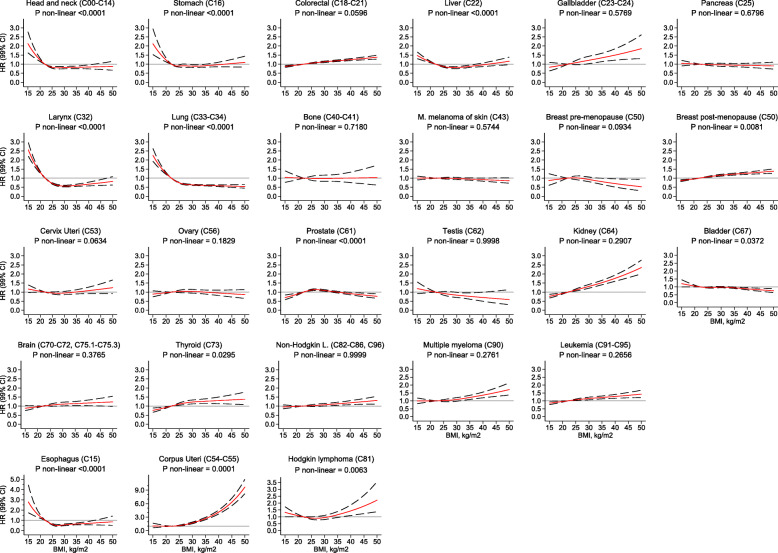
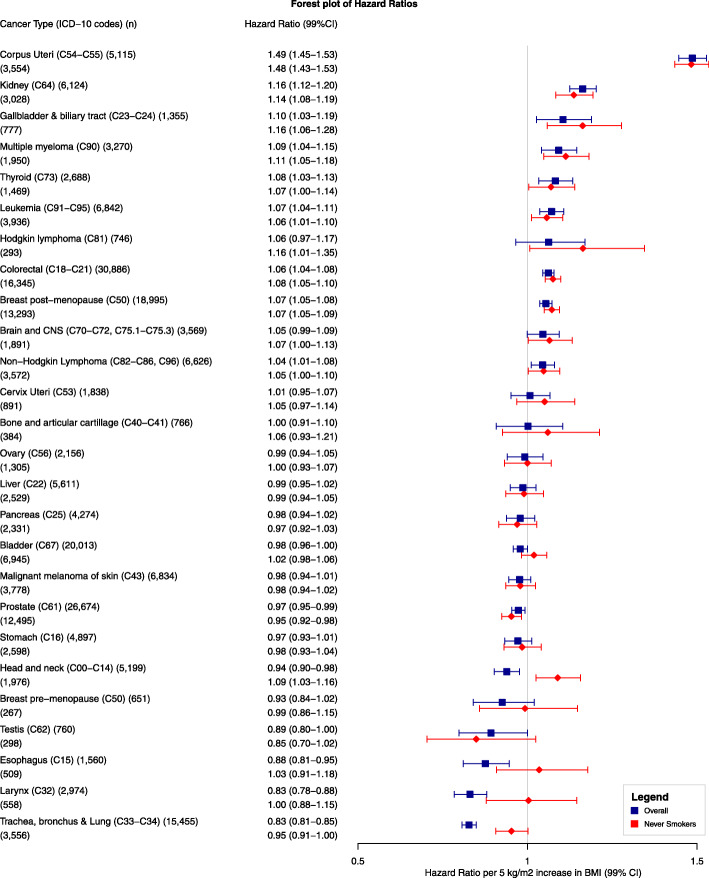
Results: After a median follow-up time of 8.3 years, 202,837 participants were diagnosed with cancer. A higher BMI was positively associated with risk of nine cancers (corpus uteri, kidney, gallbladder, thyroid, colorectal, breast post-menopausal, multiple myeloma, leukemia, non-Hodgkin lymphoma) and was positively associated with three additional cancers among never smokers (head and neck, brain and central nervous system, Hodgkin lymphoma). The respective HRs (per 5 kg/m2 increment) ranged from 1.04 (99%CI 1.01 to 1.08) for non-Hodgkin lymphoma to 1.49 (1.45 to 1.53) for corpus uteri cancer. While BMI was negatively associated to five cancer types in the linear analyses of the overall population, accounting for non-linearity revealed that BMI was associated to prostate cancer in a U-shaped manner and to head and neck, esophagus, larynx, and trachea, bronchus and lung cancers in an L-shaped fashion, suggesting that low BMIs are an approximation of heavy smoking. Of the 291,305 participants with a WC measurement, 27,837 were diagnosed with cancer. The 99%CIs of the BMI and WC point estimates (per 1 standard deviation increment) overlapped for all cancers.

Conclusions: In this large Southern European study, a higher BMI was associated with increased risk of twelve cancers, including four hematological and head and neck (only among never smokers) cancers. Furthermore, BMI and WC showed comparable estimates of cancer risk associated with adiposity.

Keywords: Adiposity; Body fat distribution; Body mass index; Body size; Cancer; Electronic health records; Obesity; Waist circumference.


Conflict of interest statement

All authors have completed the ICMJE uniform disclosure form at www.icmje.org/coi_disclosure.pdf and declare: no support from any organization for the submitted work, no financial relationships with any organizations that might have an interest in the submitted work in the previous 3 years, and no other relationships or activities that could appear to have influenced the submitted work.

Figures

Fig. 1
Fig. 1
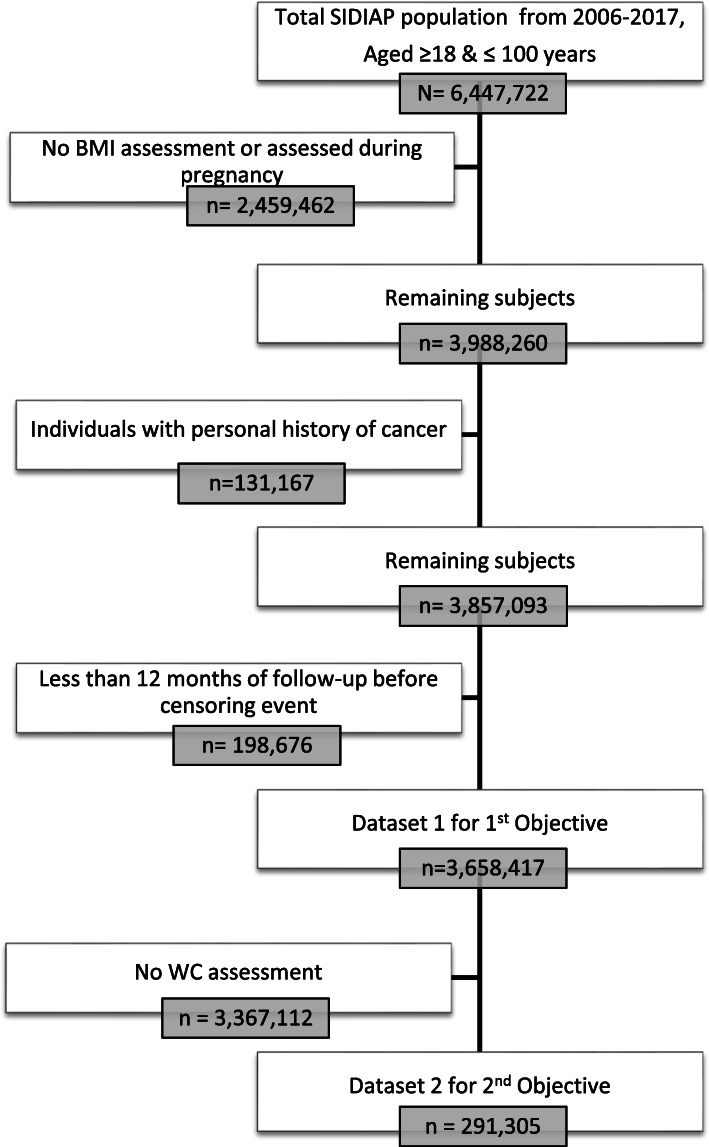
Flow chart showing the creation of the study’s datasets with the participants’ inclusion and exclusion criteria. Notes: 221 individuals were aged above 100 years at the time of their first available BMI measurement. Abbreviations: BMI, body mass index; SIDIAP, Information System for Research in Primary Care; WC, waist circumference
Fig. 2
Fig. 2
Association between body mass index and the risk of 26 cancer types in the overall population, allowing for non-linear effects, with 99% CIs. Notes: (1) The reference BMI for these plots was 22 kg/m2. Separate models were fitted for each cancer type and adjusted for smoking status, alcohol intake, nationality, the MEDEA deprivation index, type 2 diabetes, and had sex and age (5-year categories) in the strata statement. Each model had a restricted cubic spline for BMI with 3 knots placed at 21, 26, and 34 kg/m2 except for head and neck; stomach; trachea, bronchus, and lung; corpus uteri; and prostate and bladder cancers that had 5 knots placed at 19, 23, 26, 29, and 37 kg/m2. (2) Gallbladder includes biliary tract; lung includes trachea and bronchus; bone includes articular cartillage; brain includes the CNS, pituitary gland and pineal gland tumors. M. melanoma of skin stands for Malignant melanoma of skin; Non-Hodgkin L. stands for Non-Hodgkin lymphoma. (3) Models for ovary, cervix, and corpus uteri cancers were only computed in women, for breast pre-menopausal only in pre-menopausal women, for breast post-menopausal only in post-menopausal women, and for prostate and testis only computed in men. (4) All models have a scale up to a HR of 3 and are ordered by ascending ranking of ICD-10 codes, except for esophagus, corpus uteri, and Hodgkin lymphoma. Abbreviations: BMI, body mass index; CI, confidence interval; CNS, central nervous system; HR, hazard ratio; KG, kilograms; M, meters
Fig. 3
Fig. 3
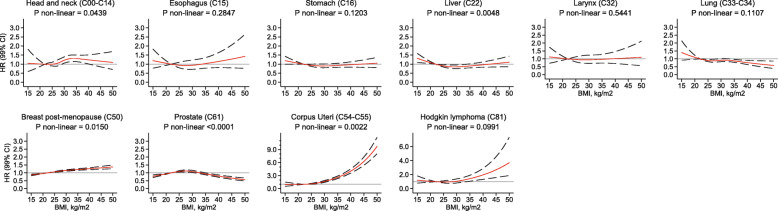
Association between body mass index and the risk of 10 cancer types in never smokers, allowing for non-linear effects, with 99% CIs. Notes: (1) The reference BMI for these plots was 22 kg/m2. Separate models were fitted for each cancer type and adjusted for alcohol intake, nationality, the MEDEA deprivation index, type 2 diabetes, and had sex and age (5-year categories) in the strata statement. Each model had a restricted cubic spline for BMI with 3 knots placed at 21, 26, and 34 kg/m2 except for head and neck, bronchus and lung, and corpus uteri that had 5 knots placed at 19, 23, 26, 29, and 37 kg/m2. (2) Lung includes trachea and bronchus tumors. (3) The association for corpus uteri cancer was only computed in women, for breast post-menopausal only in post-menopausal women, and for prostate cancer only in men. (4) All models have a scale up to a HR of 3, except for corpus uteri and Hodgkin lymphoma. Abbreviations: BMI, body mass index; CI, confidence interval; HR, hazard ratio; KG, kilograms; M, meters
Fig. 4
Fig. 4
Forest plot of hazard ratios of 26 cancer types related to a linear increment in body mass index of 5 kg/m2 with 99% CIs, in the overall population, and in never smokers. Notes: (1) Separate models were fitted for each cancer type and adjusted for smoking status, alcohol intake, nationality, the MEDEA deprivation index, type 2 diabetes, and had sex and age (5-year categories) in the strata statement. (2) Cancer types are ordered by descending ranking. (3) Brain and CNS include pituitary gland and pineal gland tumors. (4) Models for ovary, cervix, and corpus uteri cancers were only computed in women, for breast pre-menopausal only in pre-menopausal women, for breast post-menopausal only in post-menopausal women, and for prostate and testis only computed in men. Abbreviations: BMI, body mass index; CI, confidence interval; CNS, central nervous system; KG, kilograms; M, meters; WC, waist circumference
Fig. 5
Fig. 5
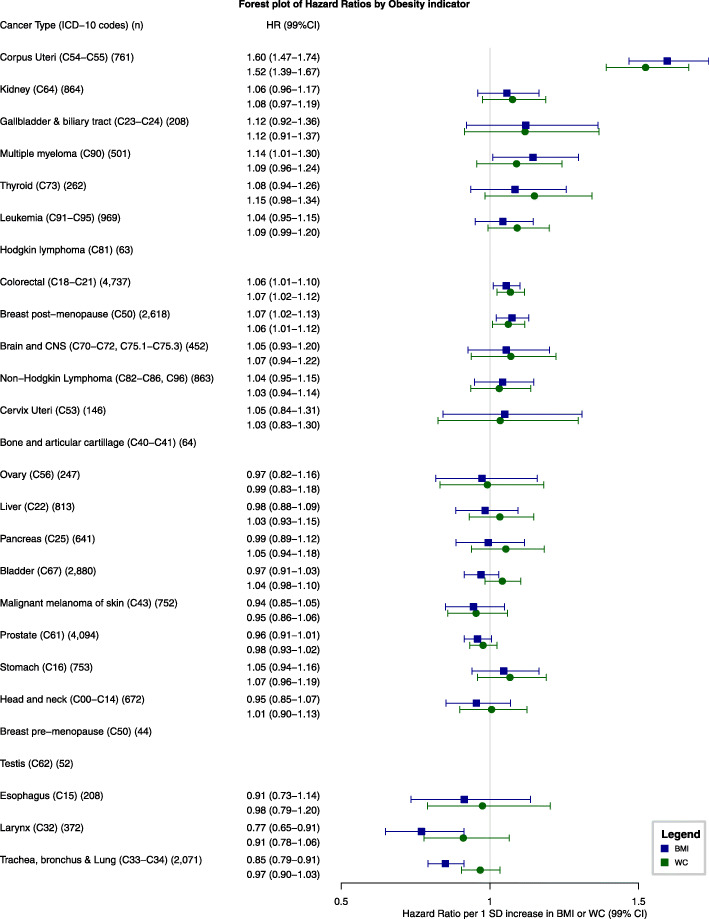
Forest plot of hazard ratios of 22 specific cancer sites related to a 1 standard deviation increase in body mass index and a 1 standard deviation increase in waist circumference. Notes: (1) SD for BMI and WC were 5.3 and 13.9 overall, 5.8 and 14.5 for women, 6.5 and 16.1 for pre-menopausal women, 5.4 and 13.3 for post-menopausal women, and 4.7 and 12.9 for men. (2) Separate models were fitted for each cancer type and adjusted for smoking status, alcohol intake, nationality, the MEDEA deprivation index, type 2 diabetes, and had sex and age (5-year categories) in the strata statement. (3) HRs are ordered by the descending ranking of BMI estimates from Fig. 4. (4) Brain and CNS include pituitary gland and pineal gland tumors. (5) Models for ovary, cervix, and corpus uteri cancers were only computed in women, for breast post-menopausal only in post-menopausal women, and for prostate only computed in men. (6) We only calculated hazard ratios for cancer types for which we ascertained at least 100 cancer cases. Abbreviations: BMI, body mass index; CI, confidence interval; CNS, central nervous system; SD, standard deviation; WC, waist circumference

References

    1. World Health Organization. Overweight and obesity. 2016 [cited 2018 Nov 5]. Available from: http://www.who.int/news-room/fact-sheets/detail/obesity-and-overweight.
    1. Secretan BL, Ph D, Scoccianti C, Ph D, Loomis D, Ph D. Body Fatness and Cancer - Viewpoint of the IARC Working Group. Vol. 375, The New England Journal of Medicine. 2016. - PMC - PubMed
    1. Reeves GK, Pirie K, Beral V, Green J, Spencer E, Bull D. Cancer incidence and mortality in relation to body mass index in the Million Women Study: cohort study. Br Med J. 2007;335(7630):1134–1139. doi: 10.1136/bmj.39367.495995.AE. - DOI - PMC - PubMed
    1. Bhaskaran K, Douglas I, Forbes H, Dos-Santos-Silva I, Leon DA, Smeeth L. Body-mass index and risk of 22 specific cancers: a population-based cohort study of 5·24 million UK adults. Lancet. 2014;384(9945):755–765. doi: 10.1016/S0140-6736(14)60892-8. - DOI - PMC - PubMed
    1. Song M, Giovannucci E. Estimating the influence of obesity on cancer risk: stratification by smoking is critical. J Clin Oncol. 2016;34(27):3237–3239. doi: 10.1200/JCO.2016.67.6916. - DOI - PubMed

Publication types