Review
. 2021 Jan 13;85(1):e00151-20.
doi: 10.1128/MMBR.00151-20. Print 2021 Feb 17.

Pseudomonas aeruginosa as a Model To Study Chemosensory Pathway Signaling

Affiliations
Review

Pseudomonas aeruginosa as a Model To Study Chemosensory Pathway Signaling

Miguel A Matilla et al. Microbiol Mol Biol Rev. .

Abstract

Bacteria have evolved a variety of signal transduction mechanisms that generate different outputs in response to external stimuli. Chemosensory pathways are widespread in bacteria and are among the most complex signaling mechanisms, requiring the participation of at least six proteins. These pathways mediate flagellar chemotaxis, in addition to controlling alternative functions such as second messenger levels or twitching motility. The human pathogen Pseudomonas aeruginosa has four different chemosensory pathways that carry out different functions and are stimulated by signal binding to 26 chemoreceptors. Recent research employing a diverse range of experimental approaches has advanced enormously our knowledge on these four pathways, establishing P. aeruginosa as a primary model organism in this field. In the first part of this article, we review data on the function and physiological relevance of chemosensory pathways as well as their involvement in virulence, whereas the different transcriptional and posttranscriptional regulatory mechanisms that govern pathway function are summarized in the second part. The information presented will be of help to advance the understanding of pathway function in other organisms.

Keywords: Pseudomonas aeruginosa; chemosensory pathway; chemotaxis; signaling.


Figures

FIG 1
FIG 1
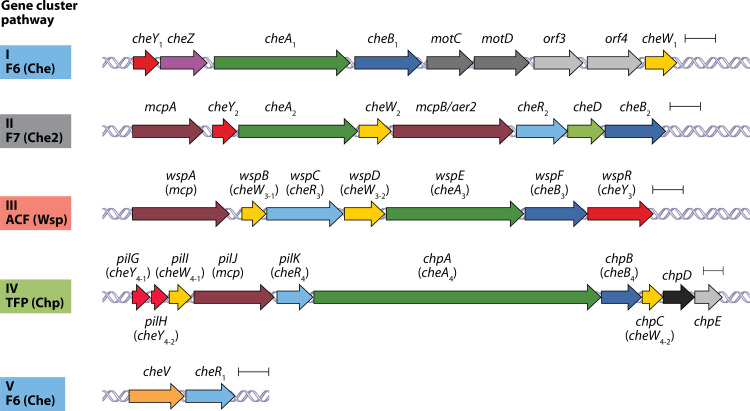
Chemosensory pathways of P. aeruginosa PAO1. A schematic representation shows the five gene clusters that encode chemosensory signaling proteins. Genes are annotated according to UniProt. Indicated are the gene clusters and the classification of chemosensory pathways as previously described (1). Che, chemotaxis; Wsp, wrinkly spreader phenotype; Chp, chemosensory pili. The F7 pathway is of unknown function. Scale bars, 0.5 kbp.
FIG 2
FIG 2
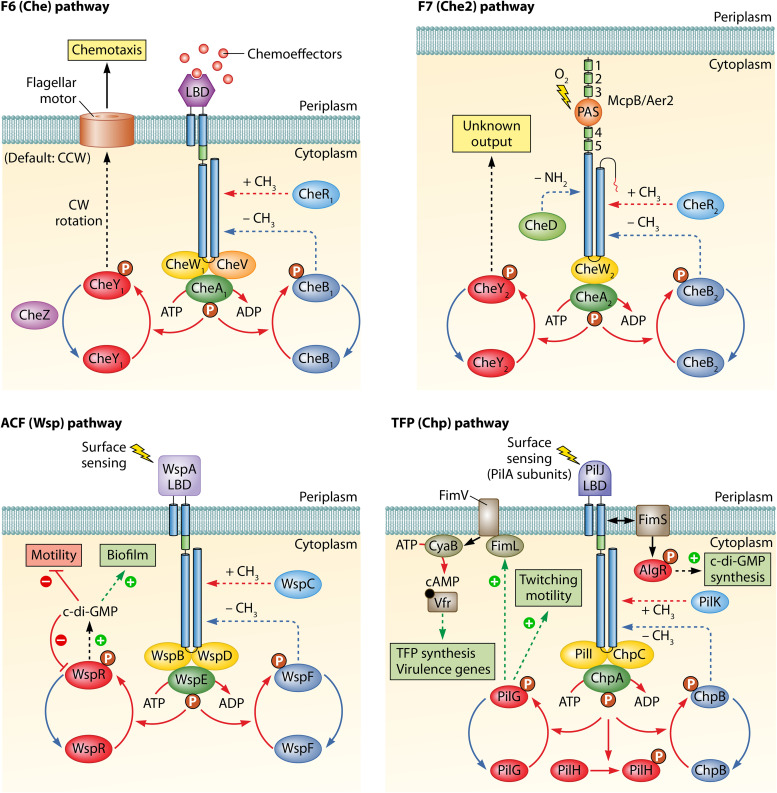
The protein interaction network of the four chemosensory pathways of P. aeruginosa. The pathway output is highlighted by boxes. The color code of signaling proteins corresponds to that of Fig. 1. CheA/WspE/ChpA, histidine kinase; CheR/WspC/PilK, methyltransferase; CheB/WspF/ChpB, methylesterase; CheW/WspB/WspD/PilI/ChpC, CheW-type coupling protein; CheV, CheV-type coupling protein; CheY/WspR/PilG/PilH, CheY-type response regulator.
FIG 3
FIG 3
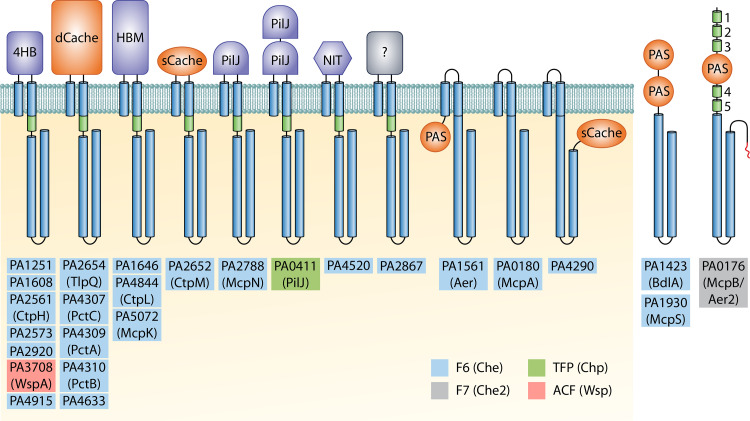
Chemoreceptor repertoire of P. aeruginosa PAO1. Ligand-binding domains with parallel helix or α/β folds are shown in blue and orange, respectively. HAMP (histidine kinases, adenyl cyclases, methyl-accepting proteins, and phosphatases) and signaling domains are represented as green cylinders, whereas transmembrane regions and signaling domains are shown in blue. No HAMP domains were identified in Aer, BdlA, McpA, McpS, and PA4290. McpB/Aer2 is the only chemoreceptor that carries a C-terminal pentapeptide (in red) that acts as an additional CheR binding site (11). 4HB, four helix bundle; Cache, calcium channels and chemotaxis receptors; HBM, helical bimodular; PilJ, N-terminal domain of type IV pilus chemoreceptor; NIT, nitrate and nitrite sensing; PAS, Per-Arnt-Sim. Chemoreceptors are present in higher oligomeric states in vivo but are shown as monomers for simplicity. The assignment of P. aeruginosa PAO1 chemoreceptors to their respective chemosensory pathways was reported by Ortega et al. (10).
FIG 4
FIG 4
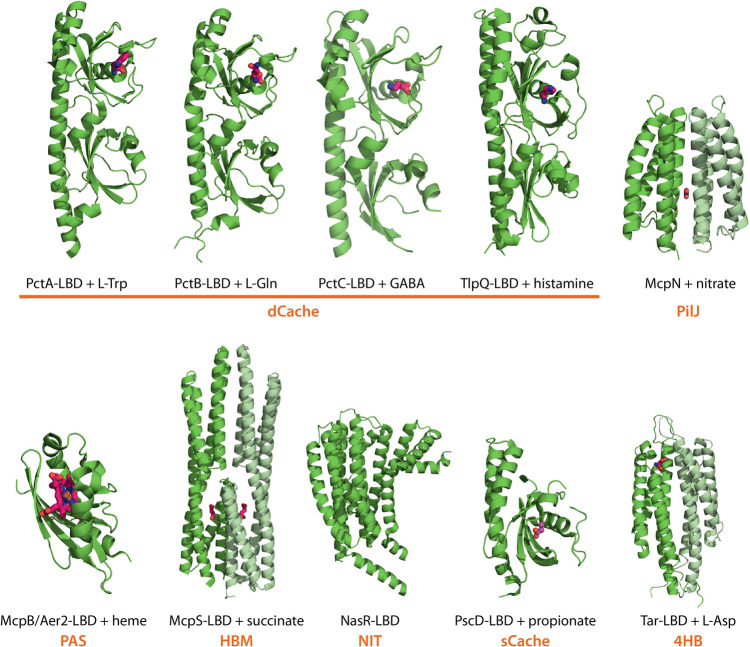
Diversity of P. aeruginosa chemoreceptor LBDs. 3D structures of LBDs from PctA (PDB ID 5T7M), PctB (5LTO), PctC (5LTV) (38), TlpQ (6FU4) (39), McpN (6GCV) (46), and McpB/Aer2 (4HI4) (88) are shown (all P. aeruginosa). For the remaining protein families (Fig. 3), the structures of homologous domains from other species are shown, namely, P. putida McpS (HBM domain, 2YFB) (59), Klebsiella oxytoca NasR (NIT domain, 4AKK) (196), P. syringae PscD (sCache domain, 5G4Z) (197), and Salmonella enterica serovar Typhimurium Tar (4HB domain, 2LIG) (198). Bound ligands are shown in stick mode, and the LBD type is shown in orange. The monomers of LBD dimers are shown in different shades of green.
FIG 5
FIG 5
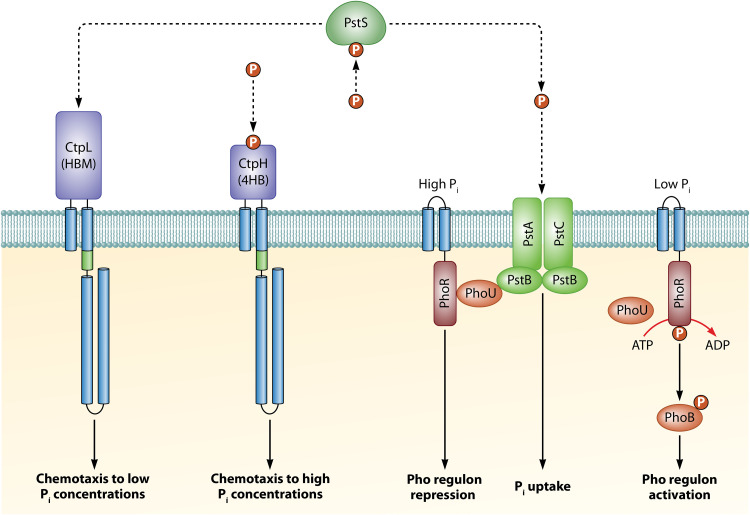
Model of the interwoven signaling processes that mediate phosphate chemotaxis, transport, and transcriptional regulation. Chemoreceptors and PhoR form oligomeric assemblies in vivo but are shown as monomers for simplicity. HAMP domains are shown as green cylinders. (Based on data from references and .)
FIG 6
FIG 6
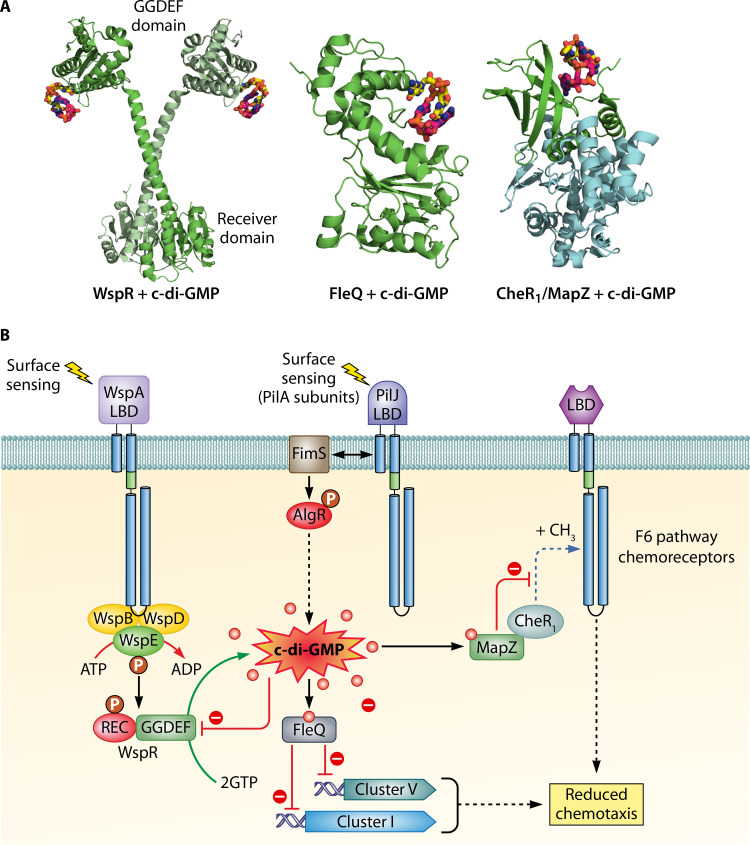
Regulation of chemosensory signaling by c-di-GMP. (A) 3D structures of CheR1/MapZ complex (PDB ID 5Y4R) (174), the WspR response regulator (3BRE) (105), and the transcriptional regulator FleQ (5EXX) (180) in complex with c-di-GMP, representing three different mechanisms by which c-di-GMP modulates pathway signaling. (B) Schematic view of chemosensory pathway-associated signaling by c-di-GMP. The Wsp and Chp pathways are involved in the synthesis of c-di-GMP that, in turn, reduces chemotaxis through the action of the FleQ and MapZ regulatory proteins.
FIG 7
FIG 7
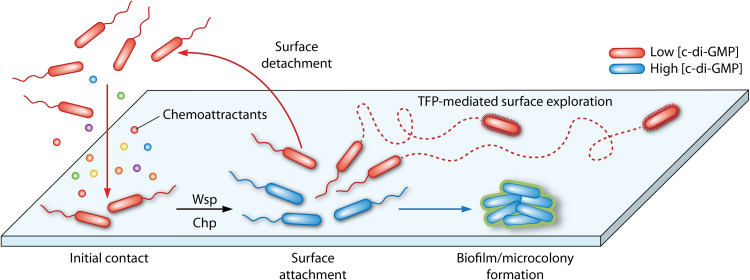
Model of Wsp and Chp pathway-mediated surface sensing modulating surface colonization and biofilm formation in P. aeruginosa. Planktonic cells can actively (via chemotaxis) or passively (environmental changes that propel bacterial cells) interact with a surface. Initial surface contact activates the Wsp and Chp signaling pathways, leading to changes in c-di-GMP and cAMP levels. Subsequently, two physiologically different subpopulations of cells arise, which differ in their c-di-GMP content. Whereas cells with elevated c-di-GMP levels increase exopolysaccharide production to initiate biofilm formation, the subpopulation with low c-di-GMP levels either detaches or explores the surface using type IV pilus-mediated motility. Detached progeny cells retain cAMP-dependent memory of the surface, and the corresponding planktonic population has an increased ability to attach to the surface.
FIG 8
FIG 8
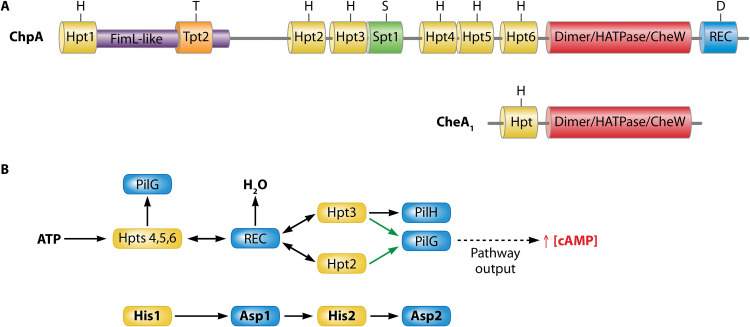
Complex domain arrangement and mechanism of the ChpA autokinase. (A) Domain arrangements of ChpA and CheA1. Hpt, Histidine-containing phosphotransfer domain; Tpt, Threonine-containing phosphotransfer domain; Spt, Serine-containing phosphotransfer domain; REC, response regulator receiver domain. (Based on data from references and .) (B) The proposed mechanism of phosphoryl group flow in the Chp pathway. Black arrows represent findings based on biochemical and genetic data; green arrows indicate findings based on genetics only. (Based on data from reference .)
FIG 9
FIG 9
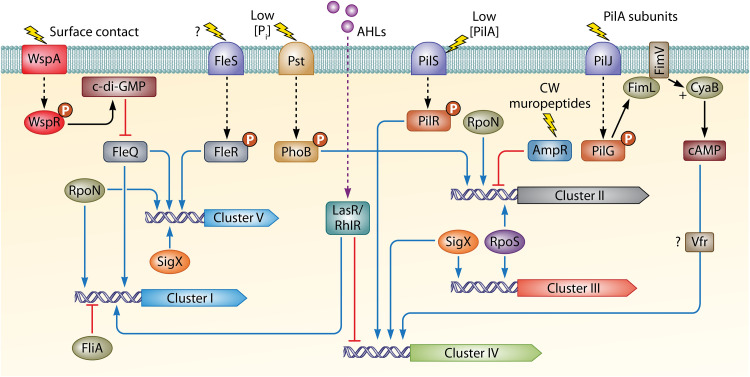
Overview of genetic regulation of chemosensory gene clusters in P. aeruginosa. Activation and repression are represented by triangular and flat arrowheads, respectively. CW, cell wall; Pi, inorganic phosphate; AHL, N-acyl homoserine lactone.

References

    1. Wuichet K, Zhulin IB. 2010. Origins and diversification of a complex signal transduction system in prokaryotes. Sci Signal 3:ra50. doi: 10.1126/scisignal.2000724. - DOI - PMC - PubMed
    1. Bi S, Sourjik V. 2018. Stimulus sensing and signal processing in bacterial chemotaxis. Curr Opin Microbiol 45:22–29. doi: 10.1016/j.mib.2018.02.002. - DOI - PubMed
    1. Parkinson JS, Hazelbauer GL, Falke JJ. 2015. Signaling and sensory adaptation in Escherichia coli chemoreceptors: 2015 update. Trends Microbiol 23:257–266. doi: 10.1016/j.tim.2015.03.003. - DOI - PMC - PubMed
    1. Hazelbauer GL, Falke JJ, Parkinson JS. 2008. Bacterial chemoreceptors: high-performance signaling in networked arrays. Trends Biochem Sci 33:9–19. doi: 10.1016/j.tibs.2007.09.014. - DOI - PMC - PubMed
    1. Hazelbauer GL. 2012. Bacterial chemotaxis: the early years of molecular studies. Annu Rev Microbiol 66:285–303. doi: 10.1146/annurev-micro-092611-150120. - DOI - PMC - PubMed

Publication types

MeSH terms

LinkOut - more resources