


Exploring the Causal Roles of Circulating Remnant Lipid Profile on Cardiovascular and Cerebrovascular Diseases: Mendelian Randomization Study
- PMID: 33441507
- PMCID: PMC8979919
- DOI: 10.2188/jea.JE20200305
Exploring the Causal Roles of Circulating Remnant Lipid Profile on Cardiovascular and Cerebrovascular Diseases: Mendelian Randomization Study
Abstract
Background: Causal evidence of circulating lipids especially the remnant cholesterol with cardiovascular and cerebrovascular disease (CVD) is lacking. This research aimed to explore the causal roles of extensive lipid traits especially the remnant lipids in CVD.
Methods: Two-sample Mendelian randomization (TSMR) analysis was performed based on large-scale meta-analysis datasets in European ancestry. The causal effect of 15 circulating lipid profiles including 6 conventional lipids and 9 remnant lipids on coronary heart disease (CHD) and ischemic stroke (IS), as well as the subtypes, was assessed.
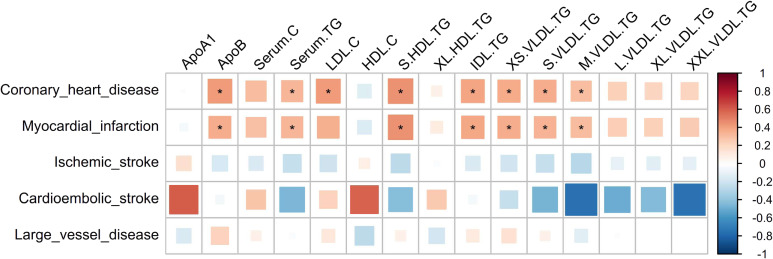
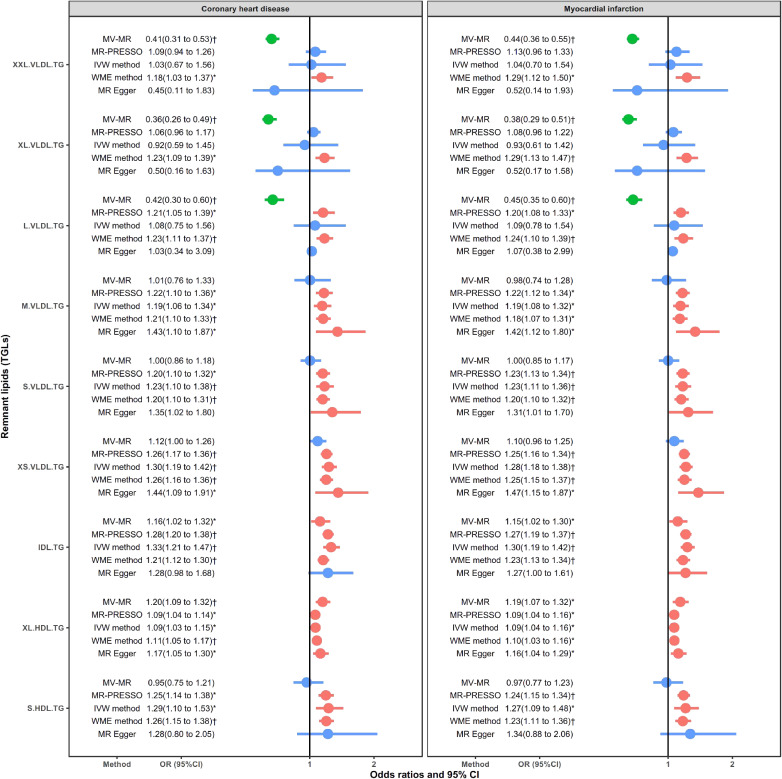
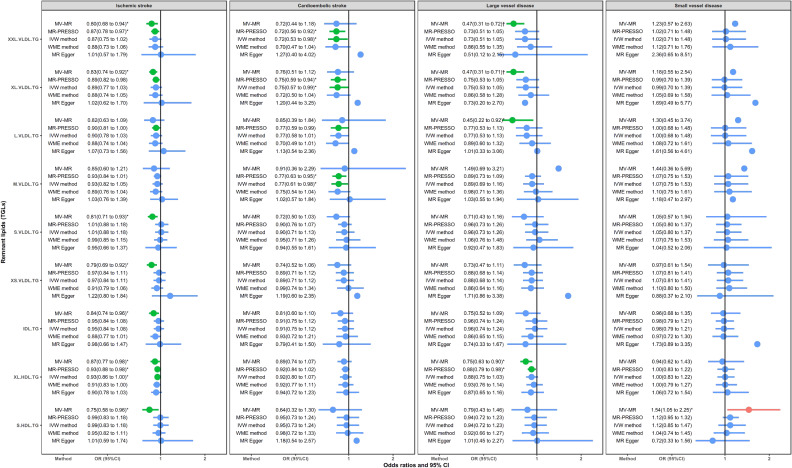
Results: Apolipoprotein B (Apo B), total cholesterol (TC), low-density lipoprotein cholesterol (LDL-C), and triglyceride (TG) were still important risk factors for CHD and myocardial infarction (MI) but not for IS. Apo B is the strongest which increased the CHD and MI risk by 44% and 41%, respectively. The odds ratios (ORs) of total TG on CHD and MI were 1.25 (95% confidence interval [CI], 1.13-1.38) and 1.24 (95% CI, 1.11-1.38), respectively. A one standard deviation difference increased TG in medium very-low-density lipoproteins (M.VLDL.TG), TG in small VLDL (S.VLDL.TG), TG in very small VLDL (XS.VLDL.TG), TG in intermediate-density lipoproteins (IDL.TG), TG in very large HDL (XL.HDL.TG), and TG in small HDL (S.HDL.TG) particles also robustly increased the risk of CHD and MI by 9-28% and 9-27%, respectively. TG in very/extremely large VLDL (XXL.VLDL.TG and XL.VLDL.TG) were insignificant or even negatively associated with CHD (in multivariable TSMR), and negatively associated with IS as well.
Conclusion: The remnant lipids presented heterogeneity and two-sided effects for the risk of CHD and IS that may partially rely on the particle size. The findings suggested that the remnant lipids were required to be intervened according to specific components. This research confirms the importance of remnant lipids and provides causal evidence for potential targets for intervention.
Keywords: Mendelian randomization; coronary heart disease; ischemic stroke; remnant lipids.
Conflict of interest statement
Conflicts of interest: None declared.
Figures


References
-
- Ference BA, Ginsberg HN, Graham I, et al. Low-density lipoproteins cause atherosclerotic cardiovascular disease. 1. Evidence from genetic, epidemiologic, and clinical studies. A consensus statement from the European Atherosclerosis Society Consensus Panel. Eur Heart J. 2017;38:2459–2472. 10.1093/eurheartj/ehx144 - DOI - PMC - PubMed
-
- Stone NJ, Robinson JG, Lichtenstein AH, et al. ; American College of Cardiology/American Heart Association Task Force on Practice Guidelines . 2013 ACC/AHA guideline on the treatment of blood cholesterol to reduce atherosclerotic cardiovascular risk in adults: a report of the American College of Cardiology/American Heart Association Task Force on Practice Guidelines. J Am Coll Cardiol. 2014;63:2889–2934. 10.1016/j.jacc.2013.11.002 - DOI - PubMed
-
- Reddy VS, Bui QT, Jacobs JR, Begelman SM, Miller DP, French WJ; Investigators of National Registry of Myocardial Infarction (NRMI) 4b–5 . Relationship between serum low-density lipoprotein cholesterol and in-hospital mortality following acute myocardial infarction (the lipid paradox). Am J Cardiol. 2015;115:557–562. 10.1016/j.amjcard.2014.12.006 - DOI - PubMed
Publication types
MeSH terms
Substances
LinkOut - more resources
Full Text Sources
Other Literature Sources
Miscellaneous
