Clinical Trial
. 2021 Jan 13;11(1):1138.
doi: 10.1038/s41598-020-80845-6.

Preliminary clinical experience applying donor-derived cell-free DNA to discern rejection in pediatric liver transplant recipients

Affiliations
Clinical Trial

Preliminary clinical experience applying donor-derived cell-free DNA to discern rejection in pediatric liver transplant recipients

Dong Zhao et al. Sci Rep. .

Abstract

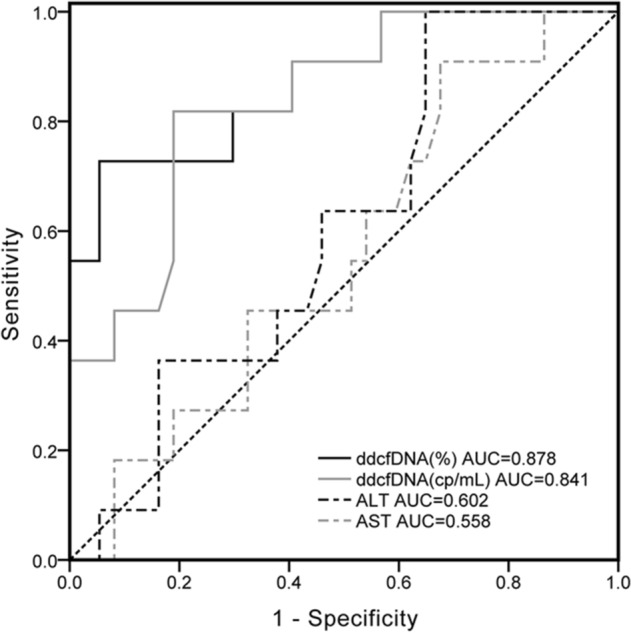
Donor-derived cell-free DNA (dd-cfDNA) has been of major interest recently as a non-invasive marker of graft injury, but has not yet been extensively tested in children. From May to September in 2019, a total of 76 pediatric patients receiving a liver graft were enrolled and there were 27 patients excluded. Ultimately plasma samples and matched liver specimens from 49 patients were successfully collected whenever rejection was suspected clinically. Dd-cfDNA were analyzed and then compared to biopsy. Of these, 11 (22.4%) patients were found to have rejection by biopsy. Dd-cfDNA levels were higher among patients with rejection compared to those with no rejection. In subgroup analysis, dd-cfDNA% among patients with rejection differed from those with EBV/CMV infection and DILI patients. Similarly, observations were available concerning dd-cfDNA (cp/mL). The AUC for dd-cfDNA% and dd-cfDNA (cp/mL) were 0.878, 0.841, respectively, both of which were higher than conventional LFTs. For rejection, dd-cfDNA% ≥ 28.7% yielded a sensitivity of 72.7%, specificity 94.7% and dd-cfDNA (cp/mL) ≥ 2076 cp/mL, yielded a sensitivity of 81.8%, specificity 81.9%. Of note, the dd-cfDNA distribution was significantly different between whole liver and LLS transplantation. In the setting of pediatric LTx, dd-cfDNA appears to be a sensitive biomarker indicating the presence of rejection.International Clinical Trails Registry Platform: ChiCTR1900022406.


Conflict of interest statement

The authors declare no competing interests.

Figures
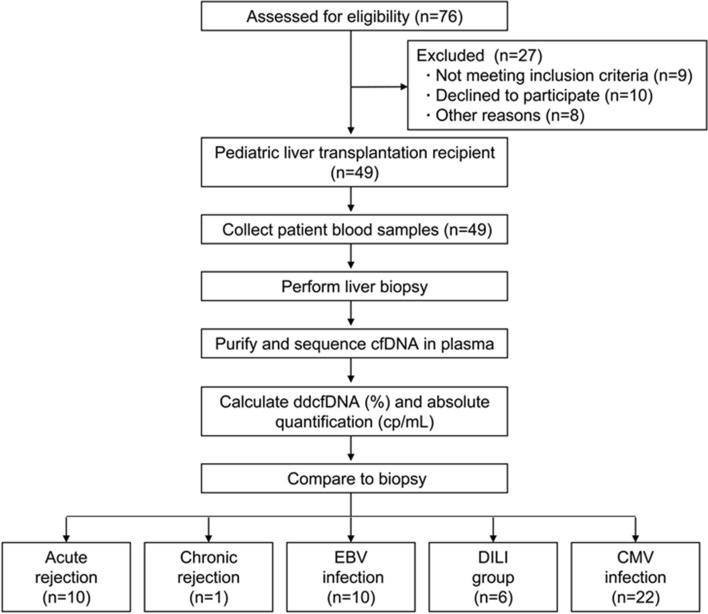
Figure 1
Figure 1
Enrollment of patients, collection of clinical samples, analysis workflow and subgroups information. Pediatric recipients with ESLD listed for liver transplantation at Renji Hospital were enrolled. Multi-organ transplant recipients were excluded. From May to September in 2019, a total of 76 pediatric patients receiving a liver graft were enrolled and there were 27 patients excluded as described in Suppl Table 1. Ultimately plasma samples and matched liver specimens from 49 patients were successfully studied. All the samples were collected whenever rejection was suspected clinically. In each case, blood samples were collected 2 h before biopsy procedures being performed. Data on the fraction of dd-cfDNA (dd-cfDNA%) and absolute number of dd-cfDNA copies per mL of plasma were compared to liver biopsy results.
Figure 2
Figure 2
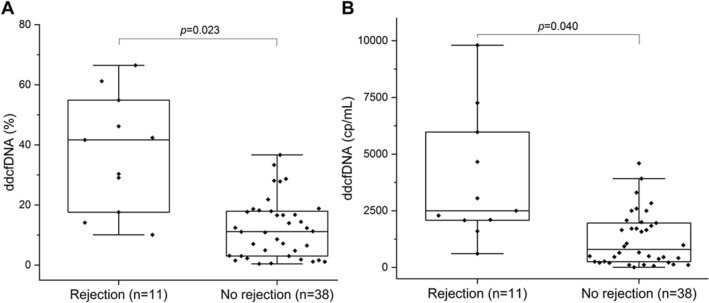
dd-cfDNA levels in rejection and no rejection group. (A) Box plots of plasma dd-cfDNA%, horizontal line represents the median; bottom and top of each box represents 25th and 75th percentiles. Dots are individual values. dd-cfDNA fraction (%) in rejection and no rejection group, p values were determined by Mann–Whitney U test. (B) dd-cfDNA (cp/mL) in Rejection and no rejection group.
Figure 3
Figure 3
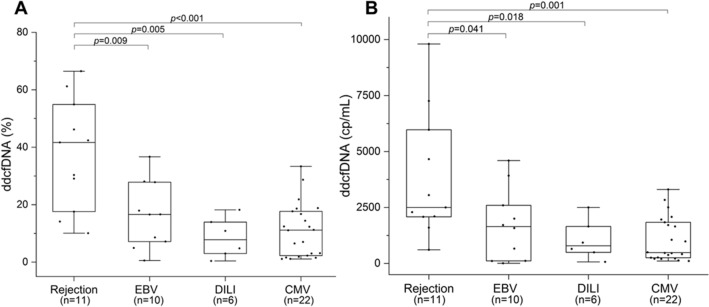
dd-cfDNA levels in different subgroups. (A) Box plots of plasma dd-cfDNA%, horizontal line represents the median; bottom and top of each box represents 25th and 75th percentiles. Dots are individual results. (B) Box plots of plasma dd-cfDNA (cp/mL). p-values were determined by Mann–Whitney U test.
Figure 4
Figure 4
dd-cfDNA as a marker for pediatric liver transplant rejection. Black dotted diagonal represents the reference line. Black solid line represents the dd-cfDNA fraction (%) curve. Gray solid line represents the absolute quantitative (cp/mL) curve. Black dashed line represents ALT curve while gray dashed line represents AST curve.
Figure 5
Figure 5
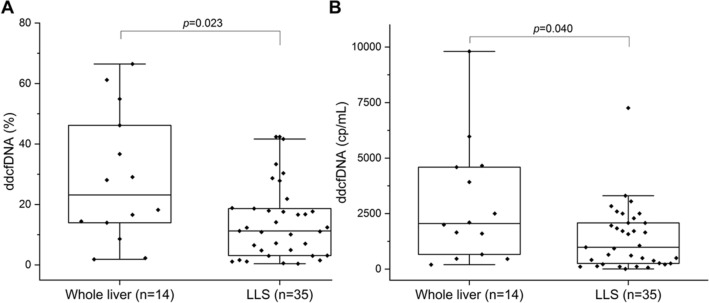
dd-cfDNA levels in different surgical procedures. (A) Box plots of plasma dd-cfDNA% in different operation types, horizontal line represents the median; bottom and top of each box represents 25th and 75th percentiles, Dots are individual values. (B) Box plots of plasma dd-cfDNA (cp/mL) in different operation procedure. LLS left lateral segment.

References

    1. Millan O, et al. Intracellular IFN-gamma and IL-2 expression monitoring as surrogate markers of the risk of acute rejection and personal drug response in de novo liver transplant recipients. Cytokine. 2013;61:556–564. doi: 10.1016/j.cyto.2012.10.026. - DOI - PubMed
    1. Vivarelli M, Smith HM, Naoumov NV, Williams R. Quantitative assessment of serum beta-2-microglobulin in liver transplant recipients and relationship to liver graft rejection. Eur. J. Gastroenterol. Hepatol. 1995;7:1215–1219. doi: 10.1097/00042737-199512000-00016. - DOI - PubMed
    1. Yu SC, et al. Size-based molecular diagnostics using plasma DNA for noninvasive prenatal testing. Proc. Natl. Acad. Sci. USA. 2014;111:8583–8588. doi: 10.1073/pnas.1406103111. - DOI - PMC - PubMed
    1. Volckmar AL, et al. A field guide for cancer diagnostics using cell-free DNA: From principles to practice and clinical applications. Genes Chromosom. Cancer. 2018;57:123–139. doi: 10.1002/gcc.22517. - DOI - PubMed
    1. Lo YM, et al. Presence of donor-specific DNA in plasma of kidney and liver-transplant recipients. Lancet. 1998;351:1329–1330. doi: 10.1016/s0140-6736(05)79055-3. - DOI - PubMed

Publication types