


The Immune-Modulatory Properties of iPSC-Derived Antigen-Presenting Cells
- PMID: 33442339
- PMCID: PMC7768145
- DOI: 10.1159/000512721
The Immune-Modulatory Properties of iPSC-Derived Antigen-Presenting Cells
Abstract
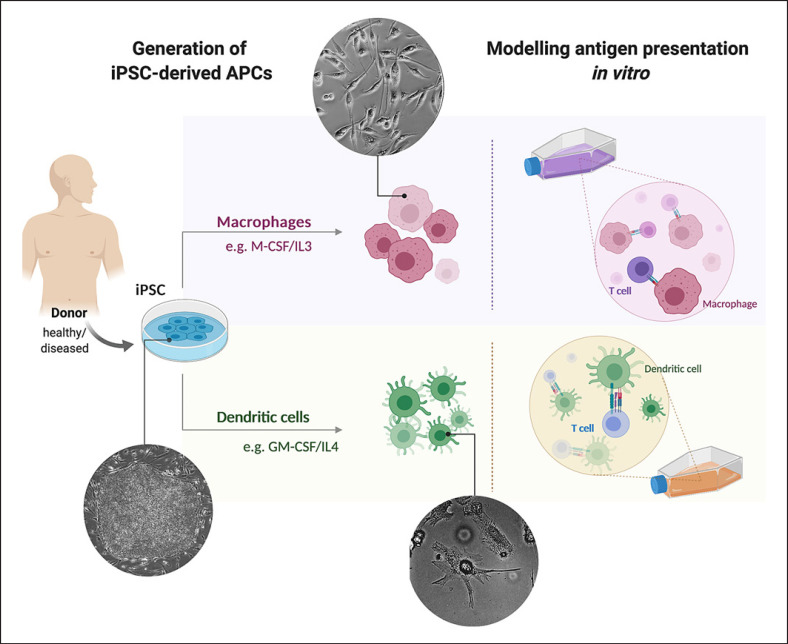
Antigen-presenting cells (APCs), such as dendritic cells (DCs) and macrophages, are important regulators of the immune system, as they connect the innate and adaptive immunity by critically regulating T-cell responses. Thus, APCs are involved in both tissue homeostasis and tolerance, but also coordinate immune responses in case of infection and inflammation. Primary APCs are commonly generated from peripheral blood-derived monocytes and have been used as cell therapeutics in several (pre-)clinical settings, e.g., immune oncology, however, with varying efficiency. One promising alternative to study antigen presentation in vitro and to develop novel cell-based therapies are induced pluripotent stem cells (iPSCs). IPSCs can nowadays be generated from a variety of different cell types using several refined reprogramming techniques. Given their unlimited proliferation and differentiation potential, they hold great promise for regenerative medicine, and recently, first iPSC derivatives have found their way into first clinical studies for cell-based therapies. In this review article, we will give a brief overview of current methods for the generation and applications of primary APCs, but also specifically focus on different strategies for the generation of defined subsets of DCs and macrophages from human PSCs. Moreover, we will highlight the potential but also hurdles for the clinical translation of iPSC-derived APCs.
Keywords: Antigen presentation; Cell therapy; Dendritic cells; Induced pluripotent stem cells; Macrophage.
Copyright © 2020 by S. Karger AG, Basel.
Conflict of interest statement
The authors have no conflicts of interest to declare.
Figures
References
-
- Ugur M, Mueller SN. T cell and dendritic cell interactions in lymphoid organs: more than just being in the right place at the right time. Immunol Rev. 2019 May;289((1)):115–28. - PubMed
-
- Sontag S, Förster M, Qin J, Wanek P, Mitzka S, Schüler HM, et al. Modelling IRF8 Deficient Human Hematopoiesis and Dendritic Cell Development with Engineered iPS Cells. Stem Cells. 2017 Apr;35((4)):898–908. - PubMed
Publication types
LinkOut - more resources
Full Text Sources
Miscellaneous
