Staging Laparoscopy in Patients with Intrahepatic Cholangiocarcinoma: Is It Still Useful?
- PMID: 33442552
- PMCID: PMC7768138
- DOI: 10.1159/000506297
Staging Laparoscopy in Patients with Intrahepatic Cholangiocarcinoma: Is It Still Useful?
Abstract
Background: The role of staging laparoscopy in patients with intrahepatic cholangiocarcinoma remains unclear. Despite extensive preoperative imaging, approximately 25% of patients are deemed unresectable at laparotomy due to metastasized disease. The aim of this study was to evaluate the frequency of unresectable disease found at staging laparoscopy and to identify predictors for detecting metastasized intrahepatic cholangiocarcinoma.
Methods: We retrospectively collected records of all patients with intrahepatic cholangiocarcinoma, presenting at our institution from 2008 to 2017. Staging laparoscopy was performed on the suspicion of distant metastases and on indication in larger tumors. The yield and sensitivity of staging laparoscopy was calculated. Reasons for unresectability at staging laparoscopy or laparotomy were recorded.
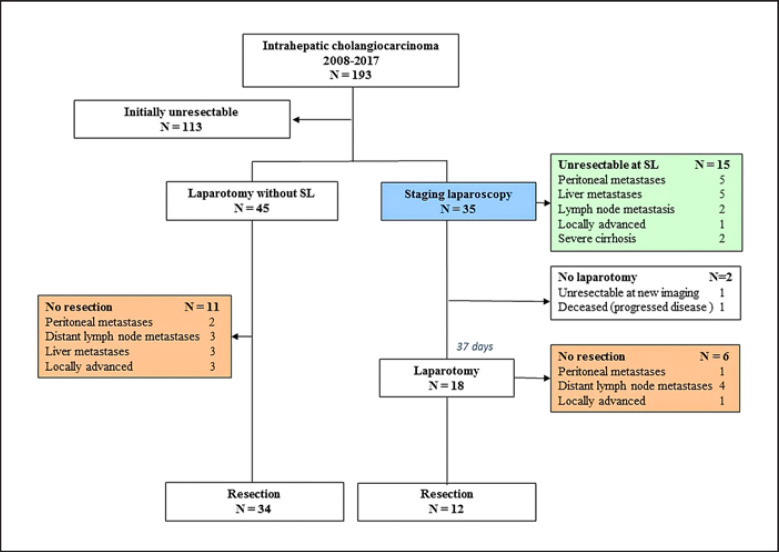
Results: Among a total of 80 patients with potentially resectable intrahepatic cholangiocarcinoma, 35 patients underwent staging laparoscopy on the suspicion of distant metastases. Unresectable disease was found at staging laparoscopy in 15 patients. Reasons for unresectability were liver metastasis (n = 6), peritoneal metastasis (n = 4), severe cirrhosis (n = 2), locally advanced tumor with satellite lesions (n = 1), and distant lymph node metastasis (n = 2). Considering optimal preoperative imaging, the true yield of staging laparoscopy was 20% (7/35). Two patients did not undergo laparotomy due to progression after staging laparoscopy. Of the remaining 18 patients who underwent laparotomy, 6 patients (30%) had unresectable disease, mostly because of distant metastasis (n = 4).
Conclusions: The role of staging laparoscopy to detect unresectable intrahepatic cholangiocarcinoma is highly dependent on the quality of preoperative imaging. Currently, no accurate selection criteria on imaging exist to select patients with intrahepatic cholangiocarcinoma who potentially benefit from staging laparoscopy.
Keywords: Intrahepatic cholangiocarcinoma; Resectability; Sensitivity; Staging laparoscopy; Yield.
Copyright © 2020 by S. Karger AG, Basel.
Conflict of interest statement
The authors have no conflicts of interest to declare.
Figures
References
-
- Khan SA, Thomas HC, Davidson BR, Taylor-Robinson SD. Cholangiocarcinoma. Lancet. 2005 Oct;366((9493)):1303–14. - PubMed
-
- Endo I, Gonen M, Yopp AC, Dalal KM, Zhou Q, Klimstra D, et al. Intrahepatic cholangiocarcinoma: rising frequency, improved survival, and determinants of outcome after resection. Ann Surg. 2008 Jul;248((1)):84–96. - PubMed
-
- Tan JC, Coburn NG, Baxter NN, Kiss A, Law CH. Surgical management of intrahepatic cholangiocarcinoma—a population-based study. Ann Surg Oncol. 2008 Feb;15((2)):600–8. - PubMed
-
- Goere D, Wagholikar GD, Pessaux P, Carrère N, Sibert A, Vilgrain V, et al. Utility of staging laparoscopy in subsets of biliary cancers: laparoscopy is a powerful diagnostic tool in patients with intrahepatic and gallbladder carcinoma. Surg Endosc. 2006 May;20((5)):721–5. - PubMed
LinkOut - more resources
Full Text Sources