


Long-Term Prognostication for 20 114 Women With Small and Node-Negative Breast Cancer (T1abN0)
- PMID: 33442658
- PMCID: PMC7791632
- DOI: 10.1093/jncics/pkaa084
Long-Term Prognostication for 20 114 Women With Small and Node-Negative Breast Cancer (T1abN0)
Abstract
Background: Although small, node-negative breast cancer (ie, T1abN0) constitutes 20% of all newly diagnosed breast cancers, data on prognosis and prognostic factors are limited.
Methods: We conducted a population-based cohort study including 20 114 Swedish women treated for T1abN0 breast cancer from 1977 onward. Patient and tumor data were collected from Swedish breast cancer registries. Cohort subjects were followed through linkage to the Cause of Death Register. We calculated the cumulative incidence of breast cancer-specific and overall death and used Cox regression to estimate hazard ratios (HRs) and 95% confidence intervals (CIs).
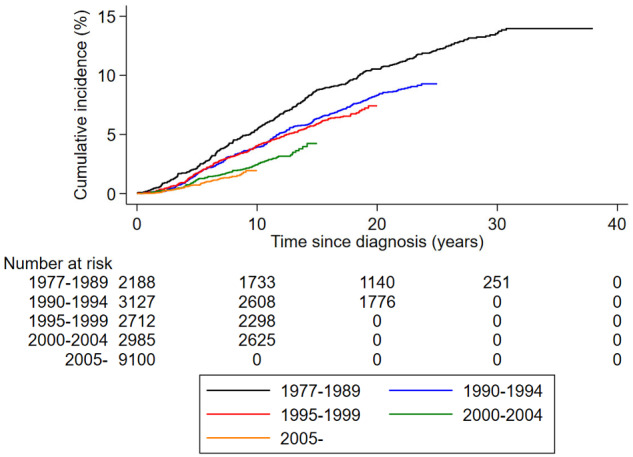
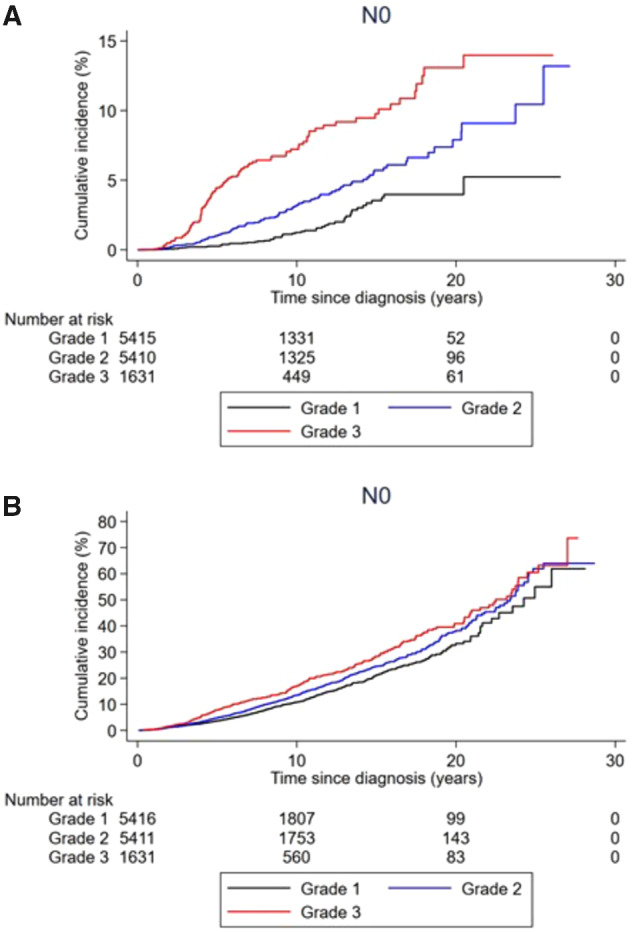
Results: During a median follow-up of 9.1 years (range = 0-38), 915 women died of breast cancer and 5416 of any cause. The 10-, 20-, and 30-year cumulative incidences of breast cancer death were 3.4% (95% CI = 3.1% to 3.7%), 7.6% (95% CI = 7.1% to 8.2%), and 10.5% (95% CI = 9.6% to 11.4%), respectively. The multivariable hazard ratios and 95% confidence intervals of breast cancer death were 0.92 (95% CI = 0.88 to 0.97) for each additional calendar year of diagnosis, 4.38 (95% CI = 2.79 to 6.87) for grade 3 vs grade 1 tumors, 0.43 (95% CI = 0.31 to 0.62) for progesterone receptor-positive vs progesterone receptor-negative disease, and 2.01 (95% CI = 0.99 to 4.07) for HER2-positive vs HER2-negative disease. Women with grade 3 vs grade 1 tumors had a 56% increased risk of death from any cause (HR = 1.56, 95% CI = 1.30 to 1.88).
Conclusions: The risk of breast cancer death in T1abN0 disease continues to increase steadily beyond 10 years after diagnosis, has improved over time, and varies substantially by tumor characteristics.
© The Author(s) 2020. Published by Oxford University Press.
Figures
References
-
- Welch HG, Prorok PC, O’Malley AJ, Kramer BS. Breast-cancer tumor size, overdiagnosis, and mammography screening effectiveness. N Engl J Med. 2016;375(15):1438–1447. - PubMed
-
- Chia S, Norris B, Speers C, et al. Human epidermal growth factor receptor 2 overexpression as a prognostic factor in a large tissue microarray series of node-negative breast cancers. J Clin Oncol. 2008;26(35):5697–5704. - PubMed
-
- Chia SK, Speers CH, Bryce CJ, Hayes MM, Olivotto IA. Ten-year outcomes in a population-based cohort of node-negative, lymphatic, and vascular invasion-negative early breast cancers without adjuvant systemic therapies. J Clin Oncol. 2004;22(9):1630–1637. - PubMed
-
- Joensuu H, Pylkkänen L, Toikkanen S. Late mortality from pT1N0M0 breast carcinoma. Cancer. 1999;85(10):2183–2189. - PubMed
-
- Ingvar C, Ahlgren J, Emdin S. Long-term outcome of pT1a-b, cN0 breast cancer without axillary dissection or staging: a prospective observational study of 1543 women. Br J Surg. 2020. doi:10.1002/bjs.11610. - PubMed
Publication types
MeSH terms
Substances
LinkOut - more resources
Full Text Sources
Medical
Research Materials
Miscellaneous