


This is a preprint.
Molecular dynamics simulations and functional studies reveal that hBD-2 binds SARS-CoV-2 spike RBD and blocks viral entry into ACE2 expressing cells
- PMID: 33442698
- PMCID: PMC7805467
- DOI: 10.1101/2021.01.07.425621
Molecular dynamics simulations and functional studies reveal that hBD-2 binds SARS-CoV-2 spike RBD and blocks viral entry into ACE2 expressing cells
Abstract
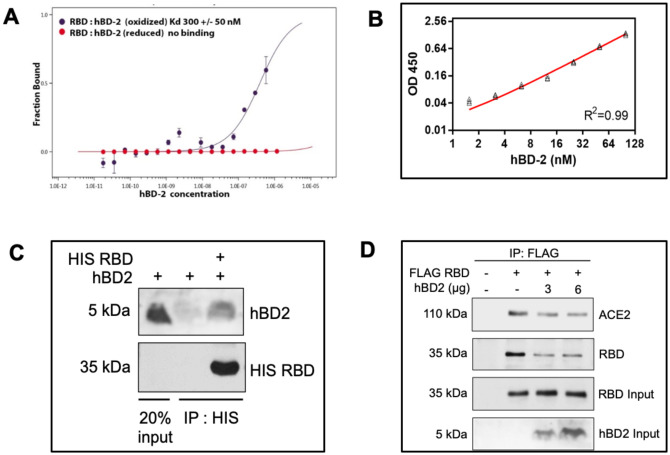
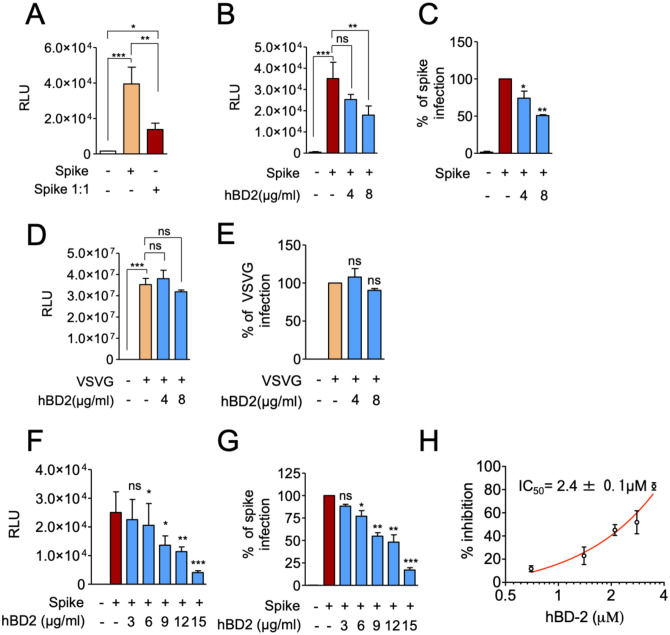
New approaches to complement vaccination are needed to combat the spread of SARS-CoV-2 and stop COVID-19 related deaths and long-term medical complications. Human beta defensin 2 (hBD-2) is a naturally occurring epithelial cell derived host defense peptide that has antiviral properties. Our comprehensive in-silico studies demonstrate that hBD-2 binds the site on the CoV-2-RBD that docks with the ACE2 receptor. Biophysical and biochemical assays confirm that hBD-2 indeed binds to the CoV-2-receptor binding domain (RBD) (KD ~ 300 nM), preventing it from binding to ACE2 expressing cells. Importantly, hBD-2 shows specificity by blocking CoV-2/spike pseudoviral infection, but not VSV-G mediated infection, of ACE2 expressing human cells with an IC50 of 2.4± 0.1 μM. These promising findings offer opportunities to develop hBD-2 and/or its derivatives and mimetics to safely and effectively use as novel agents to prevent SARS-CoV-2 infection.
Keywords: ACE2 receptor; COVID-19; Human beta defensin-2 (hBD-2); SARS-CoV-2; receptor binding domain (RBD).
Conflict of interest statement
DECLARATION OF INTERESTS: None to declare
Figures
References
-
- Bensch K.W., Raida M., Mägert H.J., Schulz-Knappe P., and Forssmann W.G. (1995). hBD-1: a novel beta-defensin from human plasma. FEBS Lett 368, 331–335. - PubMed
Publication types
Grants and funding
LinkOut - more resources
Full Text Sources
Other Literature Sources
Miscellaneous
