Case Reports
. 2022 Feb;59(2):155-164.
doi: 10.1136/jmedgenet-2020-107401. Epub 2020 Dec 21.

Deep exploration of a CDKN1C mutation causing a mixture of Beckwith-Wiedemann and IMAGe syndromes revealed a novel transcript associated with developmental delay

Affiliations
Case Reports

Deep exploration of a CDKN1C mutation causing a mixture of Beckwith-Wiedemann and IMAGe syndromes revealed a novel transcript associated with developmental delay

Siren Berland et al. J Med Genet. 2022 Feb.

Abstract

Background: Loss-of-function mutations in CDKN1C cause overgrowth, that is, Beckwith-Wiedemann syndrome (BWS), while gain-of-function variants in the gene's PCNA binding motif cause a growth-restricted condition called IMAGe syndrome. We report on a boy with a remarkable mixture of both syndromes, with developmental delay and microcephaly as additional features.

Methods: Whole-exome DNA sequencing and ultra-deep RNA sequencing of leucocyte-derived and fibroblast-derived mRNA were performed in the family.

Results: We found a maternally inherited variant in the IMAGe hotspot region: NM_000076.2(CDKN1C) c.822_826delinsGAGCTG. The asymptomatic mother had inherited this variant from her mosaic father with mild BWS features. This delins caused tissue-specific frameshifting resulting in at least three novel mRNA transcripts in the boy. First, a splice product causing CDKN1C truncation was the likely cause of BWS. Second, an alternative splice product in fibroblasts encoded IMAGe-associated amino acid substitutions. Third, we speculate that developmental delay is caused by a change in the alternative CDKN1C-201 (ENST00000380725.1) transcript, encoding a novel isoform we call D (UniProtKB: A6NK88). Isoform D is distinguished from isoforms A and B by alternative splicing within exon 1 that changes the reading frame of the last coding exon. Remarkably, this delins changed the reading frame back to the isoform A/B type, resulting in a hybrid D-A/B isoform.

Conclusion: Three different cell-type-dependent RNA products can explain the co-occurrence of both BWS and IMAGe features in the boy. Possibly, brain expression of hybrid isoform D-A/B is the cause of developmental delay and microcephaly, a phenotypic feature not previously reported in CDKN1C patients.

Keywords: INDEL mutation; RNA-seq; gain of function mutation.


Conflict of interest statement

Competing interests: None declared.

Figures
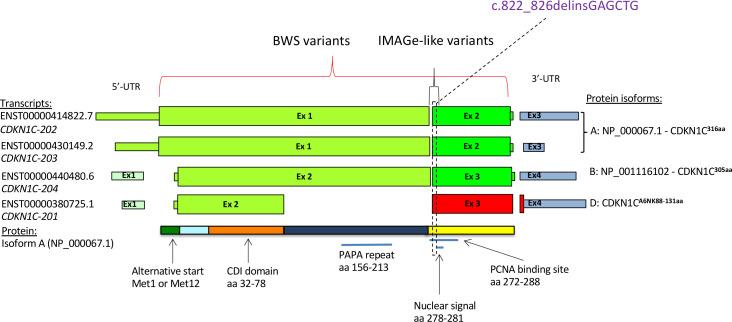
Figure 1
Figure 1
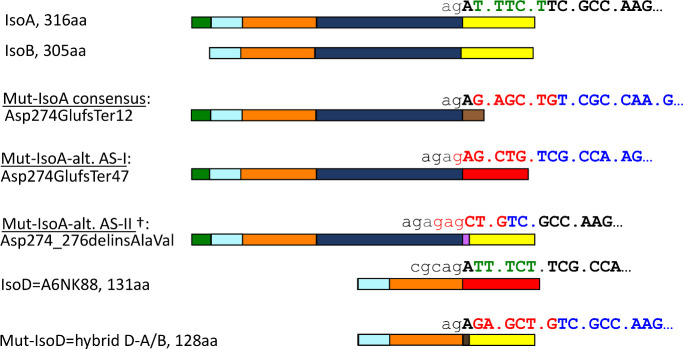
Overview of CDKN1C transcripts according to ENSEMBL GRCh38.p11, and corresponding protein isoform A. Above, the localisation of the patient’s delins variant (purple and open vertical box) and reported IMAGe and Beckwith-Wiedemann syndrome (BWS) mutations. The transcripts are not drawn to scale. The narrow bars represent untranslated regions (UTRs). To the left, ENSEMBL reference transcripts, to the right protein isoforms (NCBI protein reference sequences if known). Below, isoform A (316 aa, NP_000067.1) with amino acid borders, domains, motifs, repeats and their approximate localisation. The protein isoform A of 316 aa is encoded by two different transcripts (CDKN1C-202 and CDKN1C-203) with different lengths of UTRs but encoding identical amino acids. Isoform B (305 aa) uses an alternative start methionine, 11 aa downstream. A6NK88 is the UniProtKB accession code for the 131 aa protein isoform that we call isoform D. CDKN1C-206 (encoding isoform C) is not included in this figure as this transcript was not detected in our analysis.
Figure 2
Figure 2
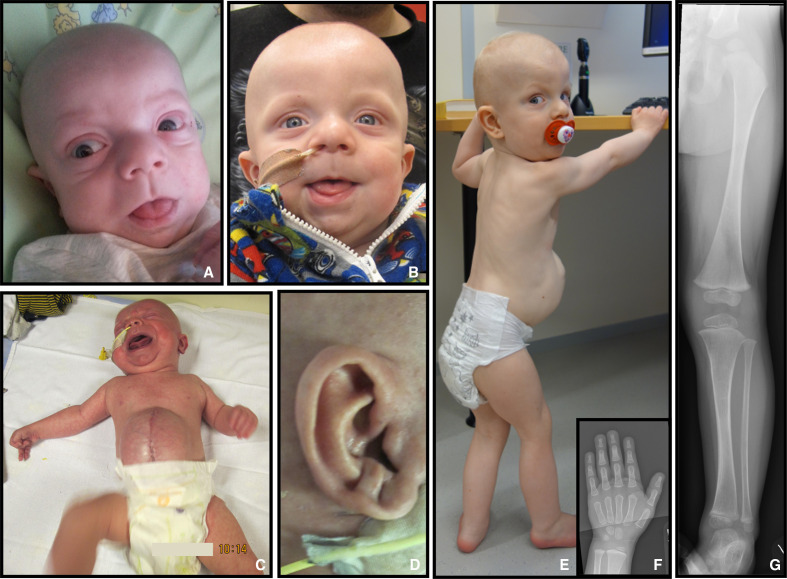
Boy at age 3 months (A, C, D), 6 months (B) and 27 months (G, F), with clinical features of both Beckwith-Wiedemann syndrome (ie, omphalocele, midface retrusion, large cheeks, hypertelorism with down-slanted palpebral fissures, infraorbital and ear creases, a fading glabellar capillary malformation, and a long and marked philtrum with a thin upper lip, wide mouth with a high palate and macroglossia) and IMAGe (slender habitus, feeding difficulties, frontal bossing, broad nasal bridge and a wide tip, low set and posteriorly rotated ears, long and slender finger and toes). Radiographs of leg (G) showing long and slender diaphysis and broad metaphysis, with a delayed bone age of fingers (F).
Figure 3
Figure 3
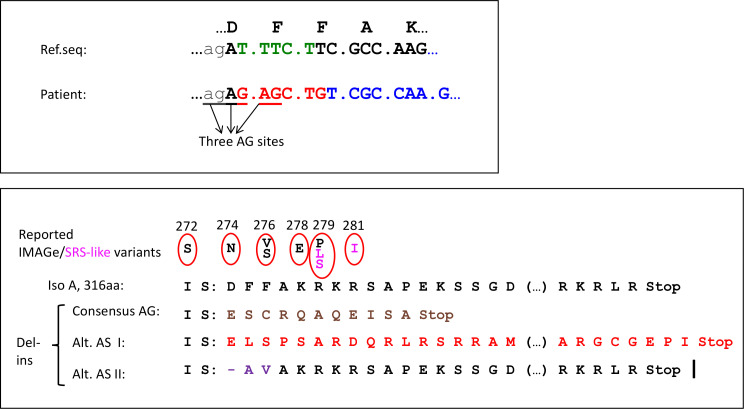
Predicted impact of the delins variant c.822_826delinsGAGCTG on DNA and isoform A. Upper panel shows the CDKN1C intron 2/exon 3 junction with reference amino acids on top and the reference nucleotide sequence (ENST00000414822.7, CDKN1C-202) just below. Intron sequences are written in lower case letters and exon sequences in capital letters. The five deleted nucleotides are in green. The bottom line shows the mutated sequence with the six inserted nucleotides in red, the three adjacent AGs (potential acceptor sites/AS) underlined and the out-of-frame sequence marked in blue. The lower panel shows details of the predicted amino acid sequence and changes introduced by the delins variant in amino acid numbers according to protein isoform A (316aa—NP_000067.1). On top reported IMAGe (black) and Silver-Russel syndrome (SRS)–like variants (magenta) from literature with the corresponding amino acid change, then the reference protein product, followed by the mutated products using the consensus AG (p.Asp274GlufsTer12), the protein product if alternative acceptor site I is used (p.Asp274GlufsTer47) and the protein product if alternative acceptor site II is used (p.Asp274_276delinsAlaVal). Parentheses (…) represent 21 amino acids omitted from the figure.
Figure 4
Figure 4
Overview of the predicted protein products. From top, wild-type isoform A (encoded by transcripts ENST00000414822.7=CDKN1C-202 and ENST00000430149.2=CDKN1C-203), wild-type isoform B (ENST00000440480.6=CDKN1 C-204), followed by three predicted CDKN1C protein variants of mutated isoform A depending on the splice acceptor site used; consensus acceptor site and alternative acceptor sites I or II. At the bottom, isoform D (A6NK88, encoded by ENST00000380725.1=CDKN1 C-201, with a reading frame different from isoforms A and B) and the mutated isoform D (hybrid isoform D–A/B), consensus acceptor site used. The colours correspond to regions in figures 1 and 3, where intron sequences are written in lowercase letters and exon sequence in capital letters. The five deleted nucleotides are in green. The six inserted nucleotides in the mutated (delins) sequences are shown in red, and the out-of-frame sequence marked in blue. † denotes a predicted transcript that was not found on RNA sequencing.
Figure 5
Figure 5
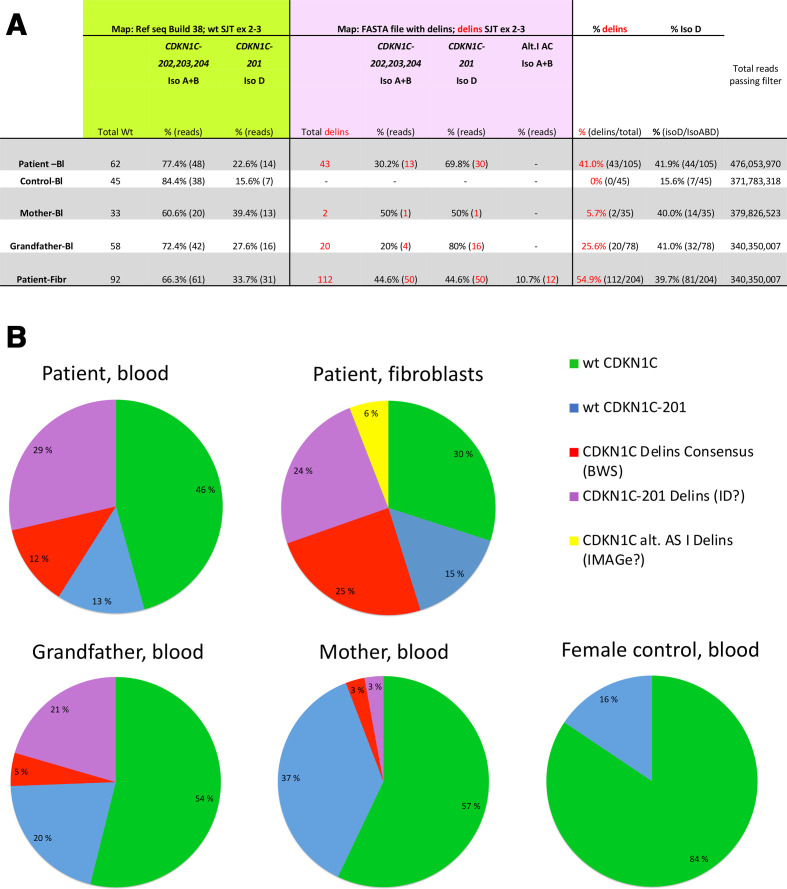
Result from NGS-based cDNA sequencing. (A) The number of reads spanning exon junctions (splice junction tracks, SJTs) after mapping to the reference sequence (from Genome Build 38, green background) and the delins-containing sequence (manually designed reference sequence, pink background). Reads with delins are shown in red. All reads were manually checked, and only SJTs spanning exons 2–3 are counted. Numbers are derived from figures as in the last part of the online supplemental file 1. Of note, reference sequence mapping did not detect any delins reads, probably because they were filtered out due to the complexity of the delins variant. (B) Sector diagrams illustrating the distributions of documented transcripts from RNA sequencing of RNA derived from blood samples and fibroblast. The percentages are calculated from the numbers in figure 5A. It was not possible to discriminate all CDKN1C transcripts by RNA sequencing, so CDKN1C-202, CDKN1C-203 and CDKN1C-204 are collectively referred to as CDKN1C in this figure, but CDKN1C-201 transcripts (isoform D, UniProt: A6NK88) are identified. Green and blue colours represent wt reads of CDKN1C and CDKN1C-201, respectively, and red and purple colours represent delins reads using the consensus acceptor site in CDKN1C and CDKN1C-201, respectively. A fifth transcript (yellow) with delins CDKN1C using alternative acceptor site I, p.(Asp274GlufsTer47), was only documented in RNA from fibroblasts in the boy. The predicted or hypothetical clinical consequences of each of the four different mutated transcripts are noted in parentheses.

References

    1. Eggermann T, Binder G, Brioude F, Maher ER, Lapunzina P, Cubellis MV, Bergadá I, Prawitt D, Begemann M. CDKN1C mutations: two sides of the same coin. Trends Mol Med 2014;20:614–22. 10.1016/j.molmed.2014.09.001 - DOI - PubMed
    1. Hatada I, Ohashi H, Fukushima Y, Kaneko Y, Inoue M, Komoto Y, Okada A, Ohishi S, Nabetani A, Morisaki H, Nakayama M, Niikawa N, Mukai T. An imprinted gene p57KIP2 is mutated in Beckwith-Wiedemann syndrome. Nat Genet 1996;14:171–3. 10.1038/ng1096-171 - DOI - PubMed
    1. Brioude F, Lacoste A, Netchine I, Vazquez M-P, Auber F, Audry G, Gauthier-Villars M, Brugieres L, Gicquel C, Le Bouc Y, Rossignol S. Beckwith-Wiedemann syndrome: growth pattern and tumor risk according to molecular mechanism, and guidelines for tumor surveillance. Horm Res Paediatr 2013;80:457–65. 10.1159/000355544 - DOI - PubMed
    1. Arboleda VA, Lee H, Parnaik R, Fleming A, Banerjee A, Ferraz-de-Souza B, Délot EC, Rodriguez-Fernandez IA, Braslavsky D, Bergadá I, Dell'Angelica EC, Nelson SF, Martinez-Agosto JA, Achermann JC, Vilain E. Mutations in the PCNA-binding domain of CDKN1C cause IMAGe syndrome. Nat Genet 2012;44:788–92. 10.1038/ng.2275 - DOI - PMC - PubMed
    1. Weksberg R, Shuman C, Beckwith JB. Beckwith-Wiedemann syndrome. Eur J Hum Genet 2010;18:8–14. 10.1038/ejhg.2009.106 - DOI - PMC - PubMed

Publication types

Substances