. 2021 Jan 5;118(1):e2021996118.
doi: 10.1073/pnas.2021996118.

Precise genome engineering in Drosophila using prime editing

Affiliations

Precise genome engineering in Drosophila using prime editing

Justin A Bosch et al. Proc Natl Acad Sci U S A. .

Abstract

Precise genome editing is a valuable tool to study gene function in model organisms. Prime editing, a precise editing system developed in mammalian cells, does not require double-strand breaks or donor DNA and has low off-target effects. Here, we applied prime editing for the model organism Drosophila melanogaster and developed conditions for optimal editing. By expressing prime editing components in cultured cells or somatic cells of transgenic flies, we precisely introduce premature stop codons in three classical visible marker genes, ebony, white, and forked Furthermore, by restricting editing to germ cells, we demonstrate efficient germ-line transmission of a precise edit in ebony to 36% of progeny. Our results suggest that prime editing is a useful system in Drosophila to study gene function, such as engineering precise point mutations, deletions, or epitope tags.

Keywords: CRISPR; Drosophila; genome engineering; pegRNA; prime editing.


Conflict of interest statement

The authors declare no competing interest.

Figures
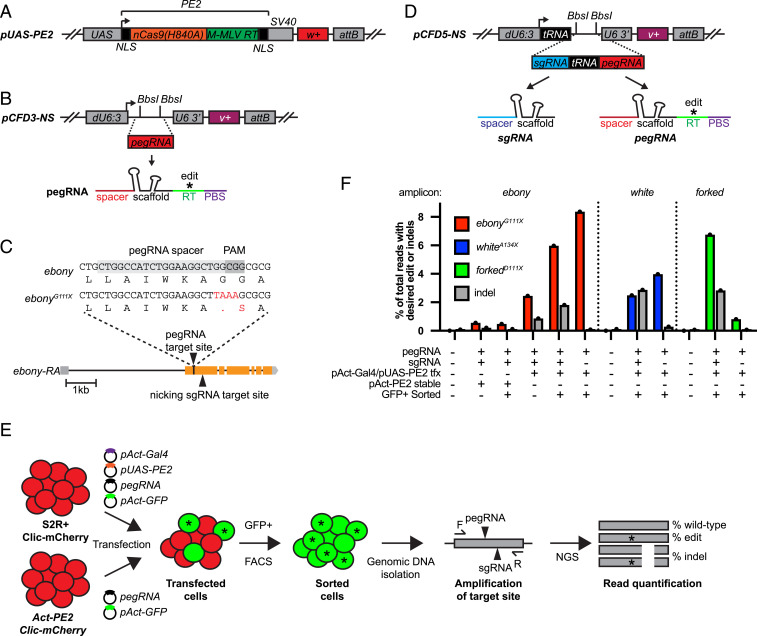
Fig. 1.
Fig. 1.
Prime editing in cultured S2R+ cells. (A) Diagram of PE2 expression plasmid pUAS-PE2. attB, phiC31 recombination site; NLS, nuclear localization sequence; PBS, primer-binding site; SV40, 3′ untranslated region; UAS, upstream activating sequence; w+, white+ rescue transgene. (B) Diagram of pCFD3-NS pegRNA expression plasmid. BbsI sites indicate cloning site for pegRNA encoding sequence. dU6:3, U6 promoter; U6 3′, U6 downstream region; v+, vermillion+ rescue transgene. (C) ebony genomic region showing target site and edit (ebonyG111X). (D) Dual sgRNA and pegRNA expression plasmid pCFD5-NS. tRNA, D. melanogaster and O.s. Gly tRNA sequence. (E) Schematic of S2R+ prime editing experiment. (F) Approximate quantification of precise editing and indels from S2R+ transfection experiments by amplicon sequencing. tfx, transfection.
Fig. 2.
Fig. 2.
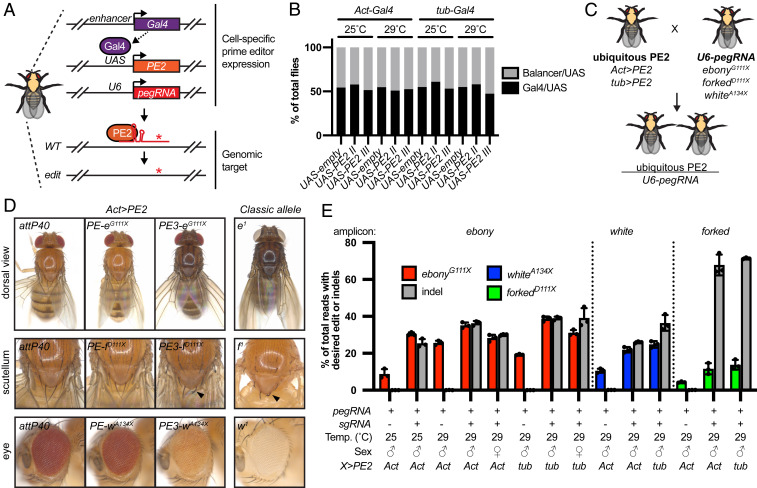
Prime editing in somatic cells. (A) Schematic of transgenic expression of prime editing components in flies and editing at an endogenous locus. Enhancer-specific Gal4 directs the tissue-specific expression of PE2. WT, wild type. (B) Quantification of adult fly viability after ubiquitous PE2 expression during all developmental stages and raised at either 25 or 29 °C. Act-Gal4/CyO or tub-Gal4/TM3 were crossed with UAS-PE2 (ChrII), UAS-PE2 (ChrIII), or UAS-empty (negative control), and the percentage of progeny with or without the balancer was calculated. Number of flies scored from left to right: 748, 687, 655, 157, 267, 202, 294, 413, 226, 131, 277, 238. (C) Schematic of genetic crosses between ubiquitous PE2 and pegRNA transgenic flies. (D) Images of adult flies with somatic editing using Act>PE2. Views of the dorsal side of whole adults (Top), scutellum (Middle), and eye (Bottom). Negative control is attP40 and positive control are classical loss-of-function alleles (Right). Females are shown for editing of ebony and forked, and males are shown for white editing. e1: (w1;; TM3,e1/TM6b,e1); f1: (y1, w1, f1). (E) Approximate quantification of precise somatic editing and indel percentage in adult flies by amplicon sequencing. Error bars show mean with SD. n = 3 adult flies.
Fig. 3.
Fig. 3.
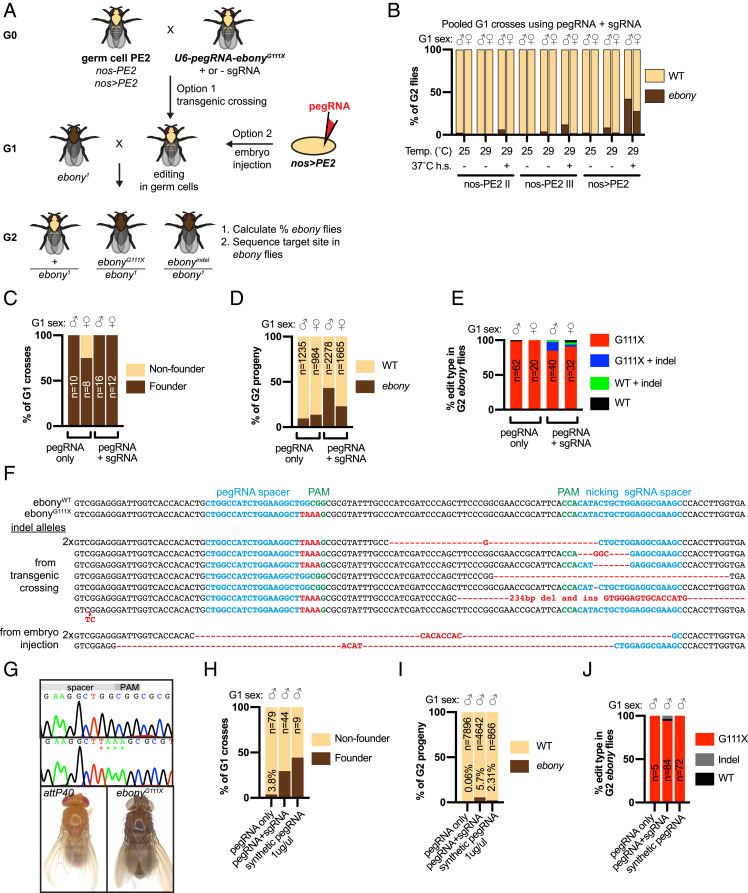
Prime editing in the germ line. (A) Schematic of genetic crosses to express PE2 and ebonyG111X pegRNA in germ cells and detect transmission of mutations in ebony. (BE) Quantification of ebony transmission and edit type using transgenic crossing. pegRNA only: pCFD3-PE-ebonyG111X; pegRNA + sgRNA: pCFD5-PE3-ebonyG111X. Sex of G1 parents and sample size are indicated on the graph unless otherwise noted. (B) Quantification of ebony transmission from the germ line of G1 parents to G2 progeny, expressed as the percent of G2 flies with dark cuticle pigmentation (phenotypically ebony). For each condition (temperature raised, PE2 genotype), 10 G1 flies were crossed as a combined pool. The number of G2 flies analyzed was (left to right) 453, 518, 574, 413, 702, 405, 514, 454, 514, 405, 376, 493, 557, 492, 510, 562, 471, 481. (C) Quantification of single G1 flies that transmit at least one ebony progeny. (D) Quantification of G2 ebony progeny transmitted from single G1 crosses in C. (E) Quantification of sequenced edit types in individual G2 flies from single G1 crosses. (F) Sequence structure at the ebony target site, showing wild type, the intended G111X edit, indel alleles, pegRNA and sgRNA spacer (blue), PAM (green), and changes to wild-type sequence (red). (G) Sequence chromatograms (Top) and images (Bottom) of wild-type and ebonyG111X homozygous adult flies. (HJ) Quantification of ebony transmission and edit type using embryo injection of plasmid or synthetic pegRNA. pegRNA only: pCFD3-PE-ebonyG111X; pegRNA + sgRNA: pCFD5-PE3-ebonyG111X. Data from plasmid injections were combined for all concentrations tested. (H) Quantification of single G1 flies that transmit at least one ebony progeny. Data from synthetic pegRNA injection are shown using 1 μg/μL. (I) Quantification of G2 ebony progeny transmitted from single G1 crosses in H. (J) Quantification of sequenced edit types in individual G2 flies from single G1 crosses. Data for synthetic pegRNA were combined for all concentrations tested.

References

    1. Pickar-Oliver A., Gersbach C. A., The next generation of CRISPR-Cas technologies and applications. Nat. Rev. Mol. Cell Biol. 20, 490–507 (2019). - PMC - PubMed
    1. Vandemoortele G., Eyckerman S., Gevaert K., Pick a tag and explore the functions of your pet protein. Trends Biotechnol. 37, 1078–1090 (2019). - PubMed
    1. Venken K. J., et al. , Genome engineering: Drosophila melanogaster and beyond. Wiley Interdiscip. Rev. Dev. Biol. 5, 233–267 (2016). - PMC - PubMed
    1. Korona D., Koestler S. A., Russell S., Engineering the Drosophila genome for developmental biology. J. Dev. Biol. 5, 16 (2017). - PMC - PubMed
    1. Bier E., Harrison M. M., O’Connor-Giles K. M., Wildonger J., Advances in engineering the fly genome with the CRISPR-Cas system. Genetics 208, 1–18 (2018). - PMC - PubMed

Publication types

MeSH terms

LinkOut - more resources