Review
doi: 10.1126/scisignal.abc6438.
Tissue-specific adrenergic regulation of the L-type Ca2+ channel CaV1.2
Affiliations
- PMID: 33443233
- PMCID: PMC7909005
- DOI: 10.1126/scisignal.abc6438
Item in Clipboard
Review
Tissue-specific adrenergic regulation of the L-type Ca2+ channel CaV1.2
Sci Signal.
.
Abstract
Ca2+ influx through the L-type Ca2+ channel Cav1.2 triggers each heartbeat. The fight-or-flight response induces the release of the stress response hormone norepinephrine to stimulate β-adrenergic receptors, cAMP production, and protein kinase A activity to augment Ca2+ influx through Cav1.2 and, consequently, cardiomyocyte contractility. Emerging evidence shows that Cav1.2 is regulated by different mechanisms in cardiomyocytes compared to neurons and vascular smooth muscle cells.
Copyright © 2020 The Authors, some rights reserved; exclusive licensee American Association for the Advancement of Science. No claim to original U.S. Government Works.
Figures
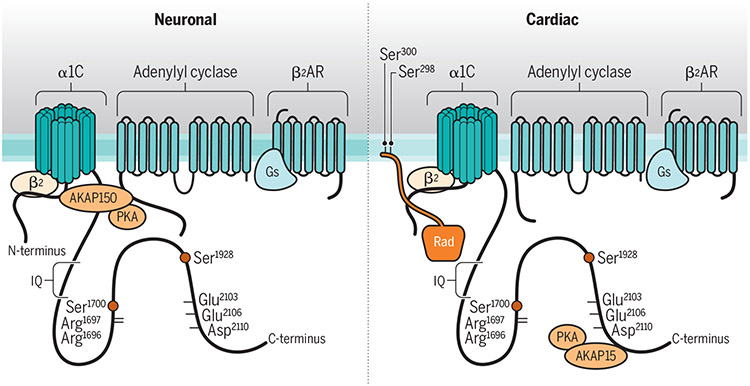
Models depict the hypothesized overall structural arrangements of part of the β2 AR/Cav1.2 signaling complex as might be prevalent in neurons (left) and cardiomyocytes (right). Cav1.2 is thought to mostly reside outside lipid rafts in neurons (darker membrane) and in lipid rafts in cardiomyocytes (lighter membrane) (22, 23). Rad is present predominantly in cardiomyocytes and might bind to the β subunit and the N-terminus and PCT of the α1 subunit of Cav1.2, either through multiple interactions as depicted or in multiple copies (not depicted). AKAP150 and AKAP15 seem to be the predominant AKAP in neurons and cardiomyocytes, respectively. AKAP150 links both adenylyl cyclase and PKA to Cav1.2 and has multiple interaction sites with Cav1.2 (15). AKAP15 is shorter than AKAP150 and may link only PKA to Cav1.2. How AC is linked to Cav1.2 when AKAP15 is in the Cav1.2 complex is unclear. The PCT and DCT are depicted in a ‘closed’ conformation in the left model due to salt bridges between Arg1696 and Arg1697 in the PCT and Glu2103, Glu2106 and Asp2110 in the DCT and in an ‘open’ conformation in the right model, perhaps due to differences in the environment of Cav1.2 (inside compared to outside of rafts) or associated proteins. Arg1696 and Arg1697 are part of the PKA consensus site for phosphorylation of Ser1700, which disrupts these salt bridges. Ser1928 is the main PKA phosphorylation site in α11.2. For simplicity, the linkers between the transmembrane segments of the α1 subunit of Cav1.2 are not shown.
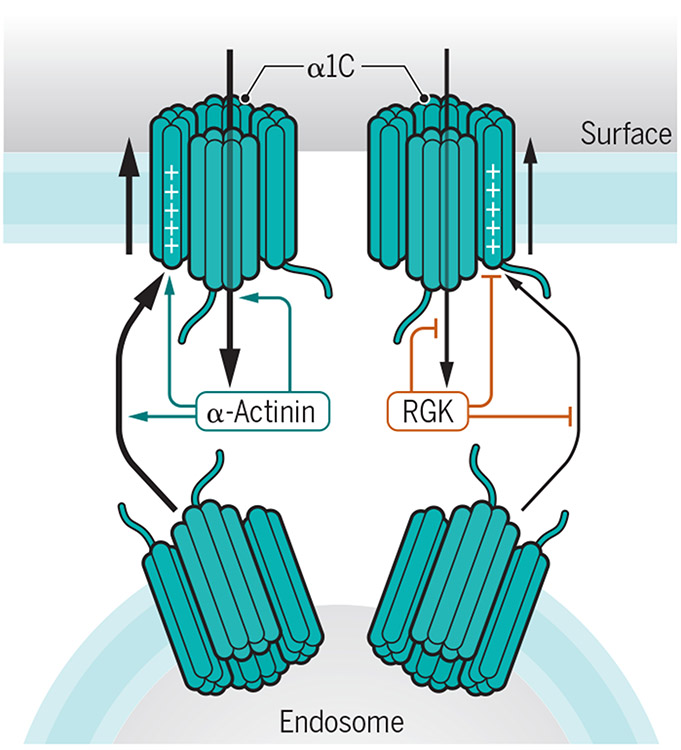
Schematic depiction of α-actinin promoting (green arrows) and Rem antagonizing (red lines) three major parameters that affect Cav1.2 functions: surface abundance, movement of the voltage sensing S4 transmembrane helices, which carry the gating charges, and coupling of gating movements to pore opening. Impaired coupling has been directly determined for loss of α-actinin binding to Cav1.2 (36) and is suggested by analogy for Rem binding (31, 33). For simplicity, the linkers between the transmembrane segments of the α1 subunit of Cav1.2 are not shown.
References
Publication types
MeSH terms
Substances
Grants and funding
LinkOut - more resources
Full Text Sources
Miscellaneous