Information Sharing Practices Between US Hospitals and Skilled Nursing Facilities to Support Care Transitions
- PMID: 33443582
- PMCID: PMC7809587
- DOI: 10.1001/jamanetworkopen.2020.33980
Information Sharing Practices Between US Hospitals and Skilled Nursing Facilities to Support Care Transitions
Abstract
Importance: Patient transitions from hospitals to skilled nursing facilities (SNFs) require robust information sharing. After a decade of investment in health information technology infrastructure and new incentives to promote hospital-SNF coordination in the US, the current state of information sharing at this critical transition is unknown.
Objective: To measure the completeness, timeliness, and usability of information shared by hospitals when discharging patients to SNFs, and to identify relational and structural characteristics associated with better hospital-SNF information sharing.
Design, setting, and participants: Survey of 500 SNFs from a US nationally representative sample (265 respondents representing 471 hospital-SNF pairs; response rate of 53.0%) that collected detailed data on information sharing that supports care transitions from each of the 2 hospitals from which they receive the largest volume of patient referrals. Survey administration occurred between January 2019 and March 2020.
Main outcomes and measures: Overall assessment of information completeness, timeliness, and usability using 5-point Likert scales. Detailed measures, including (1) completeness-routine sharing of 23 specific information types; (2) timeliness-how often information arrived after the patient; and (3) usability-whether information was duplicative, extraneous, or not tailored to SNF needs. In addition, 8 relational characteristics (eg, shared staffing, collaborative meetings, and referral volume) and 10 structural characteristics (eg, size, ownership, and staffing) were assessed as potential factors associated with better information sharing.
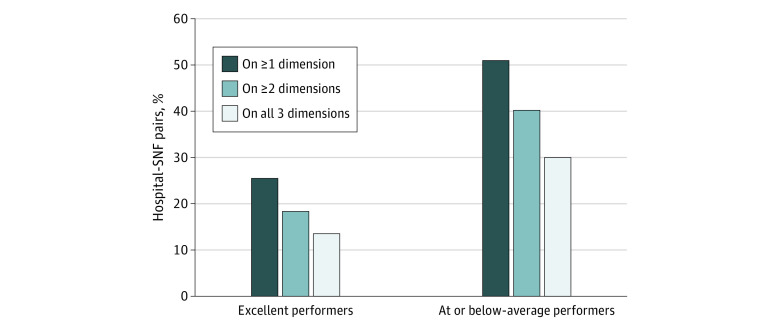
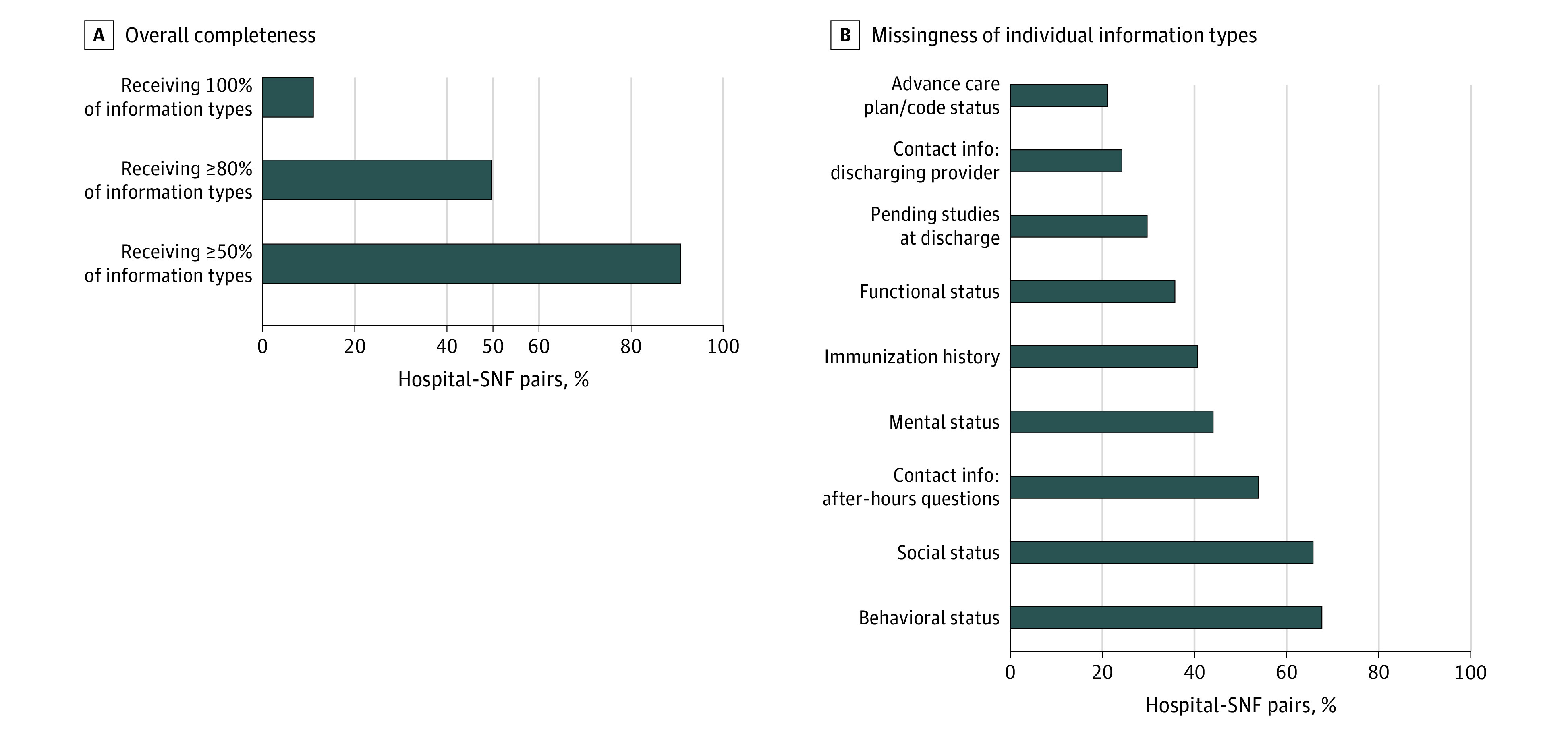
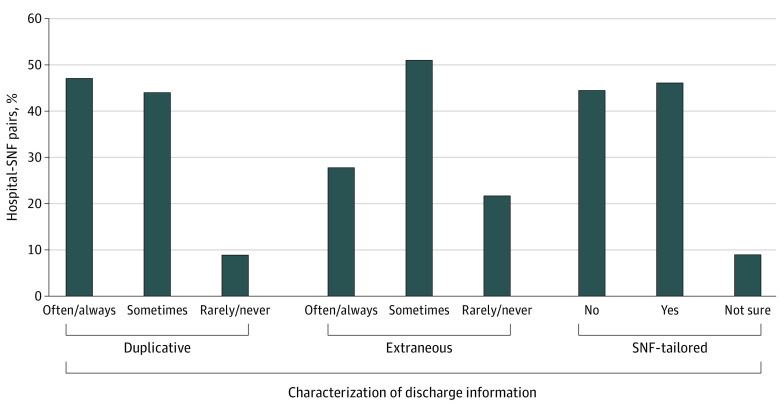
Results: Of 471 hospital-SNF pairs, 64 (13.5%) reported excellent performance on all 3 dimensions of information sharing, whereas 141 (30.0%) were at or below the mean performance on all dimensions. Social status (missing in 309 pairs [65.7%]) and behavioral status (missing in 319 pairs [67.7%]) were the most common types of missing information. Receipt of hospital information was delayed, sometimes (159 pairs [33.8%]) or often (77 pairs [16.4%]) arriving after the patient. In total, 358 pairs [76.0%] reported at least 1 usability shortcoming. Having a hospital clinician on site at the SNF was associated in multivariate analysis with more complete (odds ratio, 1.72; 95% CI, 1.07-2.78; P = .03), timely (odds ratio, 1.76; 95% CI, 1.08-2.88; P = .02), and usable (odds ratio, 1.64; 95% CI, 1.02-2.63; P = .04) information sharing. Hospital accountable care organization participation was associated with more timely information sharing (odds ratio, 1.88; 95% CI, 1.13-3.14; P = .02).
Conclusions and relevance: In this study, US SNFs reported significant shortcomings in the completeness, timeliness, and usability of information provided by hospitals to support patient transitions. These shortcomings are likely associated with a suboptimal transition experience. Shared clinicians represent a potential strategy to improve information sharing but are costly. New payment models such as accountable care organizations may offer a more scalable approach but were only associated with more timely sharing.
Conflict of interest statement
Figures
Comment in
-
Bridging the Hospital-Skilled Nursing Facility Information Continuity Divide.JAMA Netw Open. 2021 Jan 4;4(1):e2035040. doi: 10.1001/jamanetworkopen.2020.35040. JAMA Netw Open. 2021. PMID: 33443578 Free PMC article. No abstract available.
References
Publication types
MeSH terms
LinkOut - more resources
Full Text Sources
Other Literature Sources
Medical