


The Case for Biocalculus: Improving Student Understanding of the Utility Value of Mathematics to Biology and Affect toward Mathematics
- PMID: 33444110
- PMCID: PMC8108491
- DOI: 10.1187/cbe.20-06-0124
The Case for Biocalculus: Improving Student Understanding of the Utility Value of Mathematics to Biology and Affect toward Mathematics
Abstract
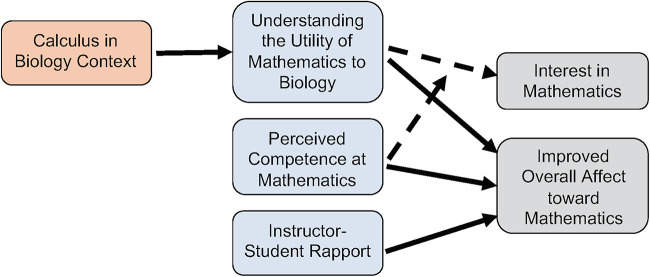
The next generation of life science professionals will require far more quantitative skills than prior generations. Calculus is important for understanding dynamical systems in biology and, therefore, is often a required course for life science students. However, many life science students do not understand the utility value of mathematics to biology. Therefore, according to expectancy-value theory, life science students may experience lower motivation, which can impact their performance in a calculus course. This study examines how two different biocalculus courses, which integrated calculus and biological concepts and successfully halved the rates of students earning a D, F, or withdrawing (DFW), affected life science students' utility value, interest, and overall attitudes toward mathematics. Using pre and post surveys, we found that students' interest in mathematics increased by the end of the semester, and they demonstrated a more sophisticated understanding of how mathematics is used in biology. Students whose attitudes toward mathematics improved primarily attributed these changes to a better understanding of the utility of mathematics to biology, feelings of competence in mathematics, or rapport with the instructor. Thus, communicating the utility value of mathematics to biology through integrated mathematics-biology courses can contribute to improved attitudes toward mathematics that can impact students' motivation and performance.
Figures
References
-
- Adler, F. R. (2012). Modeling the dynamics of life: Calculus and probability for life scientists (3rd ed.). Pacific Grove, CA: Brooks Cole.
-
- American Association for the Advancement of Science. (2011). Vision and change in undergraduate biology education: A call to action. Washington, DC.
-
- Arnett, A., Van Horn, D. (2009). Connecting mathematics and science: A learning community that helps math-phobic students. Journal of College Science Teaching, 38(6), 30–34.
-
- Association of American Medical Colleges–Howard Hughes Medical Institute. (2009). Scientific foundations for future physicians. Washington, DC: Association of American Medical Colleges.
MeSH terms
LinkOut - more resources
Full Text Sources
Other Literature Sources
