


Impact of reproduction number on the multiwave spreading dynamics of COVID-19 with temporary immunity: A mathematical model
- PMID: 33444746
- PMCID: PMC7836705
- DOI: 10.1016/j.ijid.2021.01.018
Impact of reproduction number on the multiwave spreading dynamics of COVID-19 with temporary immunity: A mathematical model
Abstract
Objectives: The recent discoveries of phylogenetically confirmed COVID-19 reinfection cases worldwide, together with studies suggesting that antibody titres decrease over time, raise the question of what course the epidemic trajectories may take if immunity were really to be temporary in a significant fraction of the population. The objective of this study is to obtain an answer for this important question.
Methods: We construct a ground-up delay differential equation model tailored to incorporate different types of immune response. We considered two immune responses: (a) short-lived immunity of all types, and (b) short-lived sterilizing immunity with durable severity-reducing immunity.
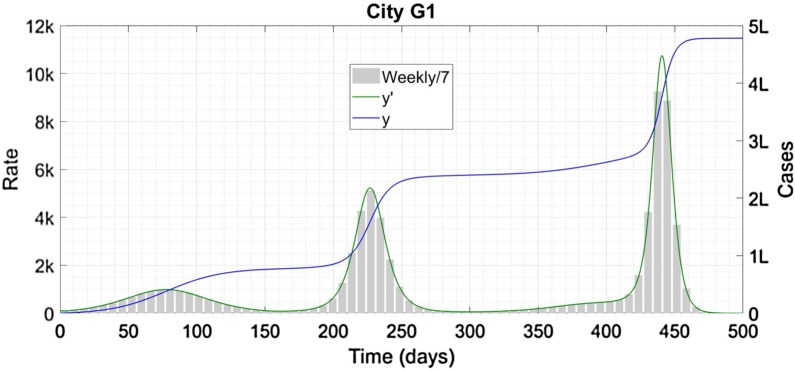
Results: Multiple wave solutions to the model are manifest for intermediate values of the reproduction number R; interestingly, for sufficiently low as well as sufficiently high R, we find conventional single-wave solutions despite temporary immunity.
Conclusions: The versatility of our model, and its very modest demands on computational resources, ensure that a set of disease trajectories can be computed virtually on the same day that a new and relevant immune response study is released. Our work can also be used to analyse the disease dynamics after a vaccine is certified for use and information regarding its immune response becomes available.
Keywords: COVID-19 reinfection; Multiple wave solutions; SEIRS-type delay model; Simple and complex immune response.
Copyright © 2021 The Authors. Published by Elsevier Ltd.. All rights reserved.
Figures




References
-
- Abu-Raddad L.J., Chemaitelly H., Ayoub H.H., Al Kanaani Z., Al Khal A., Al Kuwari E. Assessment of the risk of SARS-CoV-2 reinfection in an intense re-exposure setting. MedRxiv. 2020 https://www.medrxiv.org/content/10.1101/2020.08.24.20179457v1 Available at: - DOI
-
- Ackerly D.C. Vox; 2020. My patient caught Covid-19 twice. So long to herd immunity hopes?https://www.vox.com/2020/7/12/21321653/getting-covid-19-twice-reinfectio... Available at:
-
- Anna F., Goyard S., Lalanne A.I., Nevo F., Gransagne M., Souque P. High seroprevalence but short-lived immune response to SARS-CoV-2 infection in Paris. MedRxiv. 2020 https://www.medrxiv.org/content/10.1101/2020.10.25.20219030v1 Available at: - DOI - PMC - PubMed
-
- Bjørnstad O., Shea K., Krzywinski M., Altman N. The SEIRS model for infectious disease dynamics. Nat Methods. 2020;17(6):557–558. - PubMed
-
- CGTN . 2020. Ecuador confirms first case of COVID-19 reinfection.https://news.cgtn.com/news/2020-08-30/Ecuador-confirms-first-case-of-COV... Available from:
MeSH terms
LinkOut - more resources
Full Text Sources
Other Literature Sources
Medical
