


Patient satisfaction and oral health-related quality of life 10 years after implant placement
- PMID: 33446161
- PMCID: PMC7807859
- DOI: 10.1186/s12903-020-01381-3
Patient satisfaction and oral health-related quality of life 10 years after implant placement
Abstract
Background: Implant survival and implant success (freedom of biologic complications) are important factors in assessing the success of implant therapy. However, these factors are not the only determinants. Patients' satisfaction also plays a very important role in daily practice. Therefore, the aim of this study was to assess patients' satisfaction regarding function (phonetics, chewing comfort, stability, cleanability) and aesthetics in patients treated with XiVE and Frialite implants in a private periodontal practice ten years after implant placement. Furthermore, oral health-related quality of life (OHRQoL) was evaluated.
Methods: Patient-reported outcome measures (PROMs) regarding overall satisfaction, phonetics, chewing comfort, stability, cleanability, and aesthetics were examined on a Visual Analog Scale (VAS) 10 years ± 6 months after implant placement in a cross-sectional survey. OHRQoL and psychological impact were assessed via the Oral Health Impact Profile (OHIP) and Psychosocial Impact of Dental Aesthetics Questionnaire (PIDAQ). Potential influence of patient-related factors (age, gender, smoking, peri-implantitis, implant position, type of restoration) on VAS, OHRQoL and PIDAQ were investigated using regression analyses.
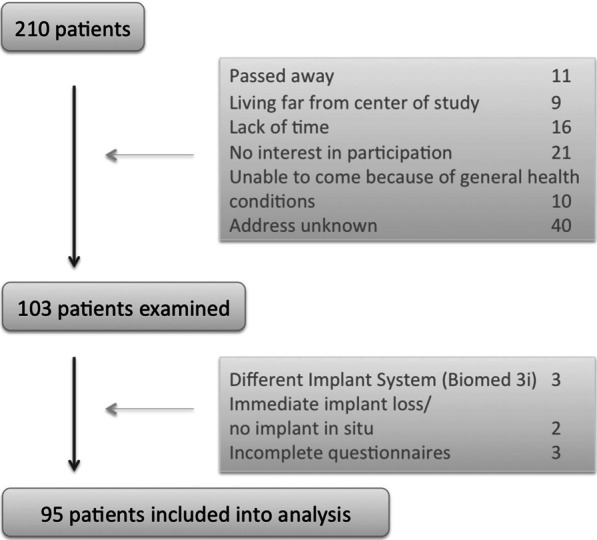
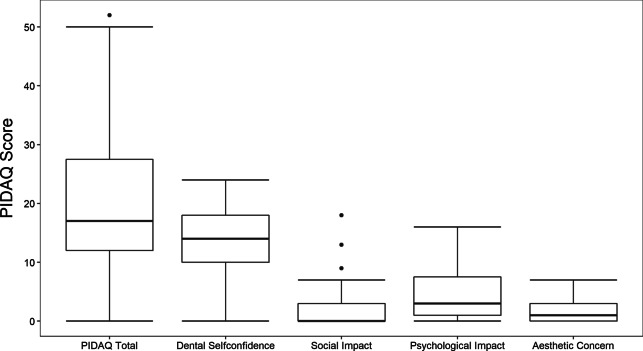
Results: High satisfaction with implant-supported restorations was seen in all 95 patients ten years after implant placement. Mean VAS-score for general satisfaction with implant-supported restoration was 93.0% (SD ± 9.4, median: 96.3%, range 50.0-100%). Mean OHIP score was 11.3 (SD ± 10.8, median: 9.0, range 0-45), mean PIDAQ score 20.5 (SD ± 11.37, median: 17.0, range 0-52). A slight tendency that presence of a moderate/severe peri-implantitis lowers satisfaction could be detected (overall satisfaction: ordinal, p = 0.012, VAS, p = 0.026). Also, the factors age, implant position and type of restoration might have an impact on patient's satisfaction.
Conclusions: Patients restored with mostly fixed implant-supported restorations showed a very high patient satisfaction regarding function and aesthetics 10-year after implant placement. The presence of a moderate/severe peri-implantitis showed a slight tendency for influencing patient satisfaction. Due to the cross-sectional design results have to be interpreted with care.
Keywords: Aesthetics; Implants; OHIP; PIDAQ; Patient satisfaction; Quality of life.
Conflict of interest statement
Author A. Bäumer declares that she has received research grants from Company Dentsply Sirona Implant, Hain Life Sciene and speaker honorarium from the following Companies: American Dental Systems, Dentsply Sirona Implant and Tecnoss. Author G. Körner has received speaker honorarium from the following Companies: American Dental Systems, Geistlich, Dentsply Sirona Implant, Tecnoss, Nobel Biocare, Quintessence, Camlog, 3i, Gebrüder Martin, BEGO. The authors Y. Wang, D. Bäumer and A.-K. Ozga declare that they have no conflict of interest.
Figures

References
-
- Brocard D, Barthet P, Baysse E, Duffort JF, Eller P, Justumus P, Marin P, Oscaby F, Simonet T, Benque E, et al. A multicenter report on 1022 consecutively placed ITI implants: a 7-year longitudinal study. Int. J. Oral Maxillofac. Implants. 2000;15(5):691–700. - PubMed
Publication types
MeSH terms
Substances
LinkOut - more resources
Full Text Sources
Other Literature Sources
Medical
