Meta-Analysis
. 2021 Jan 14;11(1):1303.
doi: 10.1038/s41598-020-79708-x.

Intake of dairy products and associations with major atherosclerotic cardiovascular diseases: a systematic review and meta-analysis of cohort studies

Affiliations
Meta-Analysis

Intake of dairy products and associations with major atherosclerotic cardiovascular diseases: a systematic review and meta-analysis of cohort studies

Marianne Uhre Jakobsen et al. Sci Rep. .

Abstract

Specific types of dairy products may be differentially associated with atherosclerotic cardiovascular disease (CVD). We conducted a systematic review and meta-analysis of cohort studies to summarize findings on the associations between total dairy product intake and intake of dairy product subgroups and the risk of major atherosclerotic CVDs in the general adult population. Our protocol was registered in PROSPERO (CRD42019125455). PubMed and Embase were systematically searched through 15 August 2019. For high versus low intake and dose-response meta-analysis, random-effects modelling was used to calculate summary risk ratios (RR). There were 13 cohort studies included for coronary heart disease (CHD), 7 for ischemic stroke and none for peripheral artery disease. High-fat milk was positively associated with CHD (RR 1.08 (95% confidence interval 1.00-1.16) per 200 g higher intake/day) and cheese was inversely associated with CHD (RR 0.96 (95% confidence interval 0.93-0.98) per 20 g higher intake/day). Heterogeneity, however, was observed in high versus low meta-analyses. Milk was inversely associated with ischemic stroke in high versus low meta-analysis only. In conclusion, this systematic review indicates a positive association of high-fat milk and an inverse association of cheese with CHD risk. The findings should be interpreted in the context of the observed heterogeneity.


Conflict of interest statement

The authors declare no competing interests.

Figures
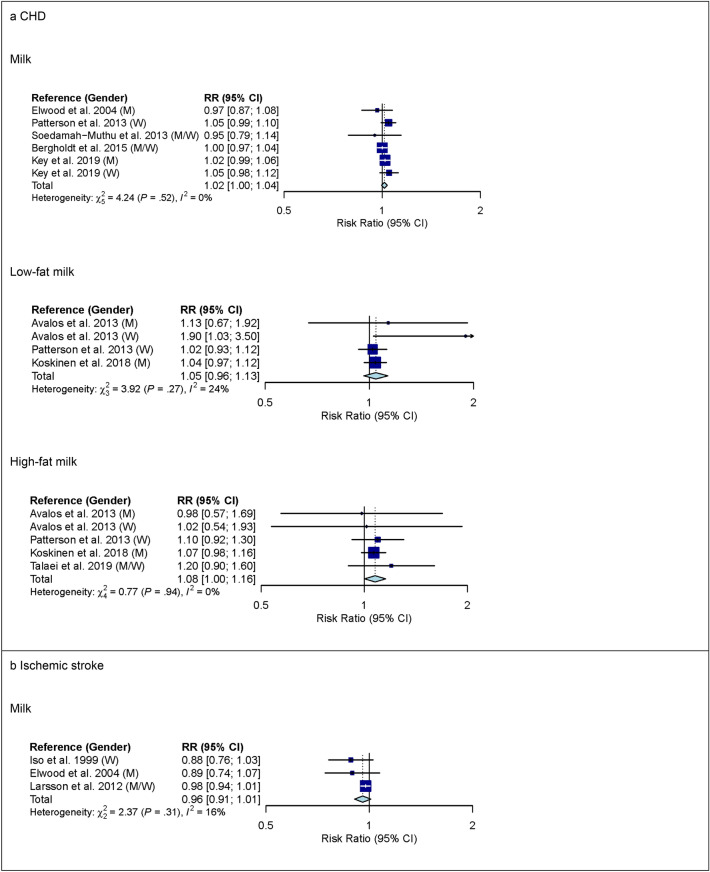
Figure 1
Figure 1
Linear dose–response meta-analysis. Summary RR of CHD (panel a) and ischemic stroke (panel b) per 200 g higher intake of milk/day. P = 0.12 for the association between milk and CHD. P = 0.04 for the association between high-fat milk and CHD. CHD coronary heart disease; CI confidence interval; M males; RR risk ratio; W women.
Figure 2
Figure 2
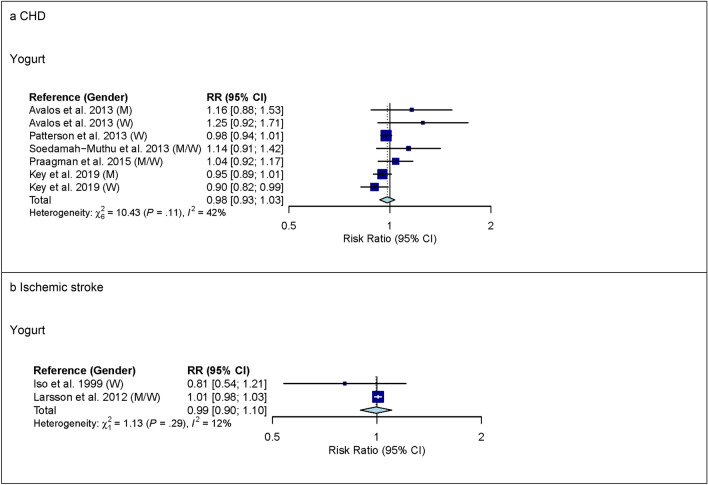
Linear dose–response meta-analysis. Summary RR of CHD (panel a) and ischemic stroke (panel b) per 100 g higher intake of yogurt/day. Yogurt defined as yogurt/other soured milk products. CHD coronary heart disease; CI confidence interval; M males; RR risk ratio; W women.
Figure 3
Figure 3
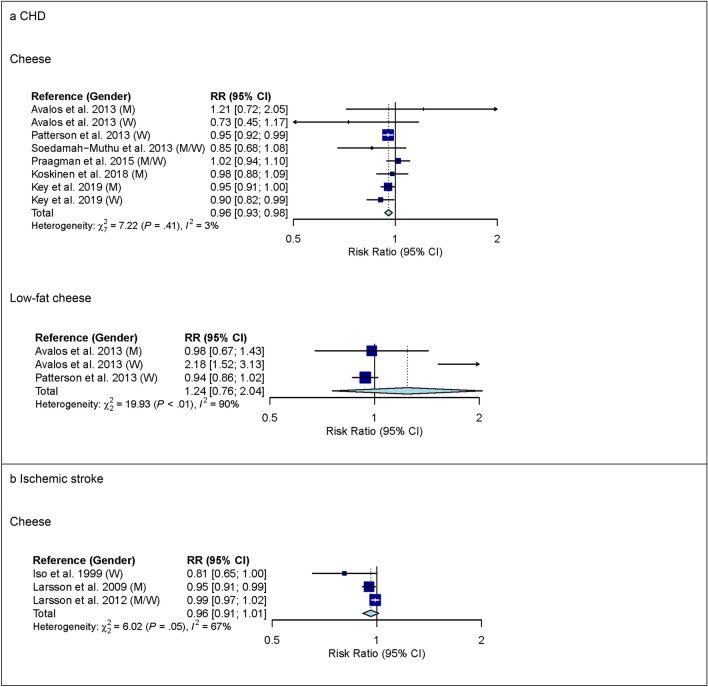
Linear dose–response meta-analysis. Summary RR of CHD (panel a) and ischemic stroke (panel b) per 20 g higher intake of cheese/day. P < 0.05 for heterogeneity for the association between cheese and ischemic stroke. CHD coronary heart disease; CI confidence interval; M males; RR risk ratio; W women.
Figure 4
Figure 4
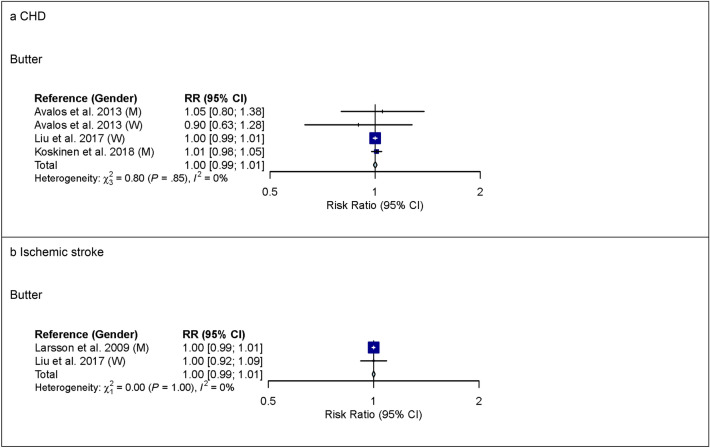
Linear dose–response meta-analysis. Summary RR of CHD (panel a) and ischemic stroke (panel b) per 6 g higher intake of butter/day. CHD coronary heart disease; CI confidence interval; M males; RR risk ratio; W women.
Figure 5
Figure 5
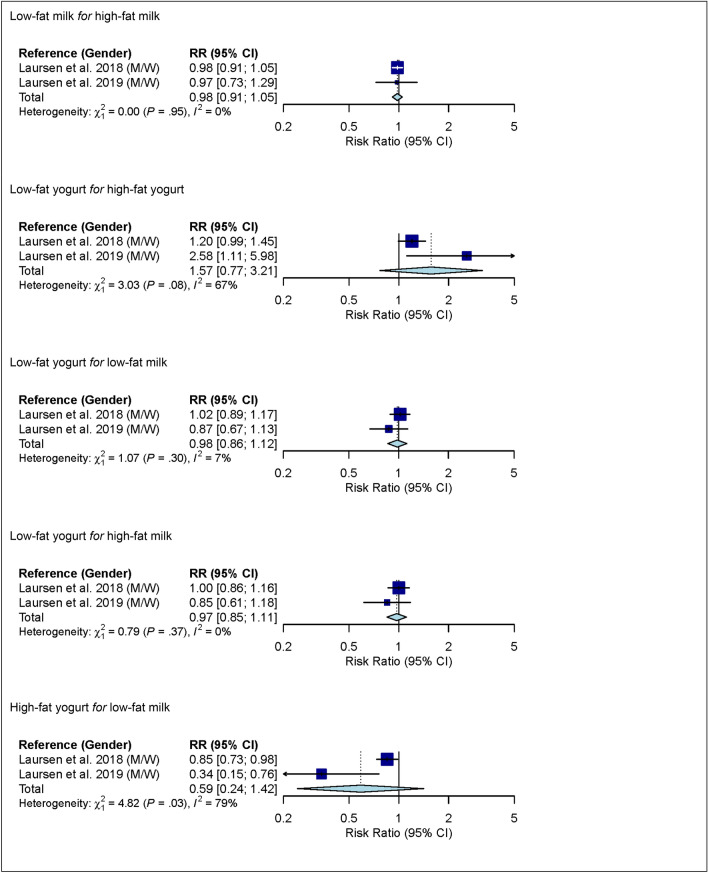
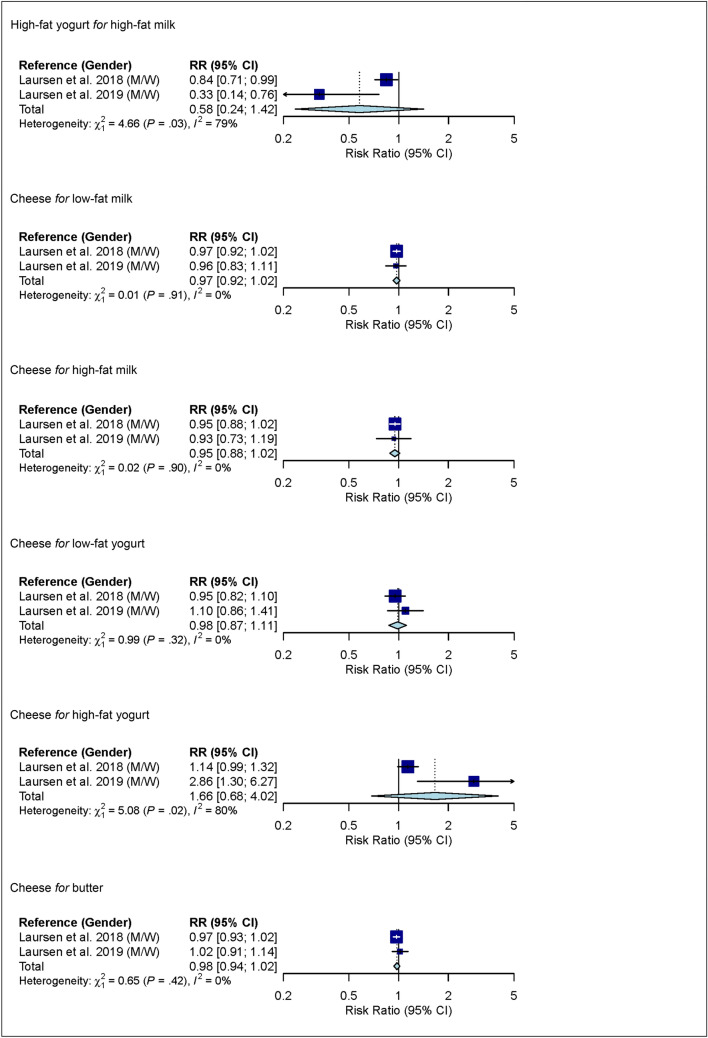
Linear dose–response meta-analysis. Summary RR of ischemic stroke for substitutions between dairy product subgroups (per 1 serving/day). For example in the mean of substitution of low-fat milk for high-fat milk; i.e. low-fat milk takes the place of high-fat milk). For milk and yogurt, the serving size was 200 g, for cheese 20 g, and for butter 6 g. Yogurt defined as yogurt/other soured milk products. CI confidence interval; M males; RR risk ratio; W women.
Figure 5
Figure 5
Linear dose–response meta-analysis. Summary RR of ischemic stroke for substitutions between dairy product subgroups (per 1 serving/day). For example in the mean of substitution of low-fat milk for high-fat milk; i.e. low-fat milk takes the place of high-fat milk). For milk and yogurt, the serving size was 200 g, for cheese 20 g, and for butter 6 g. Yogurt defined as yogurt/other soured milk products. CI confidence interval; M males; RR risk ratio; W women.

References

    1. Lusis AJ. Atherosclerosis. Atherosclerosis. Nature. 2000;407:233–241. - PMC - PubMed
    1. Mensink RP, Zock PL, Kester ADM, Katan MB. Effects of dietary fatty acids and carbohydrates on the ratio of serum total to HDL cholesterol and on serum lipids and apolipoproteins: a meta-analysis of 60 controlled trials. Am. J. Clin. Nutr. 2003;77:1146–1155. doi: 10.1093/ajcn/77.5.1146. - DOI - PubMed
    1. Nordic Council of Ministers. Nordic nutrition recommendations 2012. Integrating nutrition and physical activity. 5th ed. Nordic Council of Ministers (2014).
    1. Wang DD, Hu FB. Dietary fat and risk of cardiovascular disease: recent controversies and advances. Annu. Rev. Nutr. 2017;37:423–446. doi: 10.1146/annurev-nutr-071816-064614. - DOI - PubMed
    1. Astrup A, et al. WHO draft guidelines on dietary saturated and trans fatty acids: time for a new approach? BMJ. 2019;366:l4137. doi: 10.1136/bmj.l4137. - DOI - PubMed

Publication types