Observational Study
. 2021 Jan 14;11(1):1275.
doi: 10.1038/s41598-020-79843-5.

Mortality prediction using a novel combination of biomarkers in the first day of sepsis in intensive care units

Affiliations
Observational Study

Mortality prediction using a novel combination of biomarkers in the first day of sepsis in intensive care units

Junkun Liu et al. Sci Rep. .

Abstract

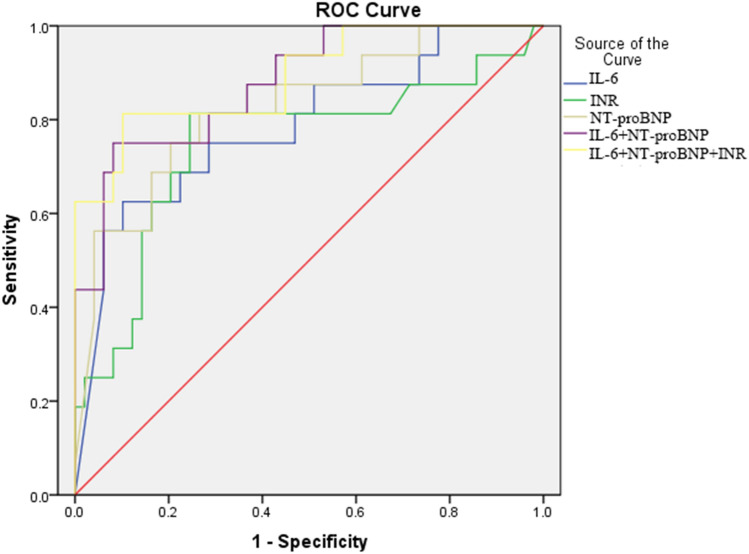
Early identification of infection severity and organ dysfunction is crucial in improving outcomes of patients with sepsis. We aimed to develop a new combination of blood-based biomarkers that can early predict 28-day mortality in patients with sepsis or septic shock. We enrolled 66 patients with sepsis or septic shock and compared 14 blood-based biomarkers in the first 24 h after ICU admission. The serum levels of interleukin-6 (IL-6) (median 217.6 vs. 4809.0 pg/ml, P = 0.001), lactate (median 2.4 vs. 6.3 mmol/L, P = 0.014), N-terminal prohormone of brain natriuretic peptide (NT-proBNP) (median 1596.5 vs. 32,905.3 ng/ml, P < 0.001), prothrombin time (PT) (median 15.6 vs. 20.1 s, P = 0.030), activated partial thrombin time (APTT) (median 45.1 vs. 59.0 s, P = 0.026), and international normalized ratio (INR) (median 1.3 vs. 1.8, P < 0.001) were significantly lower in the survivor group. IL-6, NT-proBNP, and INR provided the best individual performance in predicting 28-day mortality of patients with sepsis or septic shock. Furthermore, the combination of these three biomarkers achieved better predictive performance (AUC 0.890, P < 0.001) than conventional scoring systems. In summary, the combination of IL-6, NT-proBNP, and INR may serve as a potential predictor of 28-day mortality in critically ill patients with sepsis or septic shock.


Conflict of interest statement

The authors declare no competing interests.

Figures
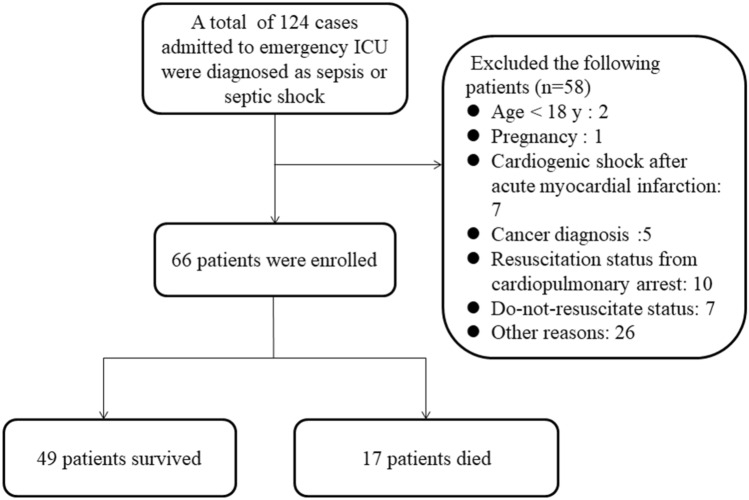
Figure 1
Figure 1
Screening and enrollment of the study.
Figure 2
Figure 2
The receiver operating characteristic (ROC) curves of the selected biomarkers for predicting 28-day mortality of critically ill patients with sepsis or septic shock. The ROC curves for single biomarker and their combinations had the following areas: interleukin-6 (IL-6), 0.785; international normalized ratio (INR), 0.748; N-terminal pro-brain natriuretic peptide (NT-proBNP), 0.825; combination of IL-6 and NT-proBNP, 0.879; and combination of IL-6, INR and NT-proBNP, 0.890.
Figure 3
Figure 3
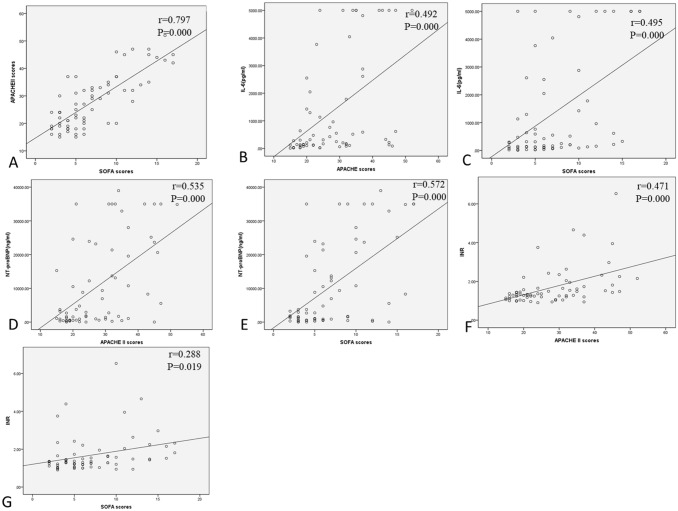
Correlation analysis of biomarkers in all subjects. (A) Correlation between APACHE II and SOFA, (B) Correlation between IL-6 and APACHE II, (C) Correlation between IL-6 and SOFA, (D) Correlation between NT-proBNP and APACHE II, (E) Correlation between NT-proBNP and SOFA, (F) Correlation between INR and APACHE II, and (G) Correlation between INR and SOFA.

References

    1. Rhodes A, et al. Surviving sepsis campaign: International guidelines for management of sepsis and septic shock: 2016. Crit. Care Med. 2017;45:486–552. doi: 10.1097/CCM.0000000000002255. - DOI - PubMed
    1. Luhr R, Cao Y, Söderquist B, Cajander S. Trends in sepsis mortality over time in randomised sepsis trials: A systematic literature review and meta-analysis of mortality in the control arm, 2002–2016. Crit. Care. 2019;23:241. doi: 10.1186/s13054-019-2528-0. - DOI - PMC - PubMed
    1. Liu Y, Han N, Li Q, Li Z. Regulatory mechanisms underlying sepsis progression in patients with tumor necrosis factor-alpha genetic variations. Exp. Ther. Med. 2016;12:323–328. doi: 10.3892/etm.2016.3308. - DOI - PMC - PubMed
    1. Costa RT, et al. T helper type cytokines in sepsis: Time-shared variance and correlation with organ dysfunction and hospital mortality. Braz. J. Infect. Dis. 2019;23:79–85. doi: 10.1016/j.bjid.2019.04.008. - DOI - PMC - PubMed
    1. Guarracino F, Bertini P, Pinsky MR. Cardiovascular determinants of resuscitation from sepsis and septic shock. Crit. Care. 2019;23:118. doi: 10.1186/s13054-019-2414-9. - DOI - PMC - PubMed

Publication types