Review
. 2020 Dec 28;8(4):424-431.
doi: 10.14218/JCTH.2020.00046. Epub 2020 Oct 10.

Macrophage Phenotypes and Hepatitis B Virus Infection

Affiliations
Review

Macrophage Phenotypes and Hepatitis B Virus Infection

Yujia Li et al. J Clin Transl Hepatol. .

Abstract

Globally, hepatitis B virus (HBV) infection and its related liver diseases account for 780,000 deaths every year. Outcomes of HBV infection depend on the interaction between the virus and host immune system. It is becoming increasingly apparent that Kupffer cells (KCs), the largest population of resident and monocyte-derived macrophages in the liver, contribute to HBV infection in various aspects. These cells play an important role not only in the anti-HBV immunity including virus recognition, cytokine production to directly inhibit viral replication and recruitment and activation of other immune cells involved in virus clearance but also in HBV outcome and progression, such as persistent infection and development of end-stage liver diseases. Since liver macrophages play multiple roles in HBV infection, they are directly targeted by HBV to benefit its life cycle. In the present review, we briefly outline the current advances of research of macrophages, especially the studies of their phenotypes, in chronic HBV infection.

Keywords: Chronic HBV infection; Hepatitis B virus; Macrophage; Phenotype.


Conflict of interest statement

The authors have no conflict of interests related to this publication.

Figures
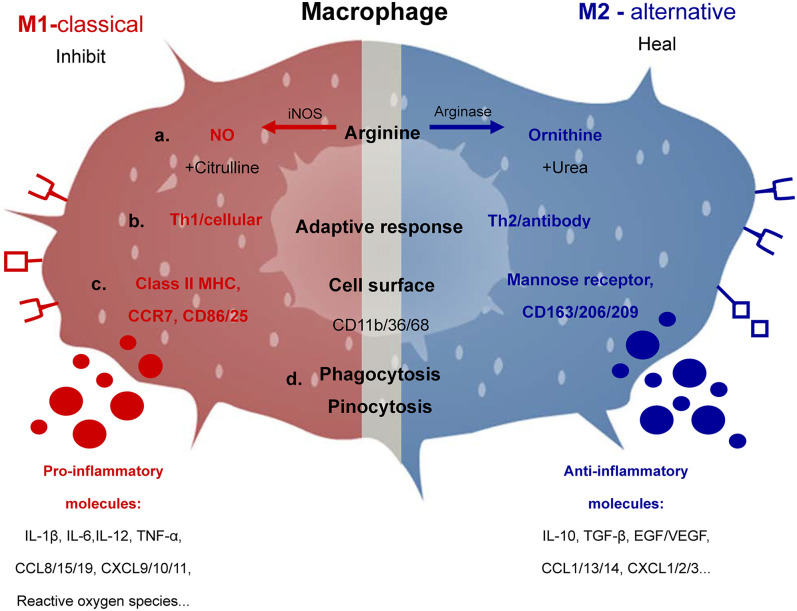
Fig. 1.
Fig. 1.. Characteristic products and functions of M1 and M2 macrophages. Macrophages can metabolize arginine with the inducible nitric oxide synthase enzyme into nitric oxide and citrulline or with arginase into ornithine and urea which is the biochemical basis of the M1 or M2 macrophage responses, respectively
(a). M1- or M2-dominant macrophages stimulate the Type 1 T helper cell or Type 2 T helper cell responses (b). Also shown are the major molecules involved, including cell surface molecules, cytokines, chemokines and so on, which are closely associated with the M1 or M2 phenotypes (c). Phagocytosis and pinocytosis are general properties of macrophages, which are not dependent on M1 or M2 type responses (d).
Fig. 2.
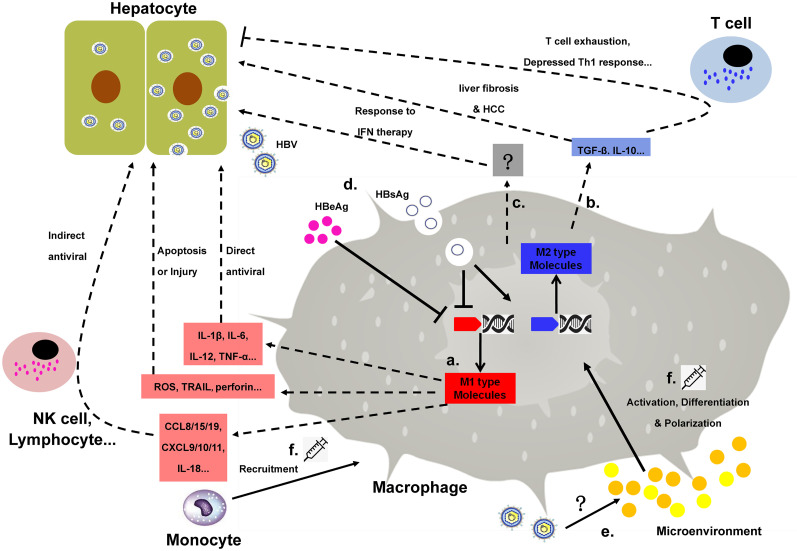
Fig. 2.. Macrophage involvement in HBV infection. The anti-HBV effect of macrophages is mediated mainly by pro-inflammatory cytokines inducing a direct antiviral response or molecules recruiting or activating other immune cells. Meanwhile, another group of M1 KCs produces molecules that may result in injury or apoptosis of the hepatocytes
(a). Immunomodulatory mediators, such as IL-10 and TGF-β, are closely associated with suppressed antiviral T cell responses and/or end-stage HBV liver disease (b).Macrophages may also contribute to the inflammatory or anti-inflammatory liver microenvironment and, consequently, alter hepatic response to IFN treatment (c). The phenotype and function of macrophages can be modified by either HBV itself (d) or the microenvironment (e). Thus, the therapeutic strategies targeting macrophages in an HBV infection may aim at modulating macrophage polarization/phenotype, monocyte recruitment/activation and so on (f).

References

    1. Aspinall EJ, Hawkins G, Fraser A, Hutchinson SJ, Goldberg D. Hepatitis B prevention, diagnosis, treatment and care: a review. Occup Med (Lond) 2011;61:531–540. doi: 10.1093/occmed/kqr136. - DOI - PubMed
    1. Publicover J, Jespersen JM, Johnson AJ, Nishimura SL, Goodsell A, Wakil AE, et al. Liver capsule: Age-influenced hepatic immune priming determines HBV infection fate: Implications from mouse to man. Hepatology. 2016;63:260. doi: 10.1002/hep.28284. - DOI - PMC - PubMed
    1. Stevens CE, Beasley RP, Tsui J, Lee WC. Vertical transmission of hepatitis B antigen in Taiwan. N Engl J Med. 1975;292:771–774. doi: 10.1056/NEJM197504102921503. - DOI - PubMed
    1. Bertoletti A, Gehring AJ. The immune response during hepatitis B virus infection. J Gen Virol. 2006;87:1439–1449. doi: 10.1099/vir.0.81920-0. - DOI - PubMed
    1. Faure-Dupuy S, Durantel D, Lucifora J. Liver macrophages: Friend or foe during hepatitis B infection? Liver Int. 2018;38:1718–1729. doi: 10.1111/liv.13884. - DOI - PubMed