. 2021 Aug;10(15):e2001894.
doi: 10.1002/adhm.202001894. Epub 2021 Jan 14.

Delivery of Anti-microRNA-712 to Inflamed Endothelial Cells Using Poly(β-amino ester) Nanoparticles Conjugated with VCAM-1 Targeting Peptide

Affiliations

Delivery of Anti-microRNA-712 to Inflamed Endothelial Cells Using Poly(β-amino ester) Nanoparticles Conjugated with VCAM-1 Targeting Peptide

Pere Dosta et al. Adv Healthc Mater. 2021 Aug.

Abstract

Endothelial cells (ECs) are an important target for therapy in a wide range of diseases, most notably atherosclerosis. Developing efficient nanoparticle (NP) systems that deliver RNA interference (RNAi) drugs specifically to dysfunctional ECs in vivo to modulate their gene expression remains a challenge. To date, several lipid-based NPs are developed and shown to deliver RNAi to ECs, but few of them are optimized to specifically target dysfunctional endothelium. Here, a novel, targeted poly(β-amino ester) (pBAE) NP is demonstrated. This pBAE NP is conjugated with VHPK peptides that target vascular cell adhesion molecule 1 protein, overexpressed on inflamed EC membranes. To test this approach, the novel NPs are used to deliver anti-microRNA-712 (anti-miR-712) specifically to inflamed ECs both in vitro and in vivo, reducing the high expression of pro-atherogenic miR-712. A single administration of anti-miR-712 using the VHPK-conjugated-pBAE NPs in mice significantly reduce miR-712 expression, while preventing the loss of its target gene, tissue inhibitor of metalloproteinase 3 (TIMP3) in inflamed endothelium. miR-712 and TIMP3 expression are unchanged in non-inflamed endothelium. This novel, targeted-delivery platform may be used to deliver RNA therapeutics specifically to dysfunctional endothelium for the treatment of vascular disease.

Keywords: atherosclerosis; endothelial inflammation; microRNA-712; poly(β-amino ester) nanoparticles; vascular cell adhesion molecule 1-targeting VHPK peptides.


Figures

Figure 1:
Figure 1:. Selection of C6-KH pBAE polymer.
(A) Structure and synthetic scheme of oligopeptide-modified pBAEs. R” terminal can be arginine-, lysine-, histidine-, glutamic acid- or aspartic acid-oligopeptide. (B and C) Biophysical characterization of pBAE NPs. (B) Average hydrodynamic diameter, polydispersity, (C) and zeta potential of pBAE:anti-miR-712 nanoparticles prepared at 75:1 polymer:anti-miR-712 ratio (w/w) with different oligopeptide-modified pBAE polymers are shown. (D) Cellular uptake of oligopeptide-modified pBAEs using fluorescent-labelled anti-miR (anti-miR-Cy3) at a final concentration of 200nM in iMAECs. (E) Fluorescent images of iMAECs using lysine/histidine-modified pBAE (C6-KH). Scale bar: 50 μm. Data are represented as mean ± SEM (n = 3). Multiple comparisons among groups were determined using one-way ANOVA followed by a post-hoc test. P-value: *p < 0.05, **p < 0.01, ***p < 0.001.
Figure 2:
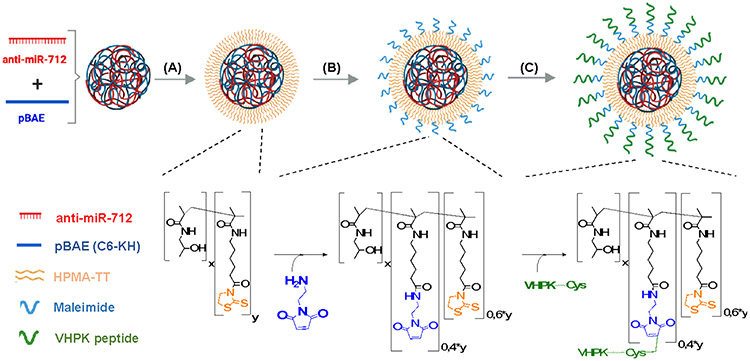
Figure 2:. Preparation of VHPK-conjugated pBAE nanoparticles.
(A) pBAE NPs were coated with pHPMA-TT. The TT groups in the pHPMA-TT copolymer react with amine groups from pBAE NPs. (B) 40% of TT groups were modified using amino-maleimide linker while 60% of TT groups were used to react with pBAE NPs. (C) Maleimide groups were used to conjugate VHPK peptides via their terminal cysteine groups.
Figure 3:
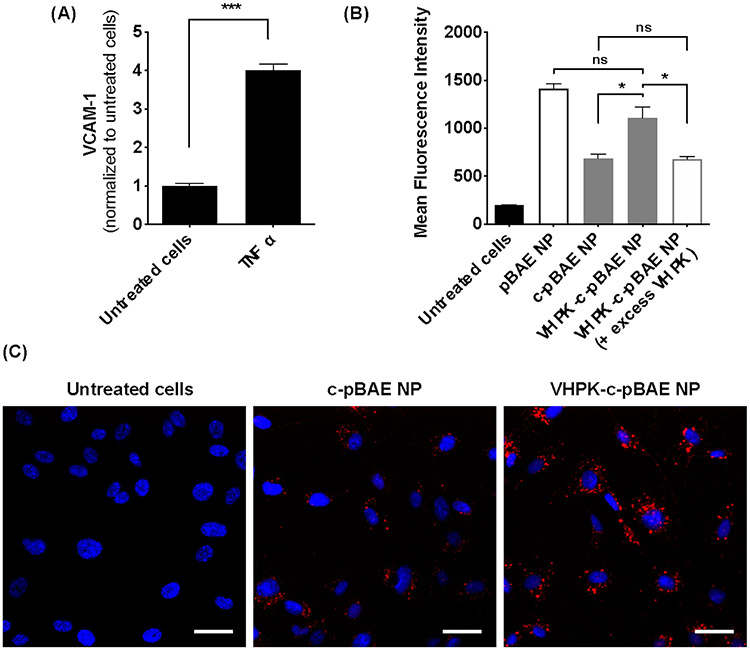
Figure 3:. Selective uptake of VHPK-c-pBAE NPs in inflamed iMAECs.
(A) iMAECs were treated with TNF-α (3 ng ml−1) for 2 hours and VCAM1 expression was determined by qPCR. (B) pBAE NPs containing Cy3-anti-miRNA were coated with pHPMA-TT polymer (c-pBAE NP) and conjugated with VHPK peptide (VHPK-c-pBAE NP) to improve their specific delivery to inflamed iMAECs. Internalization efficiency was tested at 2 hours post-transfection using flow cytometry. To assess VHPK-mediated internalization, the VCAM-1 receptor in inflamed iMAECs was blocked using excess VHPK peptide. Internalization of VHPK-c-pBAE NPs was assessed by flow cytometry. (C) VHPK-targeted internalization was validated using fluorescence microscopy. Scale bar: 50 μm. Data are represented as mean ± SEM (n = 3). Pairwise comparisons were determined using Student t-tests. Multiple comparisons among groups were determined using one-way ANOVA followed by a post-hoc test. P-value: *p < 0.05, **p < 0.01, ***p < 0.001.
Figure 4:
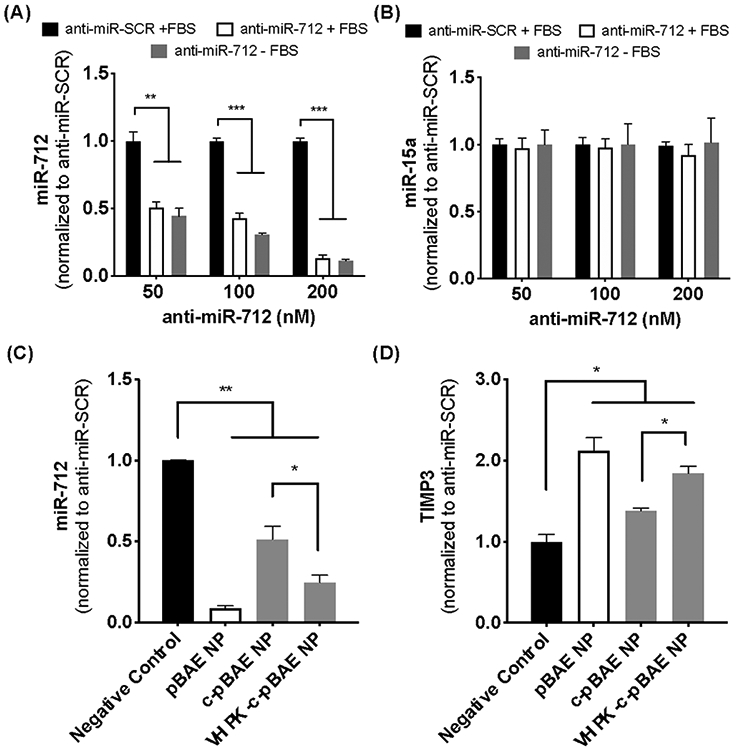
Figure 4:. VHPK-c-pBAE NP delivers anti-miR-712 to inflamed ECs in vitro.
(A, B) iMAECs were transfected with 50-200 nM anti-miR-712 or anti-miR-SCR control in the presence or absence of FBS. miR-712 expression (A) and miR-15a as a control (B) were determined 48 hours post-transfection by qPCR. (C, D) iMAECs treated with TNF-α were treated with anti-miR-712 carried by pBAE, c-pBAE or VHPK-c-pBAE NPs for 48 hours. Anti-miR-SCR carried by VHPK-c-pBAE NPs was used as a negative control (black bar). Levels of miR-712 (C) and TIMP3 (D) were determined by qPCR. Data are represented as mean ± SEM (n = 3). Multiple comparisons among groups were determined using one-way ANOVA followed by a post-hoc test. P-value: *p < 0.05, **p < 0.01, ***p < 0.001.
Figure 5:
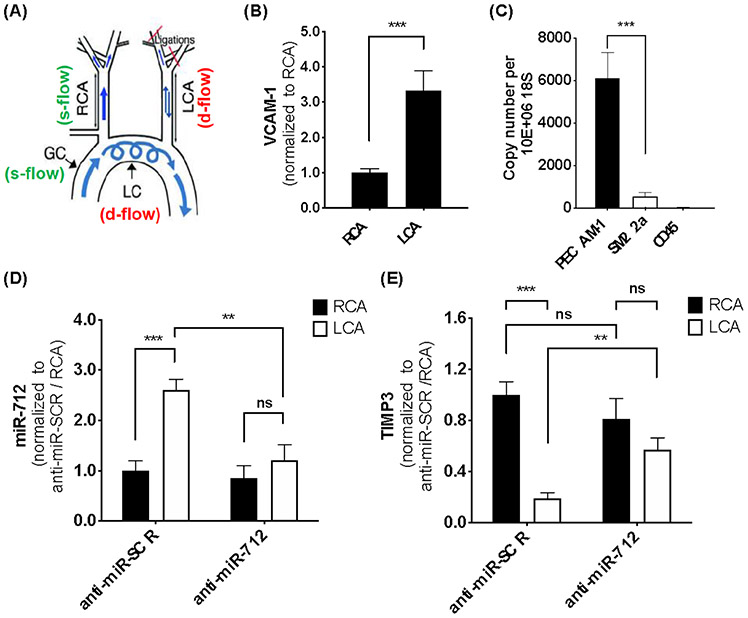
Figure 5:. Selective and efficient delivery of anti-miR-712 packaged in VHPK-c-pBAE NPs to inflamed endothelium in mouse carotid arteries in vivo.
(A) Depiction of the partial carotid ligation (PCL) surgery to induce d-flow in LCA and s-flow in the contralateral RCA. The aortic arch regions naturally exposed to s-flow (GC) and d-flow (LC) are shown as comparison. At 3 days following partial carotid ligation, C57BL/6 mice were tail-vein injected with VHPK-c-pBAE NPs carrying either anti-miR-712 or anti-miR-SCR at 1 mg kg. Two days post-injection, mice were sacrificed, and endothelial-enriched RNA was extracted from the RCA and LCA for qPCR analysis for VCAM-1 (B), markers of EC (PECAM1), smooth muscle cells (SM22a), and leukocytes (CD45) (C), miR-712 (D), and TIMP3 (E). Data are represented as mean ± SEM (n = 5). Pairwise comparisons were determined using Student t-tests. Multiple comparisons among groups were determined using one-way ANOVA followed by a post-hoc test. P-value: *p < 0.05, **p < 0.01, ***p < 0.001.
Figure 6:
Figure 6:. Biodistribution of anti-miR-712 delivered by VHPK-c-pBAE NPs using PCL model of atherosclerosis in C57BL/6 mice.
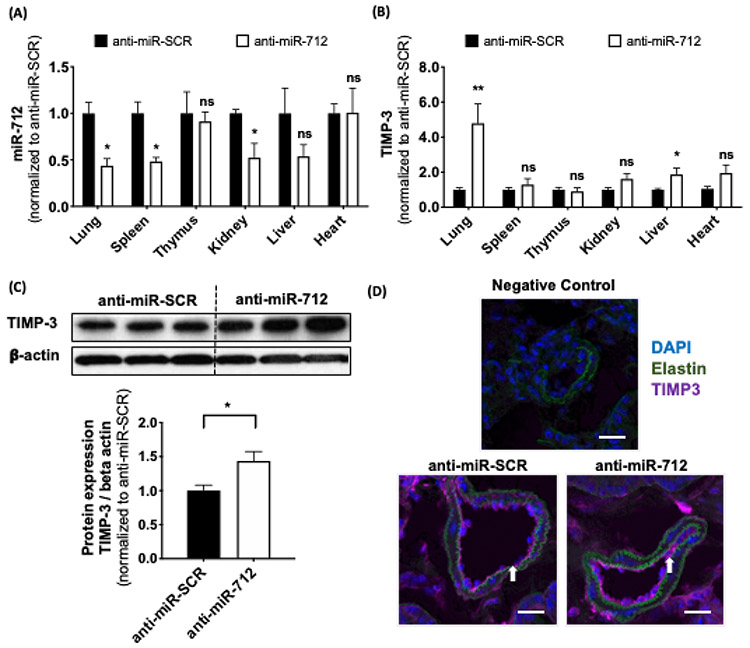
Anti-miR-712 biodistribution was analyzed by determining the (A) miR-712 expression and (B) TIMP3 expression by qPCR in tissue samples of the lung, spleen, thymus, kidney, liver and heart obtained from the mouse study described in Figure 5. (C) Anti-miR-712 restores TIMP3 protein expression in lungs. TIMP3 expression was analyzed by Western blot 48 hours post-injection. (D) Frozen lung sections obtained from these mice were used for immunofluorescence staining with antibody specific to TIMP3 shown in purple (n=3 mice). Negative control staining was performed without primary TIMP3 antibody. Scale bar: 20 μm. Data are represented as mean ± SEM (n = 4-6). Pairwise comparisons were determined using Student t-tests. P-value: *p < 0.05, **p < 0.01, ***p < 0.001.

References

    1. Herrington W, Lacey B, Sherliker P, Armitage J, Lewington S, Circ Res 2016, 118, 535. - PubMed
    1. Davies PF, Nat Clin Pract Cardiovasc Med 2009, 6, 16; - PMC - PubMed
    2. Kwak BR, Back M, Bochaton-Piallat ML, Caligiuri G, Daemen MJ, Davies PF, Hoefer IE, Holvoet P, Jo H, Krams R, Lehoux S, Monaco C, Steffens S, Virmani R, Weber C, Wentzel JJ, Evans PC, Eur Heart J 2014, 35, 3013. - PMC - PubMed
    1. Kumar S, Kim CW, Son DJ, Ni CW, Jo H, Sci Data 2014, 1, 140039; - PMC - PubMed
    2. Kumar S, Williams D, Sur S, Wang JY, Jo H, Vascul Pharmacol 2018, DOI: 10.1016/j.vph.2018.10.001; - DOI - PMC - PubMed
    3. Kumar S, Kim CW, Simmons RD, Jo H, Arterioscler Thromb Vasc Biol 2014, 34, 2206. - PMC - PubMed
    1. Martens CR, Bansal SS, Accornero F, J Mol Cell Cardiol 2019, 129, 247. - PMC - PubMed
    1. Reischl D, Zimmer A, Nanomedicine 2009, 5, 8. - PubMed

Publication types