


Safety, effectiveness, and quality of life following pulmonary vein isolation with a multi-electrode radiofrequency balloon catheter in paroxysmal atrial fibrillation: 1-year outcomes from SHINE
- PMID: 33450010
- PMCID: PMC8186540
- DOI: 10.1093/europace/euaa382
Safety, effectiveness, and quality of life following pulmonary vein isolation with a multi-electrode radiofrequency balloon catheter in paroxysmal atrial fibrillation: 1-year outcomes from SHINE
Abstract
Aims: To evaluate the safety and effectiveness of a compliant multi-electrode radiofrequency balloon catheter (RFB) used with a multi-electrode diagnostic catheter for pulmonary vein isolation (PVI).
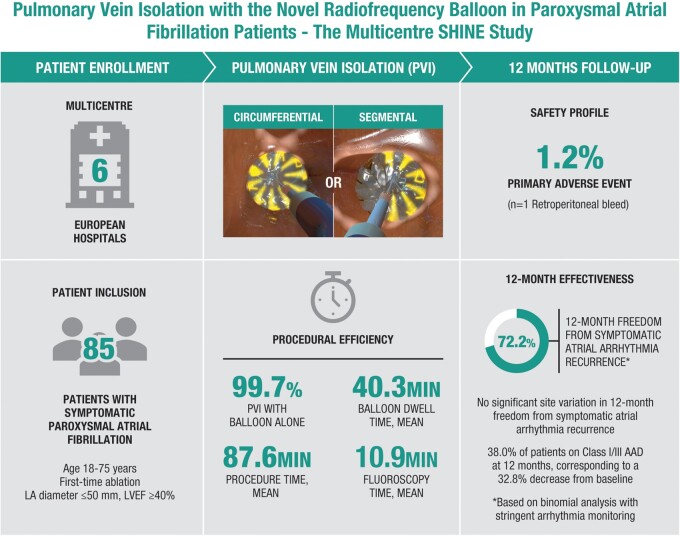
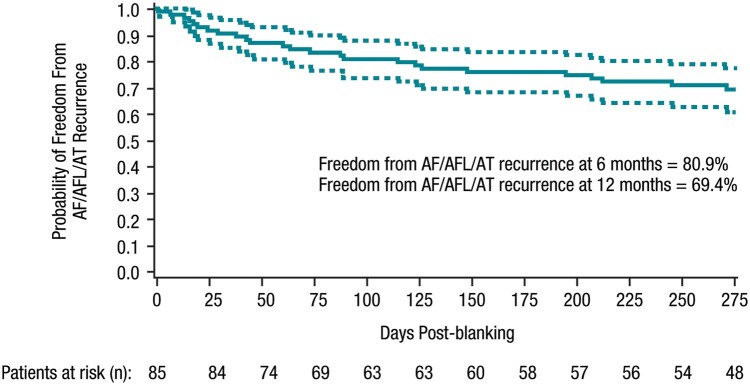
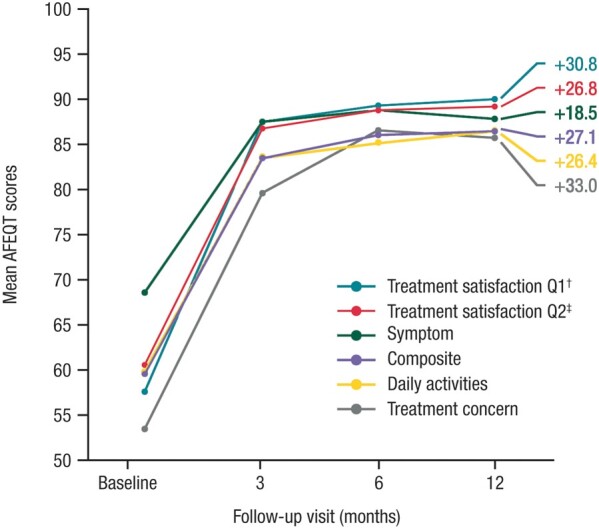
Methods and results: This prospective, multicentre, single-arm study was conducted at six European sites and enrolled patients with symptomatic paroxysmal atrial fibrillation. The primary effectiveness endpoint was entrance block in treated pulmonary veins (PVs) after adenosine/isoproterenol challenge. The primary safety endpoint was the occurrence of primary adverse events (PAEs) within 7 days. Cerebral magnetic resonance imaging and neurological assessments were performed pre- and post-ablation in a subset of patients. Atrial arrhythmia recurrence was assessed over 12 months via transtelephonic and Holter monitoring. Quality of life was assessed by the Atrial Fibrillation Effect on Quality of Life (AFEQT) questionnaire. Of 85 patients undergoing ablation per study protocol, PV entrance block was achieved in all (one PV required touch-up with a focal catheter). Acute reconnection of ≥1 PVs after adenosine/isoproterenol challenge was observed in 9.3% (30/324) of PVs ablated. Post-ablation, silent cerebral lesions were detected in 9.7% (3/31) of patients assessed, all of which was resolved at 1-month follow-up. One patient experienced a PAE (retroperitoneal bleed). Freedom from documented symptomatic and all arrhythmia was 72.2% and 65.8% at 12 months. Four patients (4.7%) underwent repeat ablation. Significant improvements in all AFEQT subscale scores were seen at 6 and 12 months.
Conclusion: PVI with the novel RFB demonstrated favourable safety and effectiveness, with low repeat ablation rate and clinically meaningful improvement in quality of life.
Clinicaltrials.gov registration number: NCT03437733.
Keywords: Atrial fibrillation; Electrophysiological mapping; Pulmonary vein isolation; Quality of life; Radiofrequency ablation; Radiofrequency balloon catheter.
© The Author(s) 2021. Published by Oxford University Press on behalf of the European Society of Cardiology.
Figures
References
-
- Dhillon GS, Honarbakhsh S, Di Monaco A, Coling AE, Lenka K, Pizzamiglio F. et al. Use of a multi-electrode radiofrequency balloon catheter to achieve pulmonary vein isolation in patients with paroxysmal atrial fibrillation: 12-month outcomes of the RADIANCE study. J Cardiovasc Electrophysiol 2020;31:1259–69. - PubMed
-
- R Reddy VY, Schilling R, Grimaldi M, Horton R, Natale A, Riva S. et al. Pulmonary vein isolation with a novel multielectrode radiofrequency balloon catheter that allows directionally tailored energy delivery: short-term outcomes from a multicenter first-in-human study (RADIANCE). Circ Arrhythm Electrophysiol 2019;12:e007541. - PubMed
-
- Holmes DN, Piccini JP, Allen LA, Fonarow GC, Gersh BJ, Kowey PR. et al. Defining clinically important difference in the atrial fibrillation effect on quality-of-life score. Circ Cardiovasc Qual Outcomes 2019;12:e005358. - PubMed
Publication types
MeSH terms
Associated data
LinkOut - more resources
Full Text Sources
Other Literature Sources
Medical
Research Materials
