. 2021 Apr:209:104556.
doi: 10.1016/j.cognition.2020.104556. Epub 2021 Jan 12.

Executive function and high ambiguity perceptual discrimination contribute to individual differences in mnemonic discrimination in older adults

Affiliations

Executive function and high ambiguity perceptual discrimination contribute to individual differences in mnemonic discrimination in older adults

Helena M Gellersen et al. Cognition. 2021 Apr.

Abstract

Mnemonic discrimination deficits, or impaired ability to discriminate between similar events in memory, is a hallmark of cognitive aging, characterised by a stark age-related increase in false recognition. While individual differences in mnemonic discrimination have gained attention due to potential relevance for early detection of Alzheimer's disease, our understanding of the component processes that contribute to variability in task performance across older adults remains limited. The present investigation explores the roles of representational quality, indexed by perceptual discrimination of objects and scenes with overlapping features, and strategic retrieval ability, indexed by standardised tests of executive function, to mnemonic discrimination in a large cohort of older adults (N=124). We took an individual differences approach and characterised the contributions of these factors to performance under Forced Choice (FC) and Yes/No (YN) recognition memory formats, which place different demands on strategic retrieval. Performance in both test formats declined with age. Accounting for age, individual differences in FC memory performance were best explained by perceptual discrimination score, whereas YN memory performance was best explained by executive functions. A linear mixed model and dominance analyses confirmed the relatively greater importance of perceptual discrimination over executive functioning for FC performance, while the opposite was true for YN. These findings highlight parallels between perceptual and mnemonic discrimination in aging, the importance of considering demands on executive functions in the context of mnemonic discrimination, and the relevance of test format for modulating the impact of these factors on performance in older adults.

Keywords: Aging; Executive function; Individual differences; Memory; Mnemonic discrimination; Perceptual discrimination.


Conflict of interest statement

none.

Figures
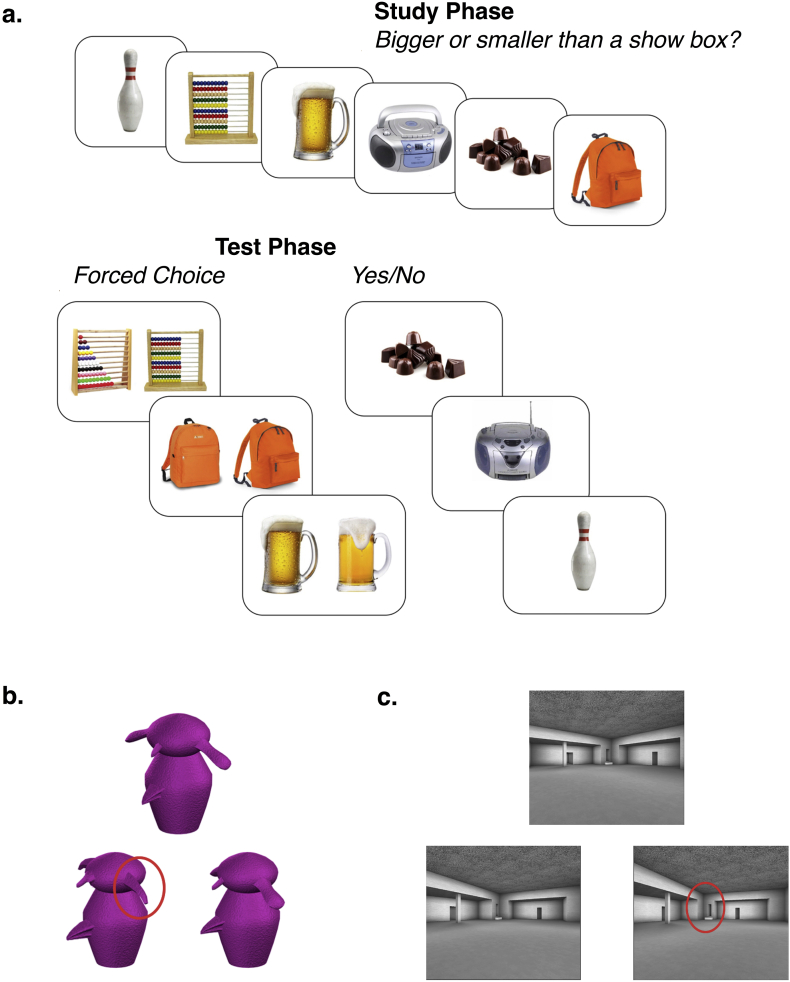
Fig. 1
Fig. 1
Schematic of the experimental paradigms. (a) Recognition memory task. During study, participants were shown objects and made a size judgment for each object (top). In the test phase (bottom), target and lure were either presented simultaneously (Forced Choice task), or either the target or the lure object was shown (Yes/No task). (b) Example of a trial of the high ambiguity object discrimination task. Red circles were not present in the actual task and are used here to illustrate which feature was different in the respective trial. (c) Example of a trial of the high ambiguity scene discrimination task. (For interpretation of the references to colour in this figure legend, the reader is referred to the web version of this article.)
Fig. 2
Fig. 2
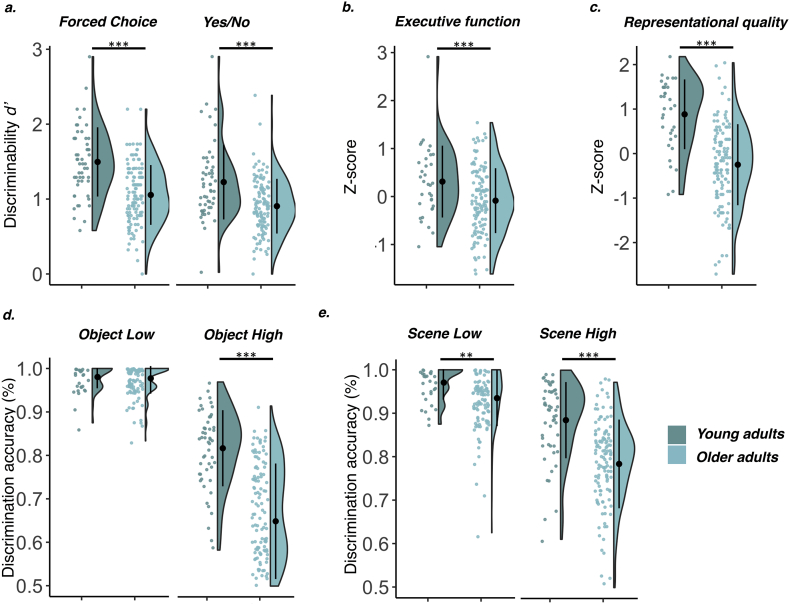
(a) Age group differences in Forced Choice and Yes/No d’ scores, (b) executive functioning composite score, (c) perceptual discrimination composite score, (d) accuracy in object discrimination under low and high feature ambiguity, (e) accuracy in scene discrimination under low and high feature ambiguity. Note: One extreme outlier on the object high task in older adults is not shown in the plot. Outliers did not alter the significance of the effects shown here. ***p<.001, **p<.01.
Fig. 3
Fig. 3
Correlations between variables of interest (Yes/No d’, Forced Choice d’, Perceptual Discrimination composite score, Executive Functioning composite score). Corrections for multiple comparisons are based on the Holm method.* p<.05, ** p<.01, *** p <.001.
Fig. 4
Fig. 4
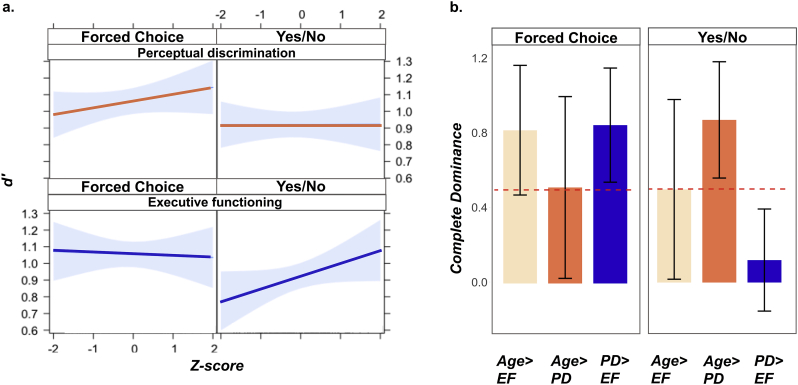
Differential importance of predictors. a. Results of the linear mixed model for d’ memory scores. The plot shows the three-way interaction effect of task format (FC, YN), cognitive process (EF, PD) and performance on the cognitive predictors (z-scores). The plots shows an attenuation in the associations between perceptual discrimination and Yes/No performance and the association between executive functioning and Forced Choice performance, respectively, after controlling for all other effects in the mixed linear model as opposed to bivariate correlations with no covariates (see Fig. 3). b. Complete dominance metric for predictors used in the Forced Choice and Yes/No d’ regression models. The y-axis represents the mean complete dominance metric across all bootstrap samples. EF: executive functions; PD: perceptual discrimination.

References

    1. Azen R., Budescu D.V. The dominance analysis approach for comparing predictors in multiple regression. Psychological Methods. 2003;8(2):129–148. doi: 10.1037/1082-989X.8.2.129. - DOI - PubMed
    1. Badre D., Wagner A.D. Left ventrolateral prefrontal cortex and the cognitive control of memory. Neuropsychologia. 2007;45(13):2883–2901. doi: 10.1016/j.neuropsychologia.2007.06.015. - DOI - PubMed
    1. Barense M.D., Gaffan D., Graham K.S. The human medial temporal lobe processes online representations of complex objects. Neuropsychologia. 2007;45(13):2963–2974. doi: 10.1016/j.neuropsychologia.2007.05.023. - DOI - PubMed
    1. Barense M.D., Groen I.I.A., Lee A.C.H., Yeung L.-K., Brady S.M., Gregori M.…Henson R.N.A. Intact memory for irrelevant information impairs perception in amnesia. Neuron. 2012;75(1):157–167. doi: 10.1016/J.NEURON.2012.05.014. - DOI - PMC - PubMed
    1. Barense M.D., Henson R.N., Lee A.C.H., Graham K.S. Medial temporal lobe activity during complex discrimination of faces, objects, and scenes: Effects of viewpoint. Hippocampus. 2010;20(3):389–401. doi: 10.1002/hipo.20641. - DOI - PMC - PubMed

Publication types

LinkOut - more resources