


Head-to-Head Comparison of Rapid and Automated Antigen Detection Tests for the Diagnosis of SARS-CoV-2 Infection
- PMID: 33450853
- PMCID: PMC7828347
- DOI: 10.3390/jcm10020265
Head-to-Head Comparison of Rapid and Automated Antigen Detection Tests for the Diagnosis of SARS-CoV-2 Infection
Abstract
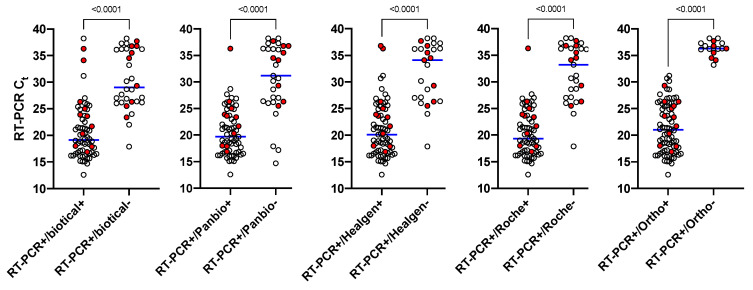
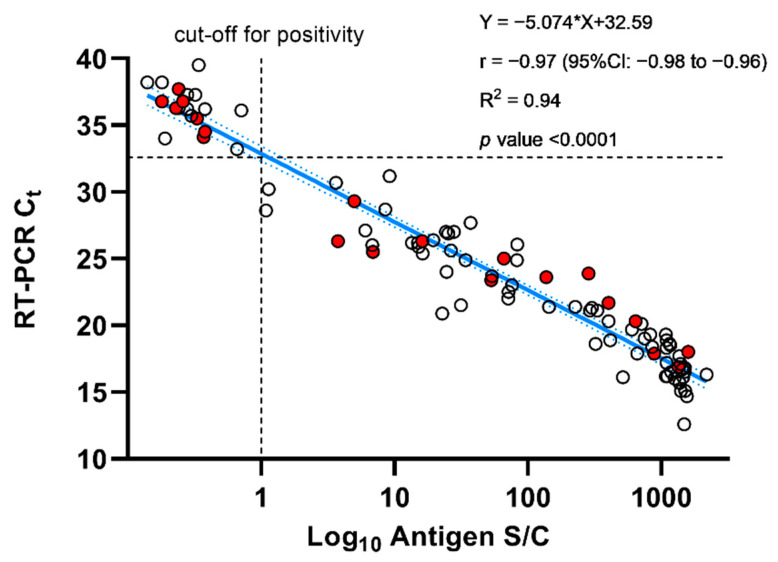
(1) Background: The detection of SARS-CoV-2 RNA in nasopharyngeal samples through real-time reverse transcription-polymerase chain reaction (RT-PCR) is considered the standard gold method for the diagnosis of SARS-CoV-2 infection. Antigen detection (AD) tests are more rapid, less laborious, and less expensive alternatives but still require clinical validation. (2) Methods: This study compared the clinical performance of five AD tests, including four rapid AD (RAD) tests (biotical, Panbio, Healgen, and Roche) and one automated AD test (VITROS). For that purpose, 118 (62.8%) symptomatic patients and 70 (37.2%) asymptomatic subjects were tested, and results were compared to RT-PCR. (3) Results: The performance of the RAD tests was modest and allowed us to identify RT-PCR positive patients with higher viral loads. For Ct values ≤25, the sensitivity ranged from 93.1% (95% CI: 83.3-98.1%) to 96.6% (95% CI: 88.1-99.6%), meaning that some samples with high viral loads were missed. Considering the Ct value proposed by the CDC for contagiousness (i.e., Ct values ≤33) sensitivities ranged from 76.2% (95% CI: 65.4-85.1%) to 88.8% (95% CI: 79.7-94.7%) while the specificity ranged from 96.3% (95% CI: 90.8-99.0%) to 99.1% (95% CI: 95.0-100%). The VITROS automated assay showed a 100% (95% CI: 95.5-100%) sensitivity for Ct values ≤33, and had a specificity of 100% (95% CI: 96.6-100%); (4) Conclusions: Compared to RAD tests, the VITROS assay fully aligned with RT-PCR for Ct values up to 33, which might allow a faster, easier and cheaper identification of SARS-CoV-2 contagious patients.
Keywords: COVID-19; SARS-CoV-2; antigen testing; automated assay; manual assay.
Conflict of interest statement
Among the authors, J.D. is CEO and founder of QUALIblood s.a., a contract research organization manufacturing the DP-Filter, is co-inventor of the DP-Filter (patent application number: PCT/ET2019/052903) and reports personal fees from Daiichi-Sankyo, Gedeon Richter, Mithra Pharmaceuticals, Stago, Roche and Roche Diagnostics outside the submitted work. The other authors have no conflict of interest to disclose.
Figures
Comment in
-
In suspected SARS-CoV-2, rapid antigen detection tests had 67% to 73% sensitivity and 98% to 100% specificity.Ann Intern Med. 2021 May;174(5):JC56. doi: 10.7326/ACPJ202105180-056. Epub 2021 May 4. Ann Intern Med. 2021. PMID: 33939481
References
-
- Buchta C., Görzer I., Chiba P., Camp J.V., Holzmann H., Puchhammer-Stöckl E., Mayerhofer M., Muller M.M., Aberle S.W. Variability of cycle threshold values in an external quality assessment scheme for detection of the SARS-CoV-2 virus genome by RT-PCR. Clin. Chem. Lab. Med. (CCLM) 2020 doi: 10.1515/cclm-2020-1602. - DOI - PubMed
LinkOut - more resources
Full Text Sources
Other Literature Sources
Miscellaneous
