


Mitochondrial Biomarkers in Patients with ST-Elevation Myocardial Infarction and Their Potential Prognostic Implications: A Prospective Observational Study
- PMID: 33451159
- PMCID: PMC7828727
- DOI: 10.3390/jcm10020275
Mitochondrial Biomarkers in Patients with ST-Elevation Myocardial Infarction and Their Potential Prognostic Implications: A Prospective Observational Study
Abstract
Background: Mitochondrial biomarkers have been investigated in different critical settings, including ST-elevation myocardial infarction (STEMI). Whether they provide prognostic information in STEMI, complementary to troponins, has not been fully elucidated. We prospectively explored the in-hospital and long-term prognostic implications of cytochrome c and cell-free mitochondrial DNA (mtDNA) in STEMI patients undergoing primary percutaneous coronary intervention.
Methods: We measured cytochrome c and mtDNA at admission in 466 patients. Patients were grouped according to mitochondrial biomarkers detection: group 1 (-/-; no biomarker detected; n = 28); group 2 (-/+; only one biomarker detected; n = 283); group 3 (+/+; both biomarkers detected; n = 155). A composite of in-hospital mortality, cardiogenic shock, and acute pulmonary edema was the primary endpoint. Four-year all-cause mortality was the secondary endpoint.
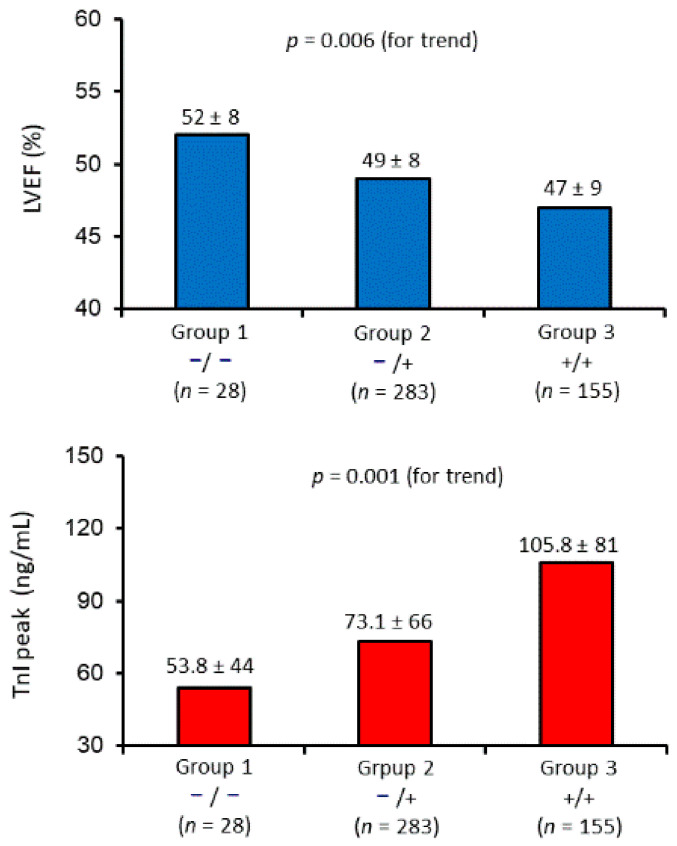
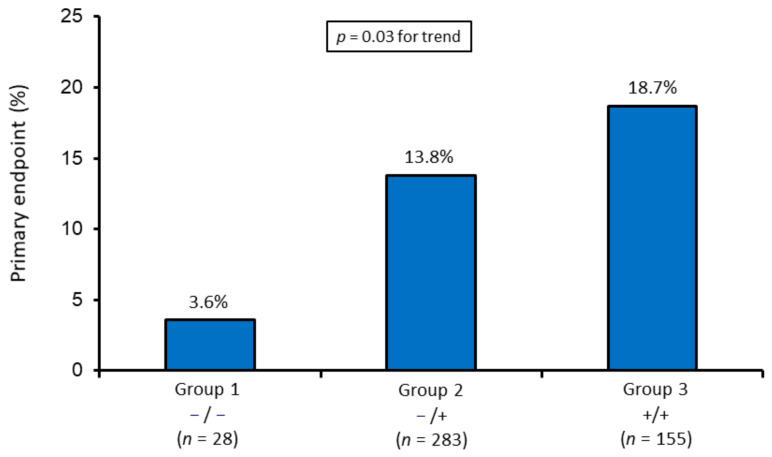
Results: Progressively lower left ventricular ejection fractions (52 ± 8%, 49 ± 8%, 47 ± 9%; p = 0.006) and higher troponin I peaks (54 ± 44, 73 ± 66, 106 ± 81 ng/mL; p = 0.001) were found across the groups. An increase in primary (4%, 14%, 19%; p = 0.03) and secondary (10%, 15%, 23%; p = 0.02) endpoint rate was observed going from group 1 to group 3. The adjusted odds ratio increment of the primary endpoint from one group to the next was 1.65 (95% CI 1.04-2.61; p = 0.03), while the adjusted hazard ratio increment of the secondary endpoint was 1.55 (95% CI 1.12-2.52; p = 0.03). The addition of study group allocation to admission troponin I reclassified 12% and 22% of patients for the primary and secondary endpoint, respectively.
Conclusions: Detection of mitochondrial biomarkers is common in STEMI and seems to be associated with in-hospital and long-term outcome independently of troponin.
Keywords: ST-elevation myocardial infarction; cell-free mitochondrial DNA; cytochrome c; prognosis; troponin I.
Conflict of interest statement
The authors declare no conflict of interest. The funders had no role in the design of the study, in the collection, analyses, or interpretation of data; in the writing of the manuscript, or in the decision to publish the results
Figures

References
LinkOut - more resources
Full Text Sources
Other Literature Sources
