


The baseline interferon signature predicts disease severity over the subsequent 5 years in systemic lupus erythematosus
- PMID: 33451338
- PMCID: PMC7811214
- DOI: 10.1186/s13075-021-02414-0
The baseline interferon signature predicts disease severity over the subsequent 5 years in systemic lupus erythematosus
Abstract
Objectives: Type I interferons (IFNs) play an important role in the pathophysiology of systemic lupus erythematosus (SLE). While cross-sectional data suggest an association between IFN-induced gene expression and SLE disease activity, interest in this as a biomarker of flare has been tempered by a lack of fluctuation with disease activity in the majority of patients. This led us to question whether IFN-induced gene expression might instead be a biomarker of overall disease severity, with patients with high levels spending more time in an active disease state.
Methods: Levels of five interferon-responsive genes were measured in the whole peripheral blood at baseline visit for 137 SLE patients subsequently followed for 5 years. Log transformed values were summed to yield a composite IFN5 score, and the correlation with various disease outcomes examined. Receiver operator characteristic analyses were performed for outcomes of interest. Kaplan-Meier curves were generated to compare the proportion of flare-free patients with high and low IFN5 scores over time.
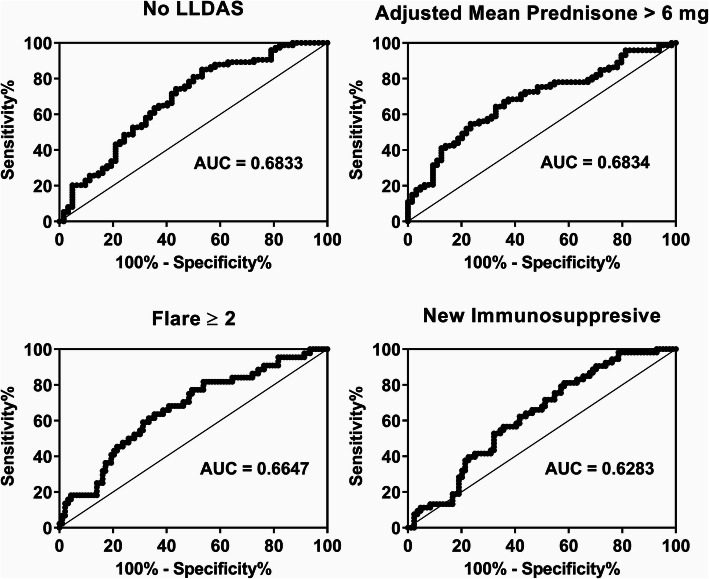
Results: The baseline IFN5 score was positively correlated with the adjusted mean SLE disease activity index-2000, number of flares, adjusted mean prednisone dose, and number of new immunosuppressive medications over the subsequent 5 years. Optimal cut-offs for the IFN5 score were determined using Youden's index and predicted more severe outcomes with 57-67% accuracy. A high baseline IFN5 level was associated with a significantly increased risk of subsequent flare.
Conclusions: Measurement of the type I IFN signature is a useful tool for predicting the subsequent disease activity course.
Keywords: Disease course; Interferon; SLEDAI-2K; Systemic lupus erythematosus.
Conflict of interest statement
The authors declare that they have no competing interests.
Figures


References
-
- Baechler EC, Batliwalla FM, Karypis G, Gaffney PM, Ortmann WA, Espe KJ, Shark KB, Grande WJ, Hughes KM, Kapur V, et al. Interferon-inducible gene expression signature in peripheral blood cells of patients with severe lupus. Proc Natl Acad Sci U S A. 2003;100(5):2610–2615. doi: 10.1073/pnas.0337679100. - DOI - PMC - PubMed
-
- Weckerle CE, Franek BS, Kelly JA, Kumabe M, Mikolaitis RA, Green SL, Utset TO. Jolly M, James JA, Harley JB, et al. Network analysis of associations between serum interferon-alpha activity, autoantibodies, and clinical features in systemic lupus erythematosus. Arthritis Rheum. 2011;63(4):1044–1053. doi: 10.1002/art.30187. - DOI - PMC - PubMed
-
- Feng X, Wu H, Grossman JM, Hanvivadhanakul P, FitzGerald JD, Park GS, Dong X, Chen W, Kim MH, Weng HH, et al. Association of increased interferon-inducible gene expression with disease activity and lupus nephritis in patients with systemic lupus erythematosus. Arthritis Rheum. 2006;54(9):2951–2962. doi: 10.1002/art.22044. - DOI - PubMed
Publication types
MeSH terms
Substances
Grants and funding
LinkOut - more resources
Full Text Sources
Other Literature Sources
Medical
