. 2021 Feb 26;87(6):e02417-20.
doi: 10.1128/AEM.02417-20. Print 2021 Feb 26.

Anaerobic Production of Isoprene by Engineered Methanosarcina Species Archaea

Affiliations

Anaerobic Production of Isoprene by Engineered Methanosarcina Species Archaea

Jared Aldridge et al. Appl Environ Microbiol. .

Abstract

Isoprene is a valuable petrochemical used for a wide variety of consumer goods, such as adhesives and synthetic rubber. We were able to achieve a high yield of renewable isoprene by taking advantage of the naturally high-flux mevalonate lipid synthesis pathway in anaerobic methane-producing archaea (methanogens). Our study illustrates that by genetically manipulating Methanosarcina species methanogens, it is possible to create organisms that grow by producing the hemiterpene isoprene. Mass balance measurements show that engineered methanogens direct up to 4% of total carbon flux to isoprene, demonstrating that methanogens produce higher isoprene yields than engineered yeast, bacteria, or cyanobacteria, and from inexpensive feedstocks. Expression of isoprene synthase resulted in increased biomass and changes in gene expression that indicate that isoprene synthesis depletes membrane precursors and redirects electron flux, enabling isoprene to be a major metabolic product. Our results demonstrate that methanogens are a promising engineering chassis for renewable isoprene synthesis.IMPORTANCE A significant barrier to implementing renewable chemical technologies is high production costs relative to those for petroleum-derived products. Existing technologies using engineered organisms have difficulty competing with petroleum-derived chemicals due to the cost of feedstocks (such as glucose), product extraction, and purification. The hemiterpene monomer isoprene is one such chemical that cannot currently be produced using cost-competitive renewable biotechnologies. To reduce the cost of renewable isoprene, we have engineered methanogens to synthesize it from inexpensive feedstocks such as methane, methanol, acetate, and carbon dioxide. The "isoprenogen" strains we developed have potential to be used for industrial production of inexpensive renewable isoprene.

Keywords: Methanosarcina acetivorans; Methanosarcina barkeri; archaea; isoprene; isoprenogen; isoprenoids; ispS; metabolic engineering; methanogen; methanogenesis; mevalonate; mevalonate pathway; synthetic biology.


Figures

FIG 1
FIG 1
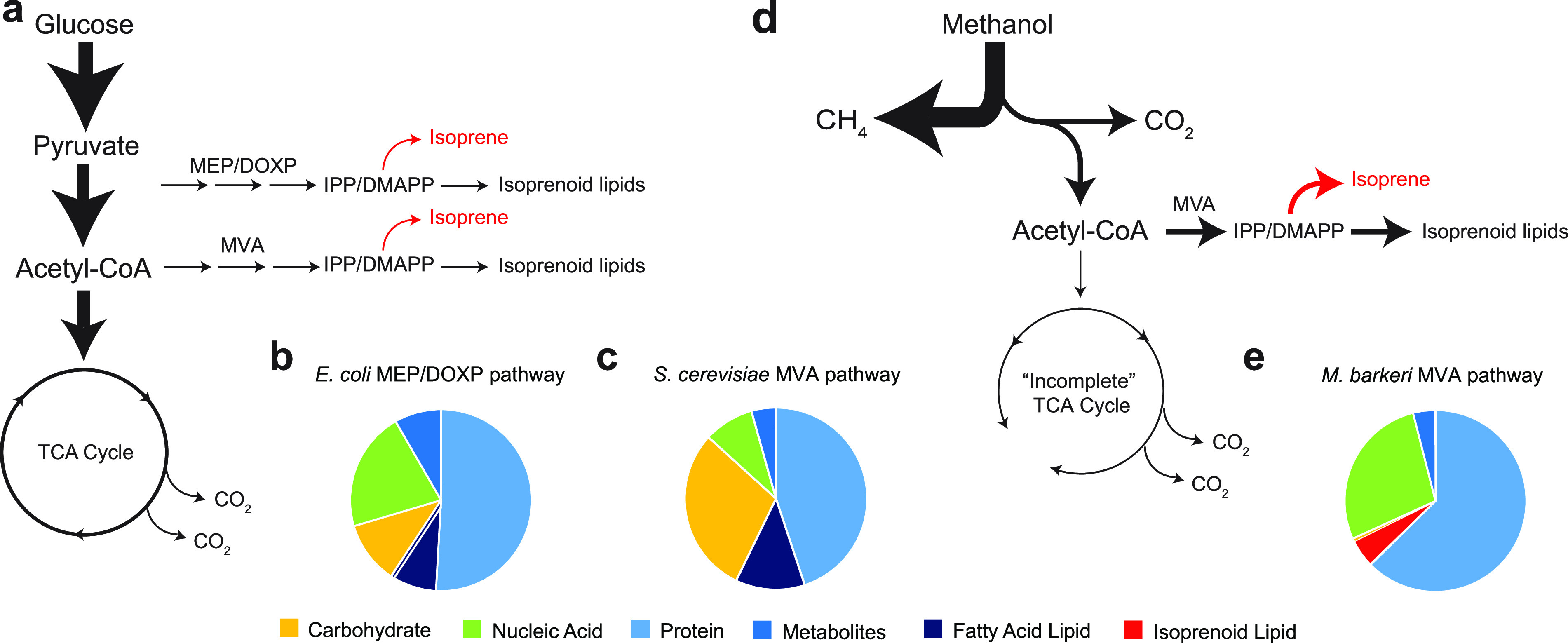
Isoprenoid biosynthesis pathways and macromolecular compositions of representative bacteria, eukarya, and archaea. (a) Isoprene is synthesized from isopentenyl pyrophosphate/dimethylallyl pyrophosphate (IPP/DMAPP) derived from glucose via the methylerythritol phosphate/deoxy xylulose phosphate (MEP/DOXP) pathway in bacteria or mevalonate (MVA) pathway in eukarya. (b and c) Relative amounts of macromolecules in E. coli bacterium (58) and S. cerevisiae yeast (59), respectively. (d) Isoprenoid lipids are synthesized from IPP/DMAPP by the archaeal MVA pathway in methanogens. (e) Isoprenoid lipids in methanogens comprise 5% of biomass dry weight (29). Arrow sizes and line widths depict published carbon fluxes through each pathway. One or more genes are required for most organisms to produce isoprene monomer (red arrows). See Table S1 for macromolecular composition values shown in panels b, c, and e.
FIG 2
FIG 2
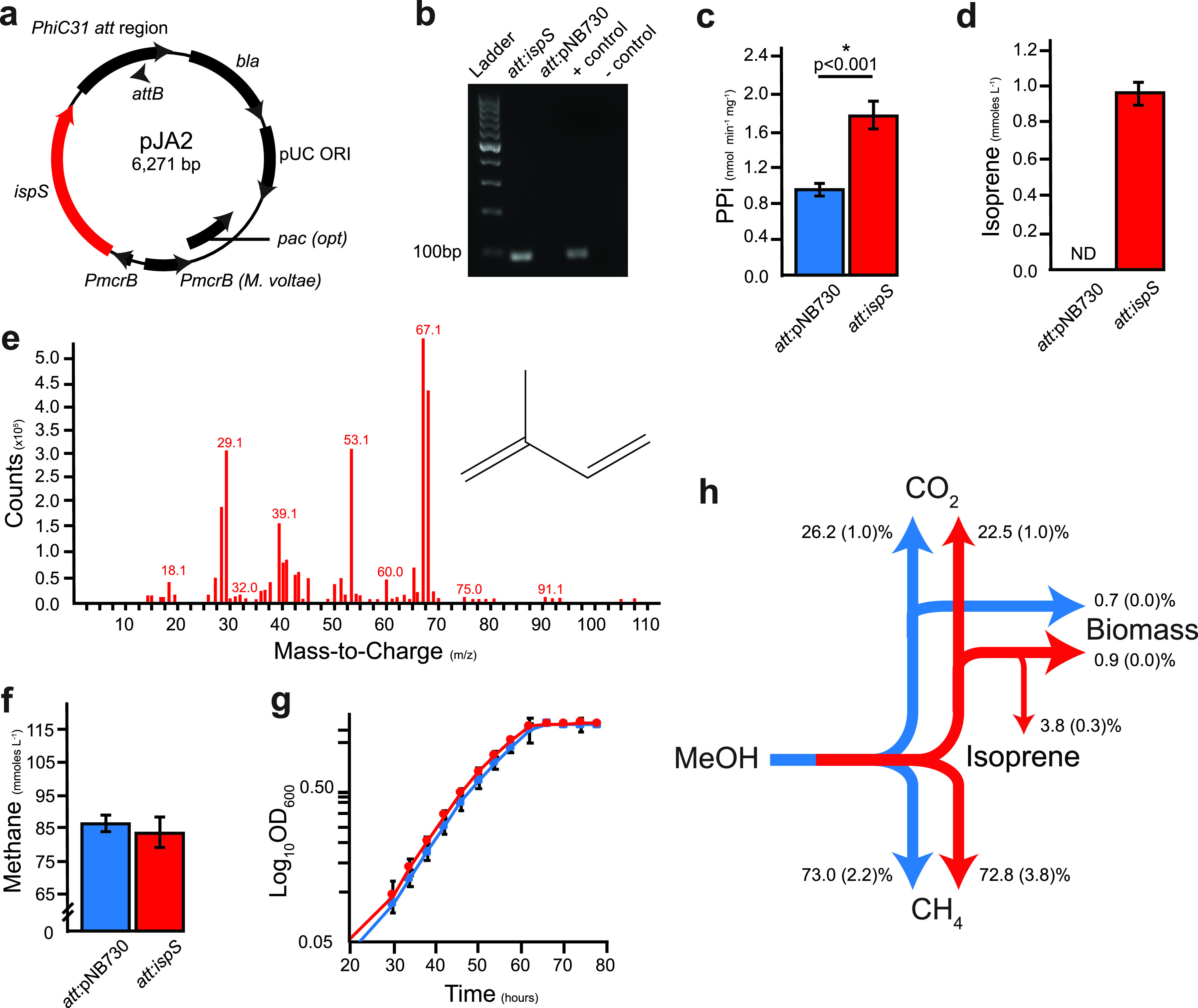
Strain construction and validation of isoprene production from methanol. (a) Plasmid map of pJA2 for constitutive expression of isoprene synthase IspS in Methanosarcina spp. (b) Validation of ispS transcription by RT-qPCR. Plasmid DNA from pJA2 was used as a positive control, while genomic DNA from the parent strain NB34 was used as a negative control. (c) Dimethylallyl pyrophosphate pyrophosphatase activity in cell extracts. (d) Isoprene production measured by gas chromatography. (e) Validation of isoprene production by mass spectrometry. (f) Endpoint methane production. (g) Growth curve of att:pNB730 and att:ispS strains. (h) Mass balance of M. acetivorans att:pNB730 (blue) and att:ispS (red) strains showing percent molar carbon fluxes. Standard deviations are shown in parentheses. Blue bars, att:pNB730 strain; red bars, att:ispS strain. Data presented in panels c, d, f, and h were obtained from quadruplicate biological and triplicate technical replicates (n = 12). Data presented in panel e were from a double-blinded experiment. Data from panel g were from five biological replicates.
FIG 3
FIG 3
Characterization of ispS+ strains grown on trimethylamine (TMA) or acetate substrates. (a and e) Dimethylallyl pyrophosphate pyrophosphatase activity in cell extracts. (b and f) Endpoint methane production. (c and g) Isoprene production measured by gas chromatography. (d and h) Growth curves of att:pNB730 and att:ispS strains. Blue bars, att:pNB730 strain; red bars, att:ispS strain. Data presented in panels a to c and e to g were obtained from quadruplicate biological and triplicate technical replicates (n = 12). Data in panels d and h were from five biological replicates.
FIG 4
FIG 4
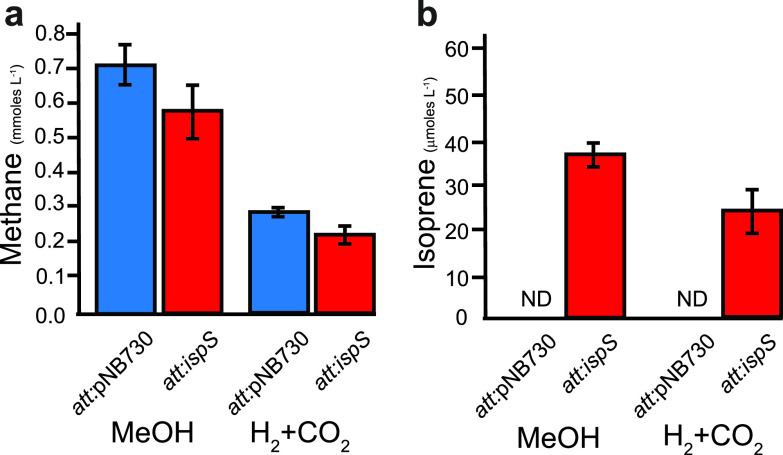
Demonstration of isoprene production by Methanosarcina barkeri. (a) Endpoint methane assays for M. barkeri att:pNB730 and att:ispS strains. (b) Isoprene production by M. barkeri att:pNB730 and att:ispS strains as measured by gas chromatography. Blue, att:pNB730 strains; red, att:ispS strains. Data for panels a and b were obtained from quadruplicate biological and triplicate technical replicates (n = 12).

References

    1. Kim JH, Wang C, Jang HJ, Cha MS, Park JE, Jo SY, Choi ES, Kim SW. 2016. Isoprene production by Escherichia coli through the exogenous mevalonate pathway with reduced formation of fermentation byproducts. Microb Cell Fact 15:214. doi: 10.1186/s12934-016-0612-6. - DOI - PMC - PubMed
    1. International Rubber Study Group. Rubber statistical bulletin. 2012. International Rubber Study Group. http://www.rubberstudy.com/reports.
    1. Miller B, Oschinski C, Zimmer W. 2001. First isolation of an isoprene synthase gene from poplar and successful expression of the gene in Escherichia coli. Planta 213:483–487. doi: 10.1007/s004250100557. - DOI - PubMed
    1. Matsumi R, Atomi H, Driessen AJM, van der Oost J. 2011. Isoprenoid biosynthesis in Archaea—biochemical and evolutionary implications. Res Microbiol 162:39–52. doi: 10.1016/j.resmic.2010.10.003. - DOI - PubMed
    1. Wagner WP, Helmig D, Fall R. 2000. Isoprene biosynthesis in Bacillus subtilis via the methylerythritol phosphate pathway. J Nat Prod 63:37–40. doi: 10.1021/np990286p. - DOI - PubMed

Publication types

LinkOut - more resources