Review
. 2021 Jan 15;12(1):388.
doi: 10.1038/s41467-020-20764-2.

Sensing the future of bio-informational engineering

Affiliations
Review

Sensing the future of bio-informational engineering

Thomas A Dixon et al. Nat Commun. .

Abstract

The practices of synthetic biology are being integrated into 'multiscale' designs enabling two-way communication across organic and inorganic information substrates in biological, digital and cyber-physical system integrations. Novel applications of 'bio-informational' engineering will arise in environmental monitoring, precision agriculture, precision medicine and next-generation biomanufacturing. Potential developments include sentinel plants for environmental monitoring and autonomous bioreactors that respond to biosensor signaling. As bio-informational understanding progresses, both natural and engineered biological systems will need to be reimagined as cyber-physical architectures. We propose that a multiple length scale taxonomy will assist in rationalizing and enabling this transformative development in engineering biology.


Conflict of interest statement

The authors declare no competing interests.

Figures

Fig. 1
Fig. 1. Multiple length scale engineering across organic and inorganic information substrates.
Engineering information communication across substrates interfaces a diverse array of systems over multiple length scales. Bio-informational system integrations operate across 10−15 m through to 107 m. To date, this process has primarily involved the collection of biological metadata via digital means. Developments in optogenetics and bioelectrochemistry suggest multiscale engineering may become a two-way communication channel.
Fig. 2
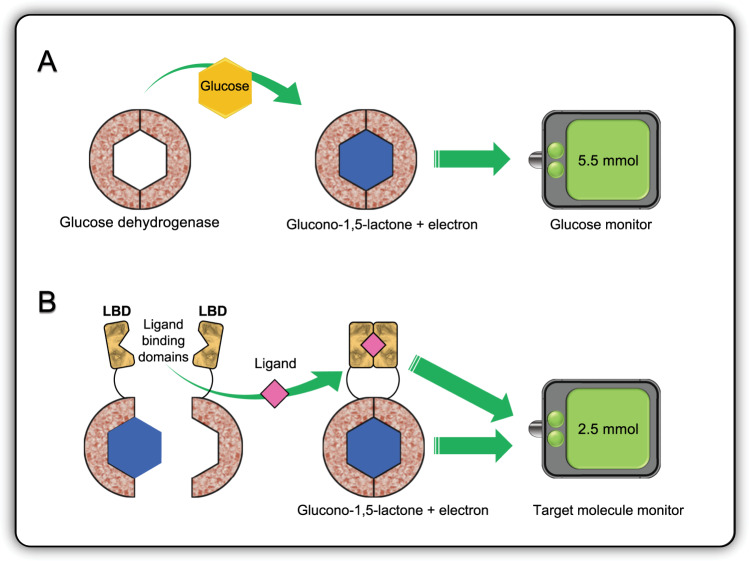
Fig. 2. Engineering ligand-binding domains creates opportunities for translating the biosensing of target molecules into digital signals.
(A) Pyrroloquinoline quinone glucose dehydrogenase (GDH) releases an electron in the presence of glucose, which can be detected using an electrode in a blood-glucose monitor. (B) Split GDH fused to ligand-binding domains (LBDs) for another molecule can be used as a generic biosensor, as the GDH domains can only co-localize to release an electron when the fused LBDs bind to a molecule of interest.
Fig. 3
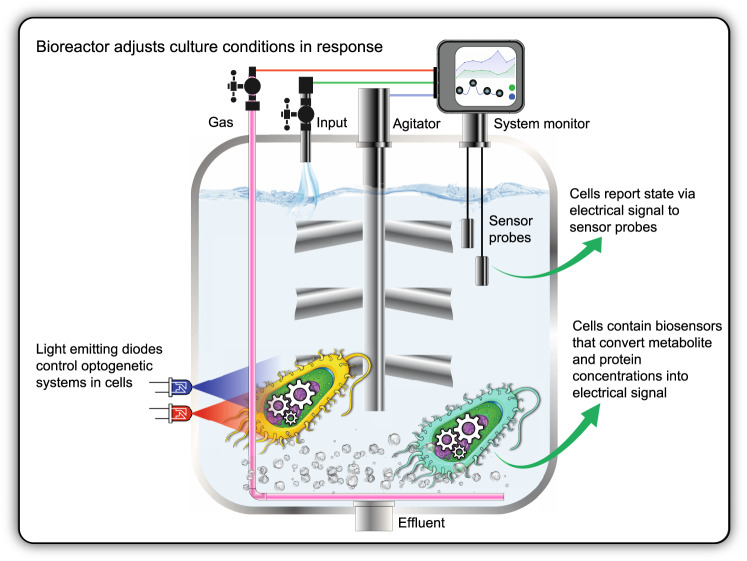
Fig. 3. An autonomous bioreactor enabling smart culture condition control and the targeted actuation of engineered gene expression without human intervention.
Bio-informational systems involving optogenetic control of gene expression and biosensor-mediated output of intracellular physiological states could be integrated within a bioreactor to facilitate high-yield production of sustainable chemicals, fuels, foods, materials, and pharmaceuticals using microbial cell factories.
Fig. 4
Fig. 4. A sentinel plant-enabled precision agriculture control loop integrating space-based capability.
Harvested sentinel plant sensor signals could be communicated to a proximal smart farm through an Internet of Biological Things satellite architecture in real-time with low latency. Edge computing at the smart far could combine sentinel signals with daily-refreshed geospatial and current local weather forecasts. Embedded artificial intelligence agents at the smart farm could undertake insight-driven drone route planning to optimize autonomous application of fertilizer and pesticide.
Fig. 5
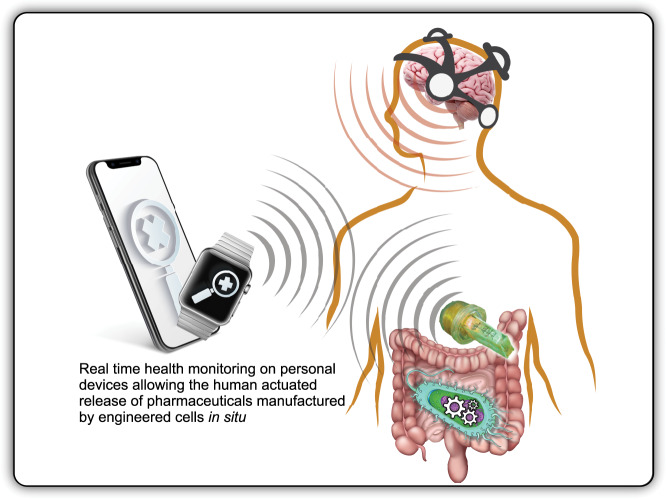
Fig. 5. Optogenetic designer cell implants bio-informationally integrated with wearables, personal devices, and EEG-based actuation for specific use cases.
Longer-term applications include viewing health information on a personal device reported via a subcutaneous optogenetic device with bioelectrical monitoring properties. Engineered microbiomes could both report real-time patient data and deliver on-demand pharmaceuticals in situ.

References

    1. Egan P, Sinko R, LeDuc PR, Keten S. The role of mechanics in biological and bio-inspired systems. Nat. Commun. 2015;6:7418. doi: 10.1038/ncomms8418. - DOI - PubMed
    1. Justus KB, et al. A biosensing soft robot: autonomous parsing of chemical signals through integrated organic and inorganic interfaces. Sci. Robot. 2019;4:eaax0765. doi: 10.1126/scirobotics.aax0765. - DOI - PubMed
    1. Shi L, et al. Extracellular electron transfer mechanisms between microorganisms and minerals. Nat. Rev. Microbiol. 2016;14:651. doi: 10.1038/nrmicro.2016.93. - DOI - PubMed
    1. Liu, Z. et al. Programming bacteria with light—sensors and applications in synthetic biology. Front. Microbiol. 9, 2692 (2018). This review introduces engineered light sensors in bacteria and their applications, including tuning synthetic circuits and achieving feedback controls over microbial cell culture. - PMC - PubMed
    1. Schofield Z, et al. Bioelectrical understanding and engineering of cell biology. J. R. Soc. Interface. 2020;17:20200013. doi: 10.1098/rsif.2020.0013. - DOI - PMC - PubMed

Publication types