


Cardiogenic shock teams and centres: a contemporary review of multidisciplinary care for cardiogenic shock
- PMID: 33452763
- PMCID: PMC8006679
- DOI: 10.1002/ehf2.13180
Cardiogenic shock teams and centres: a contemporary review of multidisciplinary care for cardiogenic shock
Abstract
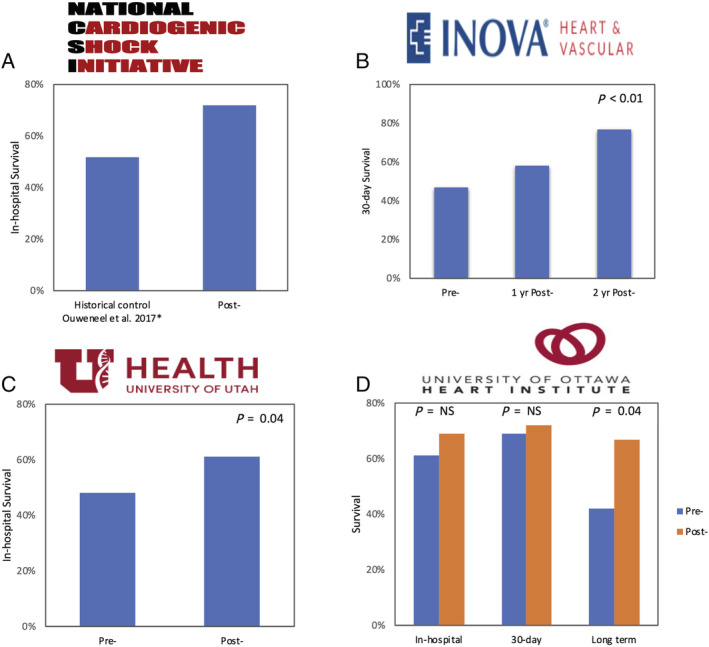
Cardiogenic shock (CS) portends high morbidity and mortality in the contemporary era. Despite advances in temporary mechanical circulatory supports (MCS), their routine use in CS to improve outcomes has not been established. Delays in diagnosis and timely delivery of care, disparities in accessing adjunct therapies such revascularization or MCS, and lack of a systematic approach to care of CS contribute to the poor outcomes observed in CS patients. There is growing interest for developing a standardized multidisciplinary team-based approach in the management of CS. Recent prospective studies have shown feasibility of CS teams in improving survival across a spectrum of CS presentations. Herein, we will review the rationale for CS teams focusing on evidence supporting its use in streamlining care, optimizing revascularization strategies, and patient identification and MCS selection. The proposed structure and flow of CS teams will be outlined. An in-depth analysis of four recent studies demonstrating improved outcomes with CS teams is presented. Finally, we will explore potential implementation hurdles and future directions in refining and widespread implementation of dedicated cross-specialty CS teams.
Keywords: Cardiogenic shock; Cardiogenic shock centres; Cardiogenic shock teams.
© 2021 The Authors. ESC Heart Failure published by John Wiley & Sons Ltd on behalf of European Society of Cardiology.
Figures
References
-
- Anderson ML, Peterson ED, Peng SA, Wang TY, Ohman EM, Bhatt DL, Saucedo JF, Roe MT. Differences in the profile, treatment, and prognosis of patients with cardiogenic shock by myocardial infarction classification: a report from NCDR. Circ Cardiovasc Qual Outcomes 2013; 6: 708–715. - PubMed
-
- Miller L. Cardiogenic shock in acute myocardial infarction: the era of mechanical support. J Am Coll Cardiol 2016; 67:1881‐1884: 1881–1884. - PubMed
-
- Shah M, Patel B, Tripathi B, Agarwal M, Patnaik S, Ram P, Patil S, Shin J, Jorde UP. Hospital mortality and thirty day readmission among patients with non‐acute myocardial infarction related cardiogenic shock. Int J Cardiol 2018; 270: 60–67. - PubMed
-
- Hochman JS, Sleeper LA, Webb JG, Sanborn TA, White HD, Talley JD, Buller CE, Jacobs AK, Slater JN, Col J, McKinlay SM, Picard MH, Menegus MA, Boland J, Dzavik V, Thompson CR, Wong SC, Steingart R, Forman R, Aylward PE, Godfrey E, Desvigne‐Nickens P, LeJemtel TH. Early revascularization in acute myocardial infarction complicated by cardiogenic shock. SHOCK Investigators. Should we emergently revascularize occluded coronaries for cardiogenic shock. N Engl J Med 1999; 341: 625–634. - PubMed
-
- Thiele H, Zeymer U, Neumann FJ, Ferenc M, Olbrich HG, Hausleiter J, Richardt G, Hennersdorf M, Empen K, Fuernau G, Desch S, Eitel I, Hambrecht R, Fuhrmann J, Böhm M, Ebelt H, Schneider S, Schuler G, Werdan K. Intraaortic balloon support for myocardial infarction with cardiogenic shock. N Engl J Med 2012; 367: 1287–1296. - PubMed
Publication types
MeSH terms
LinkOut - more resources
Full Text Sources
Other Literature Sources